Phap Bao Pagoda is the largest Buddhist temple and a must see attraction in Hoi An Old Town, Vietnam. It has been serving as the headquarter of Hoi An’s Buddhist Association and its activities. Therefore, it’s also important. Locals come here at least twice a month to pray. Now, let’s HoiAn Day Trip Company tell everything that you need to know about Phap Bao Pagoda in Hoi An.
You may also like: Quan Am Pagoda, Chuc Thanh Pagoda
• Content by Tam Le, founder of HOIAN DAY TRIP CO.,LTD
• Designed by Giang Cong Minh, co-founder of LS E&C LTD and his team
• Photo by Dang Cong Loi, Dao Xuan Son, Tam Le & others

Must Knows about Phap Bao Pagoda (Hoi An)
– Location/address: 673 Hai Ba Trung St, Minh An ward, Hoi An, Vietnam
– Name meaning: Phap Bao means ‘treasure of the law’ (originating from Buddhism), Phac Hat Temple
– Other name(s): Chua Tinh Hoi (or the Pagoda of Quang Nam Provincial Buddhist Association), Chua Phat Hoc (or the Pagoda of Studying Buddha’s Teachings)
– Opening hours: 7 AM to 9 PM everyday
– Year of construction:
– Ticket price: free
– Reason(s) to visit: the largest Buddhist temple in Hoi An Ancient Town
– Best time to visit: anytime
– Time to spend: 15-30 mins
– Travel blog: https://hoiandaytrip.com/phap-bao-pagoda-hoi-an
– Recognition(s): world heritage site (1999)
– Food & drink: vegetarian foods are sold here on the 1st and 15th days each lunar month
– Shopping: not available
– Tour guide: contact +84968009827 (hotline/whatsapp/line/zalo)
– Fact:
Phap Bao Pagoda on Map
History of Phap Bao Pagoda in Hoi An
Phap Bao Pagoda is not one of the oldest, but one of the most important buddhist temples in Hoi An.
In 1934 and 1935, two monks Thich Don Hau (leader of Thien Mu Pagoda) and Thich Mat Nguyen came from Hue to Hoi An, to teach and establish local buddhist associations. To accommodate activities for many people, they borrowed the temple of sir Trinh Van Dang and here, Quang Nam province’s buddhist association was founded. In 1936, Buddhists and believers in Hoi An collected enough money to buy a piece of land (current location) and built a pagoda on it. At that time, its name was Tinh Hoi Pagoda (or Pagoda of the Provincial Buddhist Association).
In the beginning, Tinh Hoi Pagoda had no leading monk. In important activities, reputable monks from Hue would come and be the host. To be more organized, in 1942, monk Thich Dong Chon was invited and appointed to be the first leading monk.
In 1967, Tinh Hoi Pagoda was named after the founding monk of Chuc Thanh zen sect (which was established in Hoi An) and became Phap Bao Pagoda. After 1975, when Vietnam was unified, Hoi An was not the capital of Quang Nam province anymore. For that reason, Phap Bao Pagoda lost its role as the headquarter of the province’s buddhist association. Phap Lam Pagoda in Da Nang city replaced it, and after 1997, the role again was transferred to Dao Nguyen Pagoda in Tam Ky city.
From 1955 to 1972, Monk Thich Tri Minh (1904-1972) was appointed to be the lead of Phap Bao Pagoda, the headquarter of Quang Nam Provincial Buddhist Association. He was borned in Dien Tien commune, Dien Ban district, in a family of Buddhist beliefs. At age of 3, he lost mother and then took care of his aunt. In 1914, his father took him to a pagoda where his uncle (a monk) lived and here, he could follow this family member. In 1957, he moved to Nha Trang, a coastal city down south, and was recognized to be in the 8th generation of Chuc Thanh sect. In 1963, when the Buddhist crisis happened in southern Vietnam, he wanted to burn himself to protest in front of Hoi An city hall, just like Thich Quang Duc monk, but other monks didn’t let him do it. In 1964, local Buddhist associations were unified to establish ‘Quang Nam Provincial Buddhist Association’ and he was appointed to be an advisor. Due to a health situation, he refused to hold any positions in this organization. In 1971, he requested to build a buddhist’s house and auditorium, and then passed away. His ashes were preserved in one of the burial towers in the garden of Chuc Thanh Pagoda today.
HOIAN DAY TRIP Company daily organizes tours and transfers to Hoi An Old Town. Contact us by +84968009827 (hotline/whatsapp/line/zalo) or hoiandaytripcompany@gmail.com or browse www.hoiandaytrip.com to see tours and make a reservation. Thank you very much!

Architecture of Phap Bao Pagoda
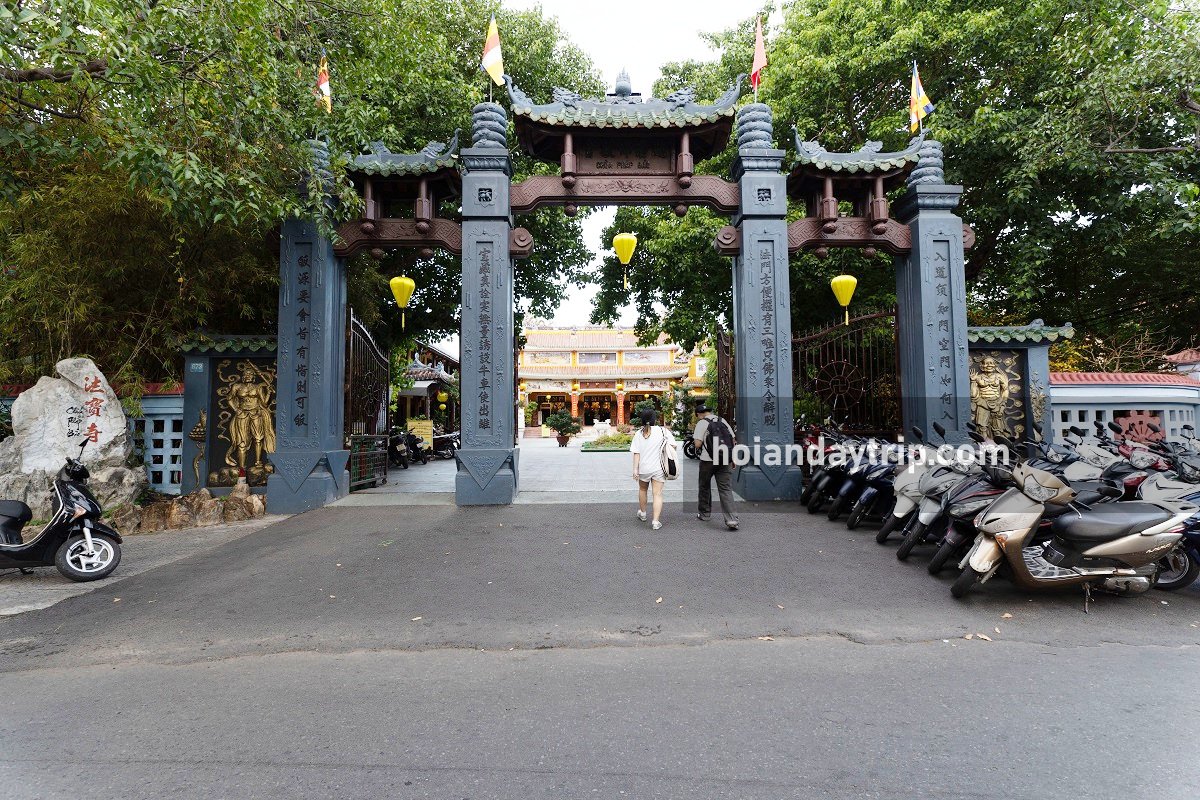
About the architecture, Phap Bao Pagoda has an three-arched entrance gate, a Buddha Hall, a monk’s house and gardens with statues. In the front, there is a lake.
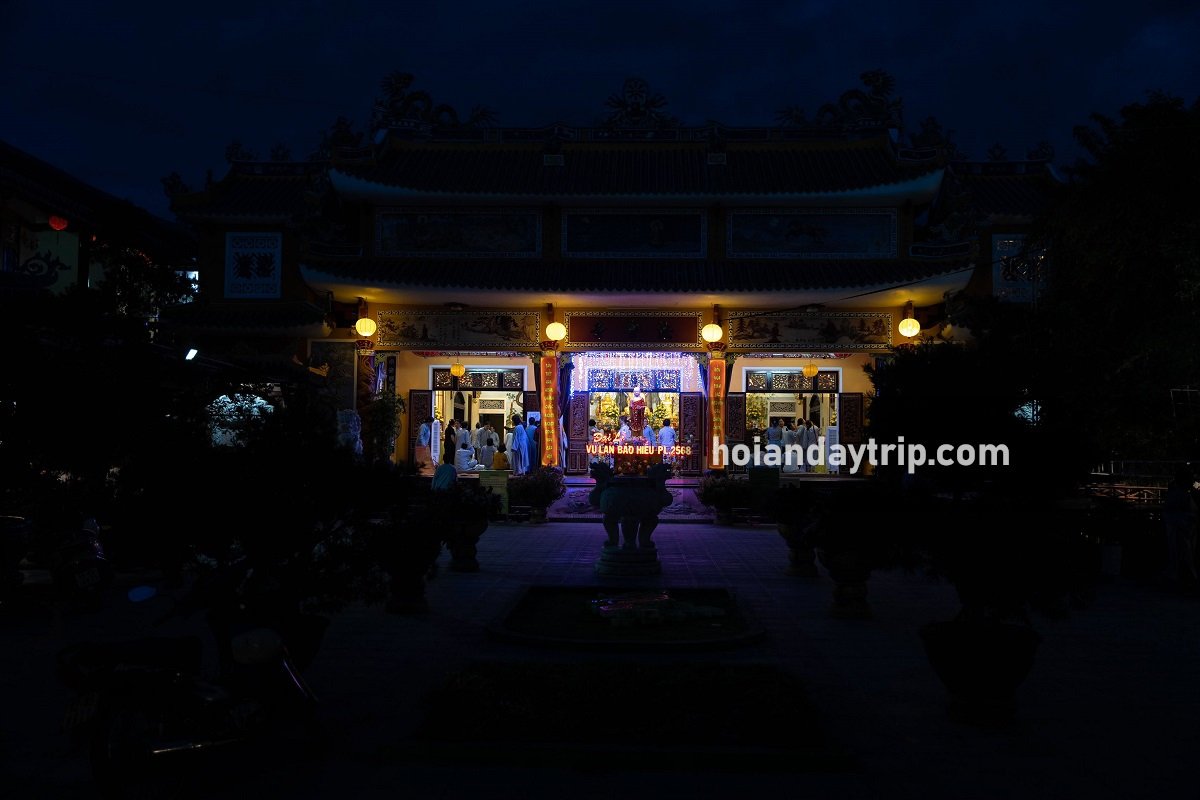
The Buddha Hall of Phap Bao Pagoda is used to worship three buddhas, including Sakyamuni Buddha (Phat Thich Ca Mau Ni) in the middle, Amitabha Buddha (Phat A Di Da) to the left, and Maitreya Buddha (Phat Di Lac) to the right. On both sides, there are altars for two bodhisattvas: Avalokitesvara (Quan The Am Bo Tat) and Mahasthamaprapta (Dai The Chi Bo Tat). In its back, leading monks of the pagoda over time are also honored. On the top of its roof ridges, there are dragons and phoenixes, two of four holy animals in Vietnamese traditional culture.
Phap Bao Pagoda was restored in 1998, 2000, 2008.
HOIAN DAY TRIP Company daily organizes tours and transfers to Hoi An Old Town. Contact us by +84968009827 (hotline/whatsapp/line/zalo) or hoiandaytripcompany@gmail.com or browse www.hoiandaytrip.com to see tours and make a reservation. Thank you very much!

Tomb of Khong Thien Thu
Near Phap Bao Pagoda, there is the tomb of Khong Thien Thu, one of 10 first Chinese men who founded Minh Huong commune in Hoi An. He was borned in Quanzhou city (aka Zayton) in Fujian province, southern China. In the first half of the 17th century, he moved to Hoi An (when it’s bustling and prosperous). Later, he was appointed by Nguyen lords, to be // who was in charge of controlling, inspecting, weighing, and measuring foods in foreigner’s boats docking at Hoi An. Together with nine other men, he requested the lords to establish ‘Minh Huong commune’, an official administrative unit for all Chinese communities in the town (in mid-17th century). In the late 17th century, he passed away and was buried in a piece of land next to Phap Bao Pagoda.
Khong Thien Thu’s tomb is small, with a stele carved in 1695 at the request of Nguyen lords. It’s restored 2 times in history by Chinese communities, in 1849 and 1942.
Tombs of other historical figures in Hoi An:
– Japanese merchant Banjiro tomb (built in 1665)
– Japanese merchant Tani Yajirobe tomb (built in 1647)
– Japanese merchant Gosukukun tomb (built in 1689)
– Chinese mandarin Chu Ky Son tomb (built in 1694)
– Tomb of one of Quang Trung king’s wifes
– Vietnamese mandarin Nguyen Dien tomb (in Tra Que vegetable village)
HOIAN DAY TRIP Company daily organizes tours and transfers to Hoi An Old Town. Contact us by +84968009827 (hotline/whatsapp/line/zalo) or hoiandaytripcompany@gmail.com or browse www.hoiandaytrip.com to see tours and make a reservation. Thank you very much!
Tips to Visit Phap Bao Pagoda in Hoi An
– It’s free to visit Phap Bao Pagoda because it’s a Buddhist temple.
– Visitors need to wear respectively if want to sightsee Phap Bao Pagoda, especially before entering the worshipping building.
– In Phap Bao Pagoda, visitors can see long dresses to choose one and cover for sightseeing. The right place to find them is behind the entrance gate, to the right hand side, and by the big tree. It’s free to use.
– In the dry season, from February to the end of August, visitors should bring sun cream, sun glasses, hat/cap/umbrella, and bottles of water.
– In the rainy season, from September to January, visitors should bring rain poncho/jacket or umbrella, sandals or waterproof shoes.
– Visitors are not allowed to go into monk’s houses and other private places (often with a sign to let people know).
– On the 1st and 15th days of each lunar month, there are many locals coming here to pray and listen to chanting.
– Around the lake in front of Phap Bao Pagoda, visitors can find chairs to sit and cool down.
– It’s better to visit with a local guide. Contact us by +84968009827 (hotline/whatsapp/line/zalo).
HOIAN DAY TRIP Company daily organizes tours and transfers to Hoi An Old Town. Contact us by +84968009827 (hotline/whatsapp/line/zalo) or hoiandaytripcompany@gmail.com or browse www.hoiandaytrip.com to see tours and make a reservation. Thank you very much!
How to Get to Phap Bao Pagoda in Hoi An
Phap Bao Pagoda is at 673 Hai Ba Trung Street, Minh An ward, Hoi An, Vietnam. It lies within the Hoi An Ancient Town world heritage site area.
From Hoi An, visitors can go to Phap Bao Pagoda by walking, bicycle, motorcycle, taxi/car, electric bus, shuttle bus of the hotel/resort, cyclo, bus/minivan. Although this building is NOT in the pedestrian zone, car/taxi, bus and minivan are still banned from getting here. The nearest place to drop off or park is the crossroad of Hai Ba Trung St and Tran Hung Dao St (or in the ground of Phap Bao Pagoda). The parking fee is 5,000-10,000 VND/bike/time.
From Da Nang, the distance to Phap Bao Pagoda in Hoi An is some 30 kilometers, to the south. Visitors often choose a car or ride the motorbike by themselves. The best motorbike route is the coastal road and then Hai Ba Trung Street until motorbikes are not allowed to go anymore (the entrance of the pedestrian zone, entrance of Phap Bao Pagoda). The pagoda is on the left hand side. Contact us by +84968009827 (hotline/whatsapp/zalo/line) to book a private roundtrip transfer by car.
HOIAN DAY TRIP Company daily organizes tours and transfers to Hoi An Old Town. Contact us by +84968009827 (hotline/whatsapp/line/zalo) or hoiandaytripcompany@gmail.com or browse www.hoiandaytrip.com to see tours and make a reservation. Thank you very much!
Itinerary to Visit Hoi An Old Town for First Timer
First of all, to enter and visit the Hoi An Old Town (the part inscribed by Unesco), visitors need to buy an entry ticket. Its price is 120,000 VND per adult and children above 15 years old and free of charge for smaller kids. Entry to 5 attractions is also included for free. See more information & details
If possible, first time visitors should go with a local guide, to know better about history and culture. Contact us by +84968009827 (call/whatsapp) to book a private English-speaking guide.
We suggest this itinerary for first timers:
Total distance: 1,65 kilometers
– Starting point: the Japanese style gate (the west end of Nguyen Thi Minh Khai Street). A model of the Red Seal Ship Model (Japanese merchant’s ship) and a ticket office are in a close distance.
– Walk along Nguyen Thi Minh Khai Street. On this road, visitors will have the chance to sightsee Cam Pho Communal House (ticket required), Japanese Culture Gallery (ticket required), Phung Hung Old House (one of the best heritage houses, ticket required), Nguyen Tuong Family Chapel (in the alleyway, ticket required).
– Visit the Japanese Covered Bridge, the symbol of Hoi An. This place definitely is a must see attraction.
– Walk along Tran Phu Street, the most beautiful road in Hoi An, until Hoi An Central Market. On this road, visitors will have the chance to sightsee so many historical attractions. From the bridge to the market, there are Cantonese Assembly Hall (ticket required), Museum of Sa Huynh Culture (ticket required), Duc An Old House (ticket required), Kazik Park (free), Quan Thang Old House (ticket required), Museum of Trade Ceramics (ticket required), Trung Hoa Assembly Hall (ticket required), Fujian Assembly Hall (ticket required), Quan Cong Temple (ticket required), Quan Am Pagoda (ticket required), Hoi An Central Market (free to enter), a couple of rooftop coffee shops, Instagrammable spots, shophouses selling lanterns, food, souvenirs and fashion items.
– Walk southwards and along Tieu La Street (east side of Hoi An Central Market). On this road, there are many vendors and stalls selling a diversity of local products, giving a good chance to know about local life and photograph.
– Walk westwards and along Bach Dang Street (the riverside street). On this road, visitors will see Hoi An Traditional Performance House (ticket required if want to watch shows) and Museum of Folklore (ticket required).
– Turn into Le Loi Street and then turn left, walking along Nguyen Thai Hoc Street. On this road, visitors will see Tan Ky Old House (one of the best heritage houses, ticket required) and Diep Dong Nguyen Old House (not yet opened to visitors, see from outside).
– The ending point: the crossroad near the north end of An Hoi Bridge or the west end of Nguyen Thai Hoc Street. In the evening, from here, visitors can walk cross the bridge and then turn right to see the entrance of the Hoi An Night Market, the biggest night market in Hoi An.
For more details and the map, please browse https://hoiandaytrip.com/hoi-an-self-guided-walking-tour
Guided Tours to Hoi An Ancient Town Vietnam
From Hoi An
– Hoi An Old Town Walking Tour – 2 Hour Express Tour with Local
– Hoi An Half Day Walking Tour with Traditional Art Performance
– Hoi An City Tour: Old Town, Coconut Village & Lunch
– Hoi An Morning Walking Tour with Local Breakfast & Coffee
– Hoi An Afternoon Walking Tour with Thu Bon River Sunset Cruise
– Hoi An Night Tour with Lantern Boat Ride & Dinner
– Hoi An History & Food Tour – Famous Landmarks & Specialty Dishes
– Hoi An Instagram Tour: Best Photo Spots & Rooftop Café
– Hoi An Old Town Food Tour with Night Boat Ride
– Hoi An Old Town Private Walking Tour with Local Expert
– Hoi An City Tour by Electric Car
HOIAN DAY TRIP CO.,LTD daily organizes tours in Hoi An and Da Nang. Contact us by +84968009827 (hotline/whatsapp/line/zalo) or browse www.hoiandaytrip.com to see tours and make a reservation. Thank you very much!
From Da Nang
– Hoi An Half Day Tour from Da Nang
– Hoi An Night Tour from Da Nang
– Hoi An Night Tour from Da Nang with Coconut Forest Basket Boat Ride
– Hoi An Night Tour from Da Nang with Hoi An Memories Show
– Marble Mountain & Hoi An Day Tour from Da Nang
– Marble Mountain & Hoi An Night Tour from Da Nang
– Hoi An Full Day Tour from Da Nang
– Hoi An City Tour from Airport
– Marble Mountain, Monkey Mountain & Hoi An Day Tour from Da Nang
– Hoi An Full Day Tour from Da Nang with Chinese Speaking Guide
– My Son Sanctuary & Hoi An Tour – World Heritage Site Tour
– Golden Bridge/Ba Na Hills Tour & Hoi An Tour from Da Nang
– Marble Mountain & Hoi An Tour from Da Nang Cruise Port
– Marble Mountain & Hoi An Tour from Chan May Cruise Port
– Marble Mountain & Hoi An Day Tour from Intercontinental Danang Resort
– Marble Mountain & Hoi An Day Tour from Lang Co
HOIAN DAY TRIP CO.,LTD daily organizes tours in Hoi An and Da Nang. Contact us by +84968009827 (hotline/whatsapp/line/zalo) or browse www.hoiandaytrip.com to see tours and make a reservation. Thank you very much!
Places to Visit near Phap Bao Pagoda in Hoi An
– Bridges: Japanese Covered Bridge (Pagoda Bridge), Moonlight Bridge, An Hoi Bridge (Bridge of Lights), Cam Nam Bridge
– Museums: Museum of Sa Huynh Culture, Museum of Sa Folklore, Museum of Trade Ceramics, Museum of Traditional Medicine, Hoi An Museum of History & Culture, Japanese Culture Gallery, Black Sesame Soup Demonstration, Museum of Local Products
– Chinese assembly halls: Cantonese Assembly Hall, Fujian Assembly Hall, Trung Hoa Assembly Hall, Hainan Assembly Hall, Teochew Assembly Hall
– Heritage houses: Tan Ky Old House, Phung Hung Old House, Duc An Old House, Quan Thang Ancient House, Diep Dong Nguyen House, Thai Phien Ancient House
– Temples & pagodas: Quan Cong Temple (Ong Pagoda), Ba Mu Temple, Phap Bao Pagoda, Quan Am Pagoda, Hoi An Confucius Temple, Cao Dai Temple of Hoi An, Hoi An Ancestral Temple, Cam Pho Confucius Temple, Minh Huong Confucius Temple, Vien Giac Pagoda, Hy Hoa Temple
– Family chapels: Tran Family Chapel, Nguyen Tuong Family Chapel
– Communal houses: Cam Pho Communal House, Hoi An Communal House, Minh Huong Communal House, Tu Le Communal House, Xuan Lam Communal House, Son Phong Communal House
– Markets: Hoi An Central Market, Hoi An Cloth/Fabric Market, Hoi An Night Market (Nguyen Hoang Night Market), Cam Pho Market
– Theatres: Hoi An Traditional Art Performance House, Hoi An Lune Center for Performing Arts (now where Teh Dar Show takes place), Hoi An Memories Land Theme Park (now where Hoi An Memories Show takes place)
– Famous streets: Tran Phu Street, Phan Chu Trinh Street, Nguyen Thai Hoc Street, Bach Dang Street/Wharf, Nguyen Thi Minh Khai Street, Hoi An Lantern Streets
– Other points of interest: Red Seal Ship Model, Hoi An Evanlegical Church, Thong Dang Prison & Park, Kazik Park (Memory Statue of Kazimierz Kwiatkowski), Hoai River (Hoi An River), Song Hoai Square, An Hoi Sculpture Park, Hoi An Catholic Church, Hoi An Prison, Hoi An Central Park, Ba Le Well, Hoi An Lantern Park, An Hoi Island, Cam Nam Island, Thu Bon River, Da Ken Tree
Photos, Videos about Phap Bao Pagoda
Here are beautiful photos and videos about Phap Bao Pagoda in Hoi An: