Cao Lau is the signature noodles of Hoi An, Vietnam. It’s believed to be the fusion between Vietnamese, Chinese, and Japanese cuisines. For that reason, in past centuries, to show how special it is, this food is only served on upper floors of local restaurants. Today, it’s recommended to be one of must try dishes in the town, and tagged ‘Hoi An noodles’ all over the world. Now, let’s HoiAn Day Trip Company tell you everything that you need to know about Cao Lau noodles.
You may also like: Specialty Food in Hoi An Vietnam
• Content by Tam Le, founder of HOIAN DAY TRIP CO.,LTD
• Designed by Giang Cong Minh, co-founder of LS E&C LTD and his team
• Photo by Dang Cong Loi, Dao Xuan Son, Tam Le & others
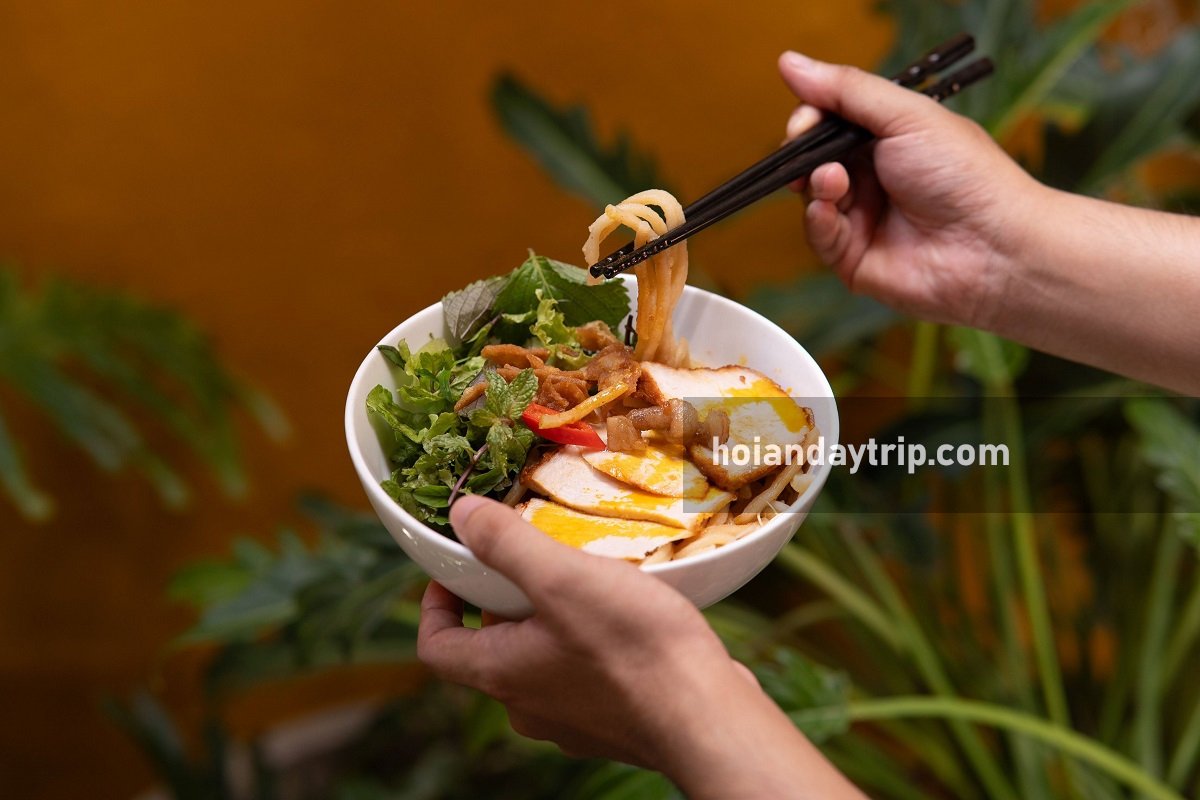
Must Knows about Cao Lau Noodles
– Other name(s): Hoi An noodles
– Origin: Hoi An Ancient Town, Quang Nam, Vietnam
– Ingredients: ‘cao lau’ noodle sticks, char siu pork belly, crispy rice crackers, raw vegetables, fresh herbs, blanching bean sprouts, savoury sauce
– Where to find: local restaurants inside the Hoi An Ancient Town, Quang Nam, Vietnam
– Pronunciation: /cow lou/
– Served for: lunch, dinner
– Price: 35,000-70,000 VND/bowl
– Callories:
– Gluten free: yes
– Vegetarian: available in local vegetarian days or at restaurants
– Fact: Cao Lau noodles is found only in Hoi An
– Travel blog: https://hoiandaytrip.com/cao-lau-noodles-hoi-an
– Fact:
History of Cao Lau Noodles
Cao Lau noodles is the specialty food of the Hoi An Ancient Town world heritage site. Nobody knows when it’s created by local people here. Based on its ingredients and recipe, this noodle dish is believed to be a fusion food between traditional cuisine of Vietnamese, Japanese and Chinese people who have lived together in town for many centuries. The earliest time might be the 15th century. Like the Japanese Covered Bridge, it has become the symbol of Hoi An, in terms of cuisine. At restaurants abroad, it’s called ‘Hoi An noodles’ to let guests know its origin. Somebody thinks that it looks like localized Japanese udon noodles.
In Vietnamese, Cao means ‘high’ and Lau means ‘floor’ or ‘upper floor’. Therefore, Cao Lau means ‘(in the) high floor’. Local inhabitants of the Hoi An Old Town believe that its name derives from the way their ancestors served and ate it in the past. Because it’s a very special food, their ancestors ate Cao Lau noodles only in the upper floor(s) of the house or restaurant, not on the ground floor. Nowadays, this tradition is lost, but the name still remains.
Interestingly, Cao Lau noodles are just popular in daily meals of those who live in the Hoi An Old Town only. Inside rural villages that are not far away from the town, local families often don’t eat this type of noodle. Mi Quang noodles and other rice vermicelli soups are much more popular for them. For that reason, Cao Lau noodles definitely have their own heritage of citizens in the Old Town.
In the 4th Hoi An International Food Festival in 2019, Cao Lau noodles is the main theme. Chiefs coming from 10 different countries competed to make the best noodles.
HOIAN DAY TRIP Company daily organizes food tours in Hoi An Vietnam. Contact us by +84968009827 (hotline/whatsapp/line/zalo) or hoiandaytripcompany@gmail.com or browse www.hoiandaytrip.com to see tours and make a reservation. Thank you very much!

Ingredients of Cao Lau Noodles & How to Make
Cao Lau Noodle Sticks
The noodle stick (also called ‘cao lau noodle’) is the first thing that makes Cao Lau noodles unique and not easy to duplicate. Today, there are a few families in Hoi An still producing this noodle. Each day, they make around 300 kilograms of fresh noodles for markets and restaurants in the city.
To make cao lau noodle sticks, local artisans need to do 8 steps, except buying ingredients. The first step is soaking the rice in fresh water brought from Ba Le Well, (a 1000-years-old well inside the Hoi An Old Town) with the ash of three plants (willow, amaranth & sesame). This step takes up to 3 hours. In the past, people would buy the wood ash from the Cham Islands, but now not too much because the archipelago’s forest has become a protection area already.
The second step to make cao lau noodle sticks is grinding the soaked rice into the milk. Some decades ago, local people had to use the stone grinder by hand (that’s why this work was for men). Now, automatic machines replace it. When all of the rice becomes the milk, people will keep it in the pot for a while, to let the sediments settle below.
The third step is ‘thickening the rice milk’. Firstly, people will place the rice milk pot on fire, and then use 2 big bamboo sticks to stir the milk around non-stop. Because this work requires strong hands, therefore the men always do it. He just stops stirring when the milk becomes thick. The whole step takes 15 to 17 minutes. Nowadays, to save time, local artisans may skip the ‘rice soaking step’, and mix the ash water directly with the rice milk (and then stir). Food safety and taste still remains.
The fourth step is using bamboo sticks to take the rice dough, to place on the banana leaf (on a round bamboo tray). After that, it’s needed to steam it and it takes local artisans 15-17 minutes.
When the dough is fully cooked, people will place it on a flat board, and then knead it by hand. Once again, make members of the family do this work. He just stops when the dough becomes flexible and soft evenly.
The next step is rolling the dough into a thin piece with a size: 80 cm x 20-25 cm. Then, people will use a big knife to cut it into noodles, place them on a metal tray, and steam for about 10 minutes. From now, the noodles are eatable and can be sold at the market or cooked at restaurants.
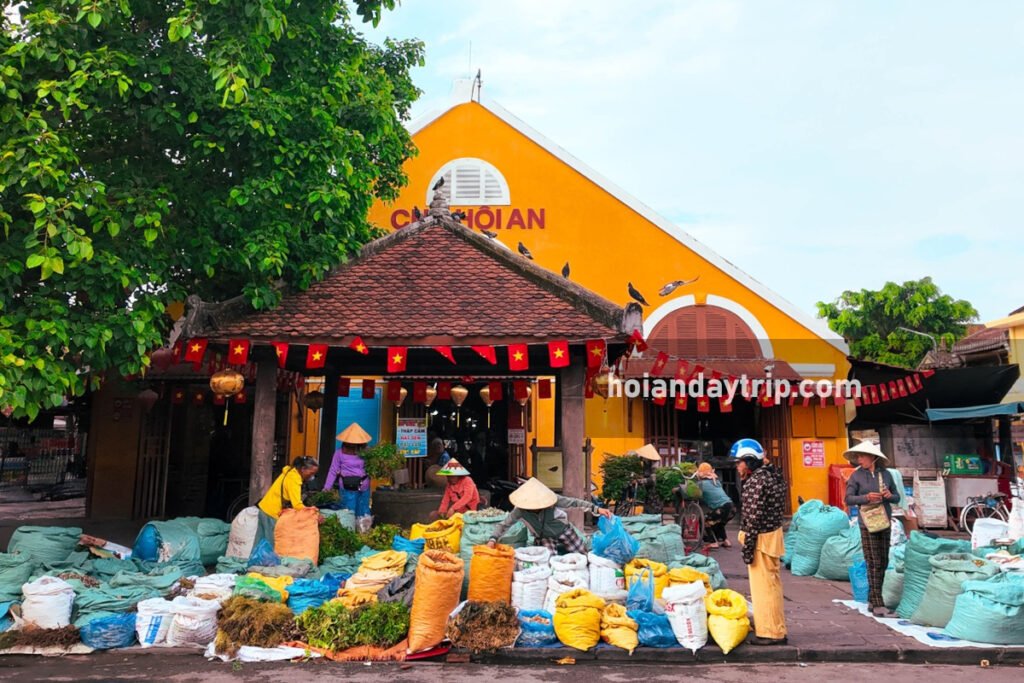
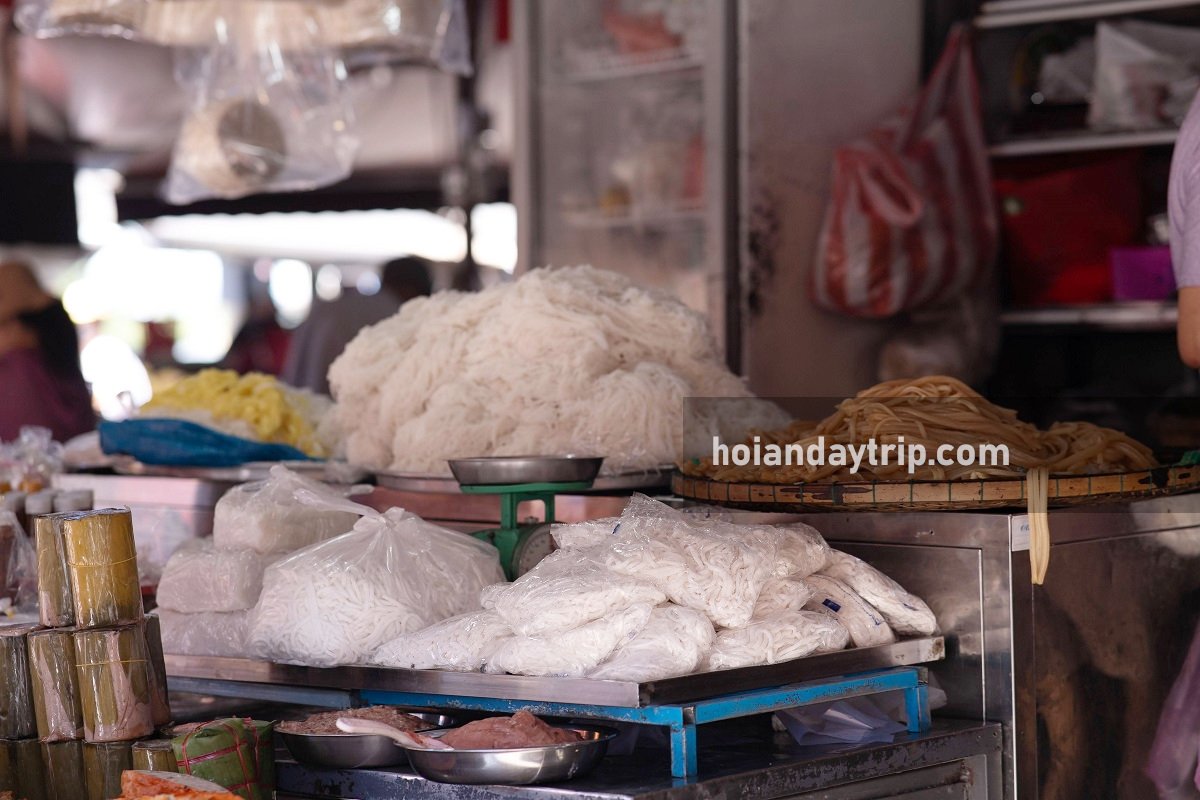
Compared to other local noodles, Cao Lau noodles are more chewy (than Mi Quang noodles, Pho noodles) and can be eatable for many days, without fridge or preservatives. To see or buy fresh cao lau noodles, visitors can to Hoi An Central Market, Tan An Market or Ba Le Market.
During the dry season (February to end of August), local people sun dry fresh cao lau noodles, to make it dry again. The reason is that they can preserve dried noodles in their house, and then use them for cooking in the rainy season later (from September to January). On heavy rain days or flood days, markets may be closed, these dried noodles are very helpful.
HOIAN DAY TRIP Company daily organizes food tours in Hoi An Vietnam. Contact us by +84968009827 (hotline/whatsapp/line/zalo) or hoiandaytripcompany@gmail.com or browse www.hoiandaytrip.com to see tours and make a reservation. Thank you very much!
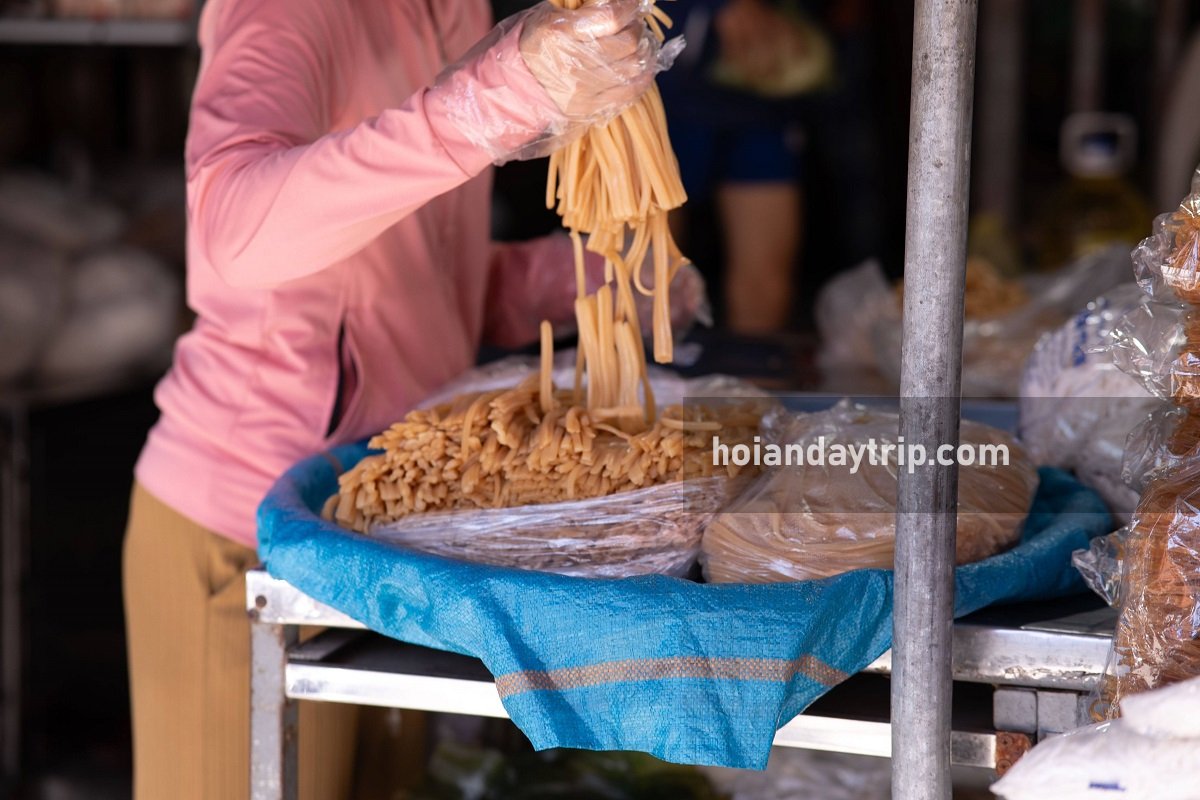
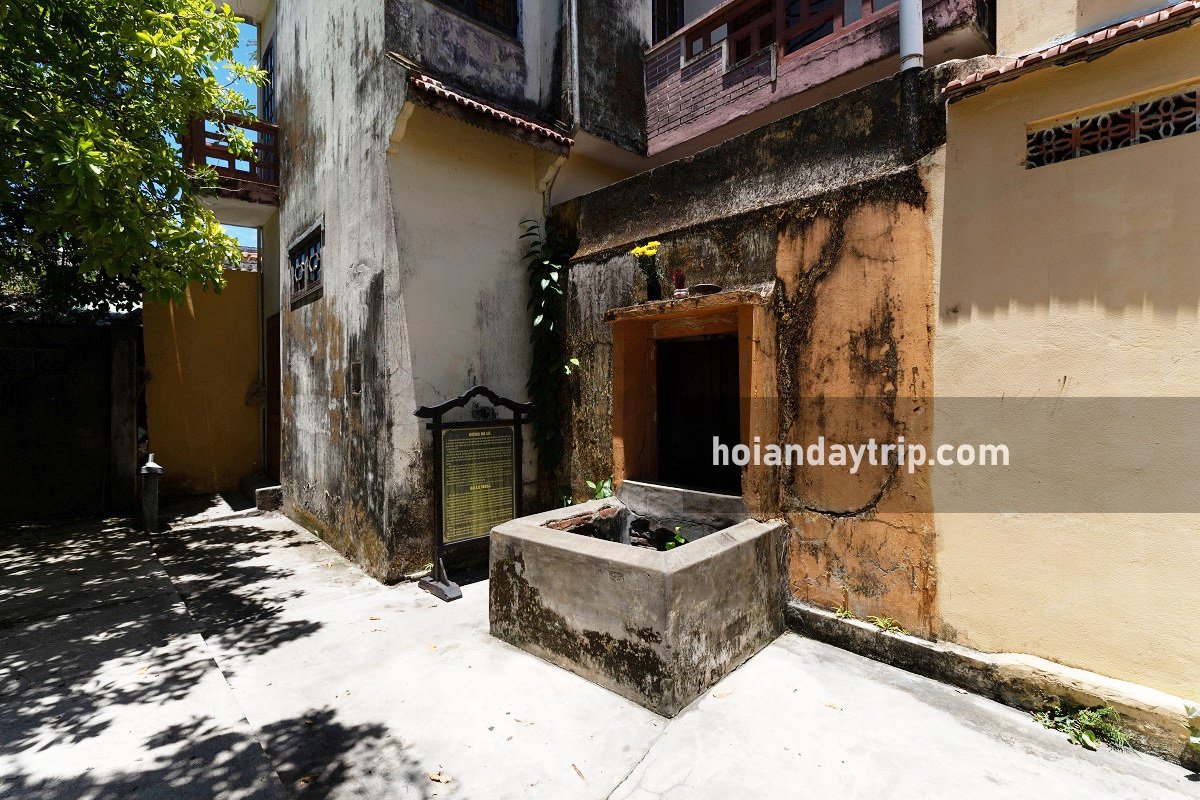
Other Ingredients to Make Cao Lau Noodles
Other ingredients in a bowl of Cao Lau noodles are char siu pork (thit xa xiu), crispy rice crackers, raw vegetables, herbs, blanching bean sprouts, and a savoury sauce.
About the pork, local food makers will buy a big piece of pork belly (half lean half fat pork), wash carefully, put into a hot, and then marinate it with soy sauce and spices. After marination, they slowly cook this pork piece until it’s fully cooked. When eating, they use the knife to slice it thinly. This way of cooking and eating allows the pork to be juicy and not rancid, in the tropical weather of Hoi An (hot, humid). A bowl of Cao Lau noodles has a couple of char siu pork slices. On the other side, the fat and savoury water (sauce) left from cooking the pork will be reused. It’s added into the bowl of Cao Lau noodles to mix and enrich the taste.
Visitors will see some squared rice crackers too. Back to cutting the steamed dough when making cao lau noodle sticks, a small amount of dough will be redundant. They flatten it and then cut it into small square-shaped crackers. This action is to make full use of ingredients and avoid waste. After that, the crackers are fried and packed. In Hoi An Central Market, visitors can see circle bamboo trays on which local people dry these crackers in the sun.
Lastly, bean sprouts, raw vegetables, and herbs are grown in Tra Que Vegetable Village. This village is only 3km away from Hoi An Ancient Town. Farmers here have grown veggies for some hundreds of years, by organic farming methods. In the bowl of Cao Lau noodles, visitors will see bean sprouts blanched in hot water, lettuce, sweet basil leaf (rau hung que), lemon basil leaf (rau hung chanh), heart leaf (rau diep ca), grass knot or bitter grass (rau dang), and shallot leaf (la he).
Vegetarian Cao Lau Noodles
On the 1st day and 14th-15th days every lunar month, locals in Hoi An will eat vegetarian food, due to Buddhist influence. In these days, vegetarian Cao Lau noodles are often made in buddhist families or at local vegetarian restaurants. Read information & details
To make vegetarian Cao Lau noodles, local people use fresh noodle sticks, root or fruit vegetables, herbs, and a savoury sauce. Root and fruit vegetables can be carrot, chayote, potato, sweet potato, and herbs can be purple shallot, white onion, spring onion, lettuce, sweet basil leaf (rau hung que), lemon basil leaf (rau hung chanh), heart leaf (rau diep ca), grass knot or bitter grass (rau dang), and shallot leaf (la he). The sauce is savoury, combining soy sauce, sugar, chilli, and other spices.
HOIAN DAY TRIP Company daily organizes food tours in Hoi An Vietnam. Contact us by +84968009827 (hotline/whatsapp/line/zalo) or hoiandaytripcompany@gmail.com or browse www.hoiandaytrip.com to see tours and make a reservation. Thank you very much!

Where to Eat the Best Cao Lau Noodles in Hoi An?
In Hoi An, there are many places selling Cao Lau noodles. In the Hoi An Old Town, here are good local restaurants where visitors can go to try:
– Cao Lau Thanh at 26 Thai Phien St, opening from 7 AM to 7 PM
– Mi Quang Ong Hai at 6A Truong Minh Luong St, opening from 7:30 AM to 9 PM
– Food Court of the Hoi An Central Market
– Cao Lau Khong Gian Xanh at 687 Hai Ba Trung St
– Cao Lau Ba Le in the alley of Ba Le Well (Tran Hung Dao St or Phan Chu Trinh St)
HOIAN DAY TRIP Company daily organizes food tours in Hoi An Vietnam. Contact us by +84968009827 (hotline/whatsapp/line/zalo) or hoiandaytripcompany@gmail.com or browse www.hoiandaytrip.com to see tours and make a reservation. Thank you very much!

How to Eat Cao Lau Noodles Like a Local
A bowl of Cao Lau noodles contains noodle sticks (fresh or dried noodles blanched in hot water), char siu pork (sliced thinly), raw vegetables and herbs, bean sprouts (blanched in hot water), and a savoury sauce.
To eat like a local, firstly visitors need to use chopsticks to mix up all ingredients in the bowl of Cao Lau noodles. To personalize the taste, let’s add lime juice (squeezing the lime/lemon), fresh chilli or Hoi An chilli sauce or soy sauce. Hoi An chilli sauce is special, made of fresh hot chilli, tomato, garlic, sugar, and other spices. It’s found only in the town.
HOIAN DAY TRIP Company daily organizes food tours in Hoi An Vietnam. Contact us by +84968009827 (hotline/whatsapp/line/zalo) or hoiandaytripcompany@gmail.com or browse www.hoiandaytrip.com to see tours and make a reservation. Thank you very much!
Where to Buy Cao Lau Noodle Sticks?
In Hoi An, visitors can buy Cao Lau noodle sticks to bring home for cooking. Fresh noodles are absolutely not recommended if you don’t use it to cook during the day. Fried noodles are better to pack, preserve and use in the future. The easiest way to buy them is going to local markets, such as the Hoi An Central Market or Tan An Market (aka Tiger Market). There, people sell them from morning to afternoon. Packs of dried Cao Lau noodle sticks are often 1/2 kilogram or 1 kilogram.
HOIAN DAY TRIP Company daily organizes food tours in Hoi An Vietnam. Contact us by +84968009827 (hotline/whatsapp/line/zalo) or hoiandaytripcompany@gmail.com or browse www.hoiandaytrip.com to see tours and make a reservation. Thank you very much!
Best Food Tours in Hoi An Vietnam
Here are the best food tours with local guide in Hoi An Vietnam:
– Hoi An Old Town Food Tour with Lantern Boat Ride & Night Market
– Hoi An Night Walking Food Tour (Best Food Tour in Hoi An)
– Hoi An Night Market Food Tour with Lantern Boat Ride
– Hoi An Morning Walking Food Tour with Local Market
– Hoi An Street Food Walking Tour
– Hoi An History & Food Tour – Famous Landmarks & Specialty Dishes
– Hoi An Food Tour by Motorbike
HOIAN DAY TRIP Company daily organizes food tours in Hoi An Vietnam. Contact us by +84968009827 (hotline/whatsapp/line/zalo) or hoiandaytripcompany@gmail.com or browse www.hoiandaytrip.com to see tours and make a reservation. Thank you very much!
Other Foods to Try in Hoi An
Besides Cao Lau noodles, visitors will see these dishes in Hoi An: Mi Quang noodles, Vegetarian Mi Quang, White rose dumplings, Hoi An style Banh Mi sandwich, Vegetarian Banh Mi, Hoi An style chicken rice, Cao Lau noodles, Vegetarian Cao Lau, Fried wonton, Hoi An style Pho (beef noodle soup), Vegetarian Pho, Banh xeo (crispy rice pancake), Vegetarian Banh xeo, Banh xoai (mango cake), Banh uot thit nuong (Hoi An grilled pork), Nem lui (Hoi An pork skewers), Banh dap (smashing rice paper), Stir-fried baby clams with rice cracker, Banh beo (steamed rice cake), Banh trang nuong (grilled rice paper or rice paper pizza), Chuoi nep nuong (grilled banana sticky rice), Hoi An banana pancake, Che (sweet soup), Black sesame soup, Kem cuon (ice cream rolls), Dau hu (tofu pudding), Bo la lot (grilled beef wrapped in betel leaf), Bun thit nuong (grilled pork noodle), Bun mam nem (fermented anchovy rice noodle), Banh canh (thick noodle soup), Chao ngheu (clam porridge), Banh trang cuon thit heo (rice paper rolls), Banh bot loc (tapioca cake), Banh da lon (pig skin cake), Banh it la gai (Ramie leaf rice cake), Banh to (ancestor cake), Green/Mung bean cake, Banh can (mini pancake), Banh cam (fried sesame balls), Banh tieu (hollow donut), Banh phu the (husband and wife cake), Banh bo (cow cake), Banh u tro (Lye water rice dumpling), Mot herbal tea, Da tron (pig skin salad), Banh khoai mon (taro cake), Xoi (sticky rice), Com tam (broken rice), Bun dau mam tom (rice noodle, shrimp paste and fried tofu), Bun cha ca (fish cake noodle), Banh chung (square sticky rice cake), Banh tet (cylindrical sticky rice cake), Trung lon (fetal duck egg or balut),…
HOIAN DAY TRIP Company daily organizes food tours in Hoi An Vietnam. Contact us by +84968009827 (hotline/whatsapp/line/zalo) or hoiandaytripcompany@gmail.com or browse www.hoiandaytrip.com to see tours and make a reservation. Thank you very much!
Better to Know about Eating Local in Hoi An
– Local family-run restaurants always serve better local foods than tourist restaurants. Places inside small alleyways potentially are hidden gems. The price is even more affordable at these lesser known spots.
– Restaurants where you can see a queue or crowds, food or drinks there are absolutely better or safer than others. Vietnamese people also avoid places without people eating, such as roadside eateries.
– Hot foods are often safe to eat for non-Vietnamese people. Refuse cold food (especially ones sold on the street, markets) or things you don’t see people cooking.
– Make sure that you learn some basic Vietnamese words or sentences to order foods, such as xin chao (hello, hi), cho toi mot (something) (I want one…), toi an chay (I am vegetarian), khong cay (no spicy), cam on (thank you), tam biet (goodbye) or numbers (mot/one, hai/two, ba/three, bon/four, nam/five, sau/six, bay/seven, tam/eight, chin/nine, and muoi/ten).
– Ask any local people you know (tour guide, driver, hotel receptionists, bellmen, etc) to receive their recommendation for good places to eat local.
– Raw vegetables are popularly used in local dishes, such as noodles or noodle soup or sandwich. They are often washed by tap water or unwashed. If can not drink tap water, remove or refuse them. Likewise, in most iced drinks (such as coffee or herbal tea), people add ice made by tap water also.
– On the 1st day and 14th-15th days of each lunar month, Hoi An citizens eat vegetarians. Many local restaurants and street businesses will be closed by that.
– If you don’t eat pork or beef, due to diet or religious restrictions, be careful when want to try local food here, if don’t see the ingredient description. Pork and beef are very popular meats, so they will be in numerous dishes. Street vendors may say ‘no pork’ or ‘no beef’ for better business, but please check before buying!
– Consider joining a food tour guided by locals who know much better about dishes in the city, including things never mentioned in guidebooks or on the internet.
– If have an allergy (milk, egg, peanut, wheat,…), ask anybody you know before trying or search for ingredients on the internet. By the way, fish sauce is popularly used to marinate Vietnamese foods, so make sure that you know this information if you’re fish allergic.
– Food portion (or size) here is often not really big (locals prefer eating with their family at home). You may try double or some different dishes for main meals.
– If don’t see the price on the menu, please ask in advance to avoid overcharging, especially when you are not a local. In Vietnamese, how much is bao nhieu.
– Most popular cutleries are chopsticks and spoons. To know how to use it, browse here
HOIAN DAY TRIP Company daily organizes food tours in Hoi An Vietnam. Contact us by +84968009827 (hotline/whatsapp/line/zalo) or hoiandaytripcompany@gmail.com or browse www.hoiandaytrip.com to see tours and make a reservation. Thank you very much!
Photos, Videos about Cao Lau Noodles Hoi An
Here are beautiful photos, videos about Cao Lau noodles in Hoi An: