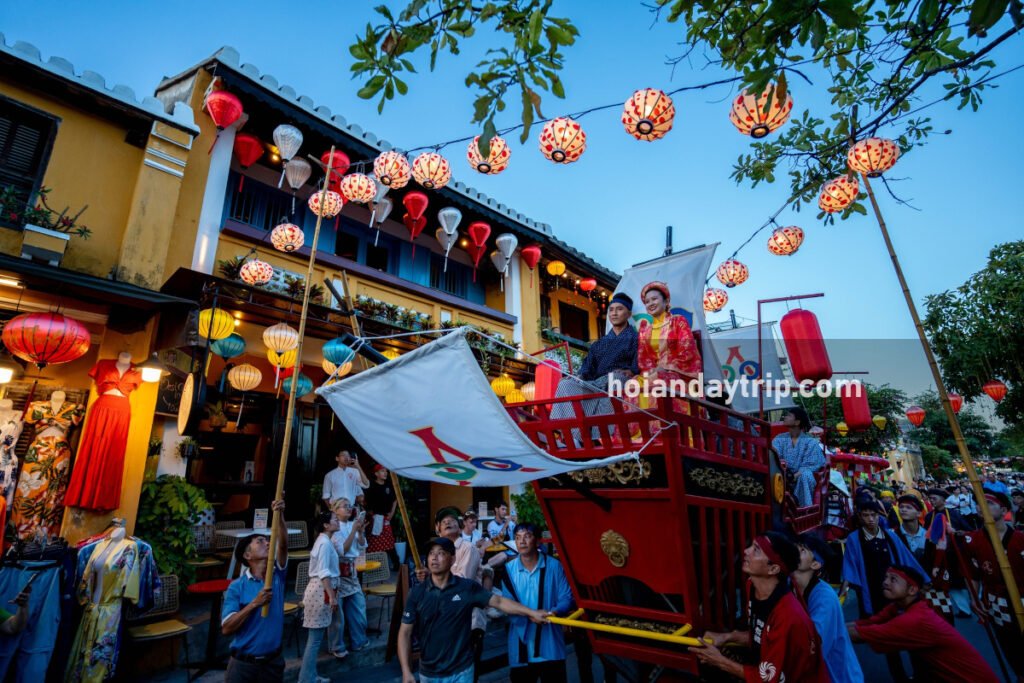
Between Quan Cong Temple and Hainan Assembly Hall, Minh Huong Communal House (Tuy Tien Duong Minh Huong) is the most important place for local Chinese communities in Hoi An. It’s used to worship their ancestors who moved to the town, to settle down and have business from past centuries. Today, Chinese people with Vietnamese nationality are officially known as ‘Hoa people’. In this article, HoiAn Day Trip Company will tell everything which visitors need to know about Minh Huong Communal House.
You may also like: Cam Pho Communal House, Hoi An Communal House
• Content by Tam Le, founder of HOIAN DAY TRIP CO.,LTD
• Designed by Giang Cong Minh, co-founder of LS E&C LTD and his team
• Photo by Dang Cong Loi, Dao Xuan Son, Tam Le & others
Must Knows about Minh Huong Communal House (Hoi An)
– Location/address: 14 Tran Phu Street, Minh An ward, Hoi An city, Quang Nam province, Vietnam
– Other name(s): Chinese Ancestral Temple of Hoi An, Tuy Tien Duong Minh Huong, Minh Huong Temple
– Name’s meaning:
– How to pronounce:
– Opening hours: 8 AM to 5 PM daily
– Ticket price: 120,000 VND for foreign adults and children above 15 years old, free for smaller kids, cheaper for Vietnamese passport holders (a sightseeing place included by Hoi An Old Town entry ticket)
– Reason(s) to visit: the most important place for all Chinese people in Hoi An, fine wooden buildings with beautifully-carved decorations
– Time to spend: 15-30 mins
– Best time to visit: anytime in opening hours
– Travel blog: https://hoiandaytrip.com/minh-huong-communal-house-hoi-an
– Tour guide: contact +84968009827 (hotline/whatsapp/line/zalo)
– Reason(s) to visit: one of the most important places for local Chinese communities
– Recognition(s): national heritage (29/3/1993), Unesco world heritage site (1999)
– Food & drink: not available
– Shopping: not available
– Fact:
Minh Huong Communal House on Map
History of Chinese Communities in Hoi An
The Chinese community is the second most important community in Hoi An Old Town (after the Vietnamese community). First Chinese families came to the town 400 years ago, to trade with merchants from Vietnam, Japan, European countries. After that, there were more and more Chinese people coming to Hoi An, because of different reasons (wars, natural disasters, business, political refugees).
In the early 17th century, the Ming dynasty in China collapsed and then was replaced by the Qing dynasty (established by Manchou people). This event led to strong waves of migration of loyal officials who worked in the Ming dynasty and people who antied the government of Manchou people, towards the south of mainland China as well as Southeast Asia. Hoi An was one of the main destinations for them because a Chinese community was here already for a long time.
In the second half of the 17th century, ‘Minh Huong village’ was established because new and old Chinese communities wanted to settle down in Hoi An. The leaders of the country – Nguyen lords also supported this. ‘Minh Huong’ means ‘people of Ming origin’.
Chinese residents in Hoi An mainly came from 4 provinces/areas: Canton, Fujian, Hainan and Chaozhou (all in southern coastal China). Each has its own assembly hall/temple, and there is one assembly hall for all communities.
In the history, there are other 4 waves of Chinese migration to Hoi An: 1715 (under the of Mac Cuu), 1840 (after the failure of Qing dynasty in the Opium war), 1851 (after the failure of the Taiping Heavenly Kingdom), and 1911 (after the Xinhai Revolution).
HOIAN DAY TRIP Company daily organizes tours and transfers to Hoi An Old Town. Contact us by +84968009827 (hotline/whatsapp/line/zalo) or hoiandaytripcompany@gmail.com or browse www.hoiandaytrip.com to see tours and make a reservation. Thank you very much!
History & Architecture of Minh Huong Communal House
Around 1725, Minh Huong Communal House was established on the piece of land where present-day Van Thanh Minh Huong temple is located (20 Phan Chu Trinh street). After that, it had changes and restorations in 1820, 1849, 1905, 1953, 1970, 2004, and 2008. It’s moved to its current location (14 Tran Phu Street) in 1905. Either construction or renovation here was carried out by very skillful artisans from Kim Bong Carpentry Village.
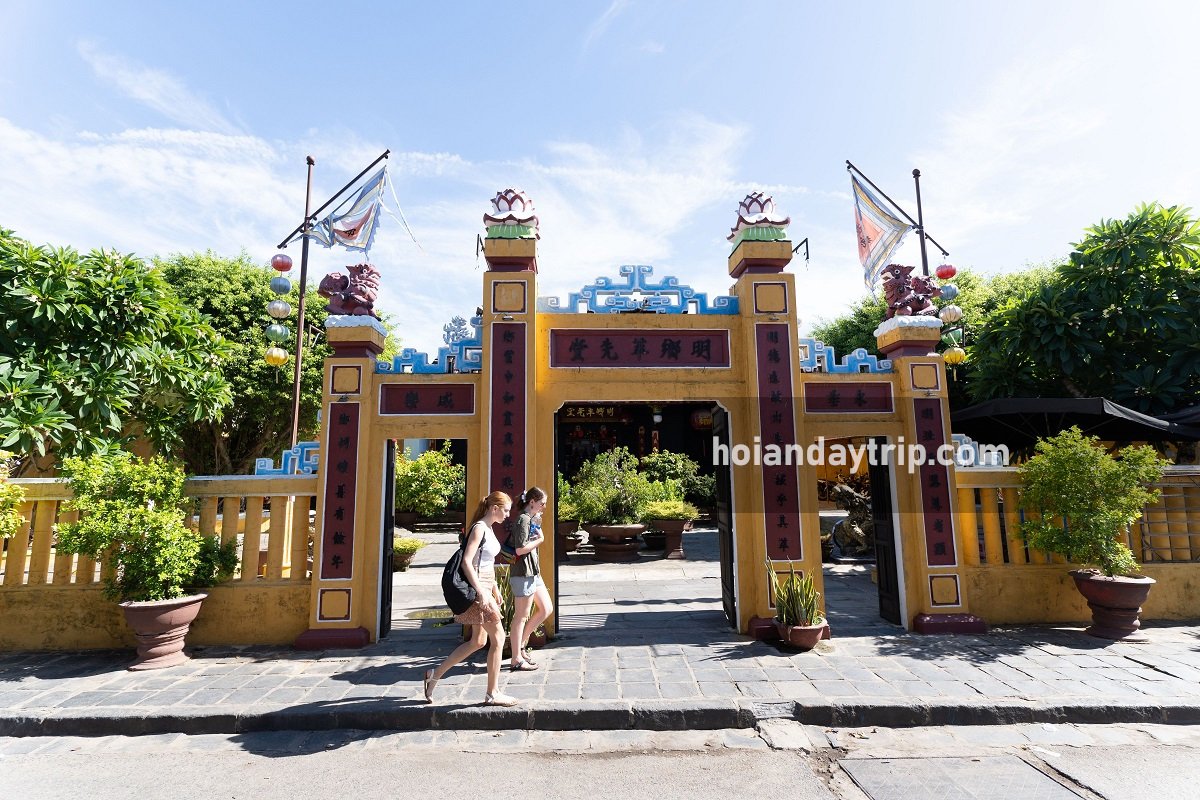
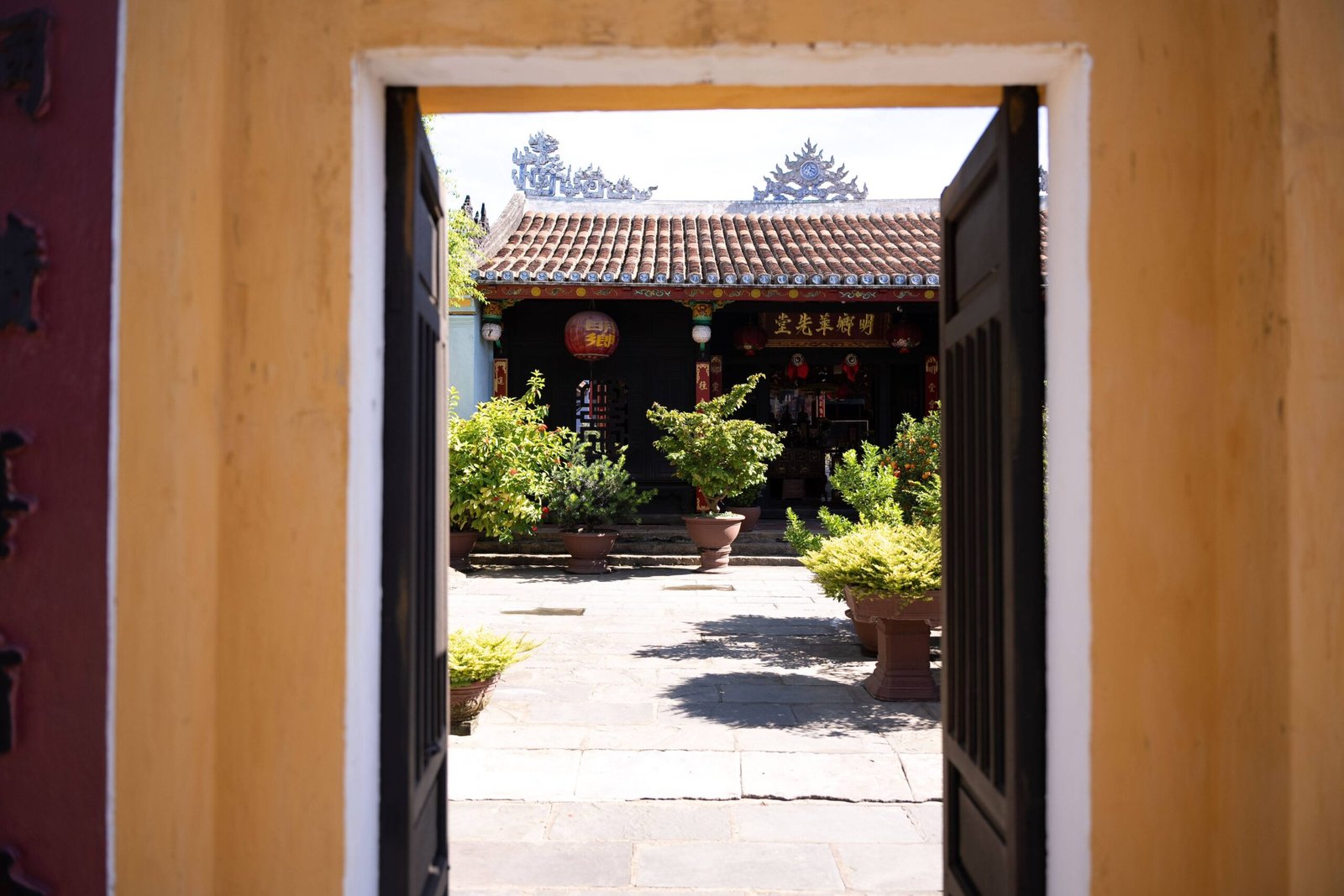
Minh Huong Communal House has a three-arched gate (tam quan), a front hall, a main hall, and two side houses. The gate has its name in Chinese inscriptions above the main entrance, and parallel sentences (cau doi) on nearby columns. It has a yellow color, typical to Hoi An, and is decorated by red lanterns.
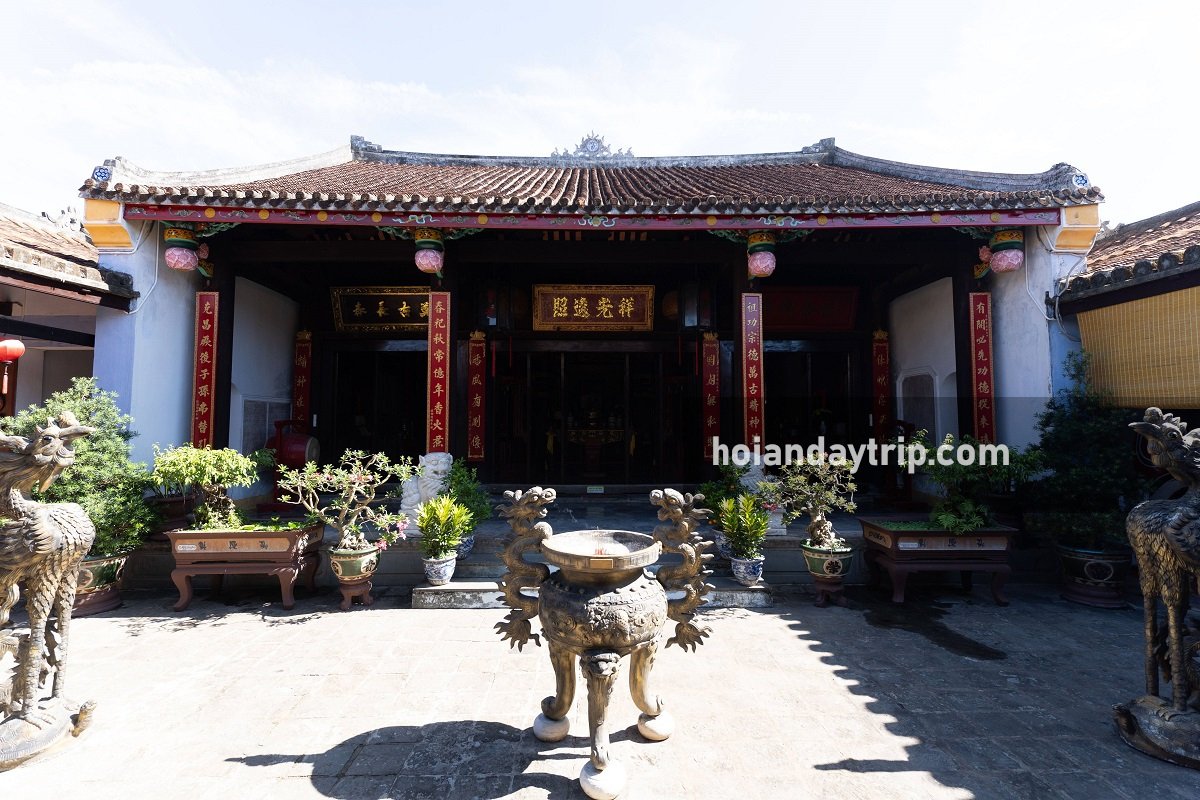
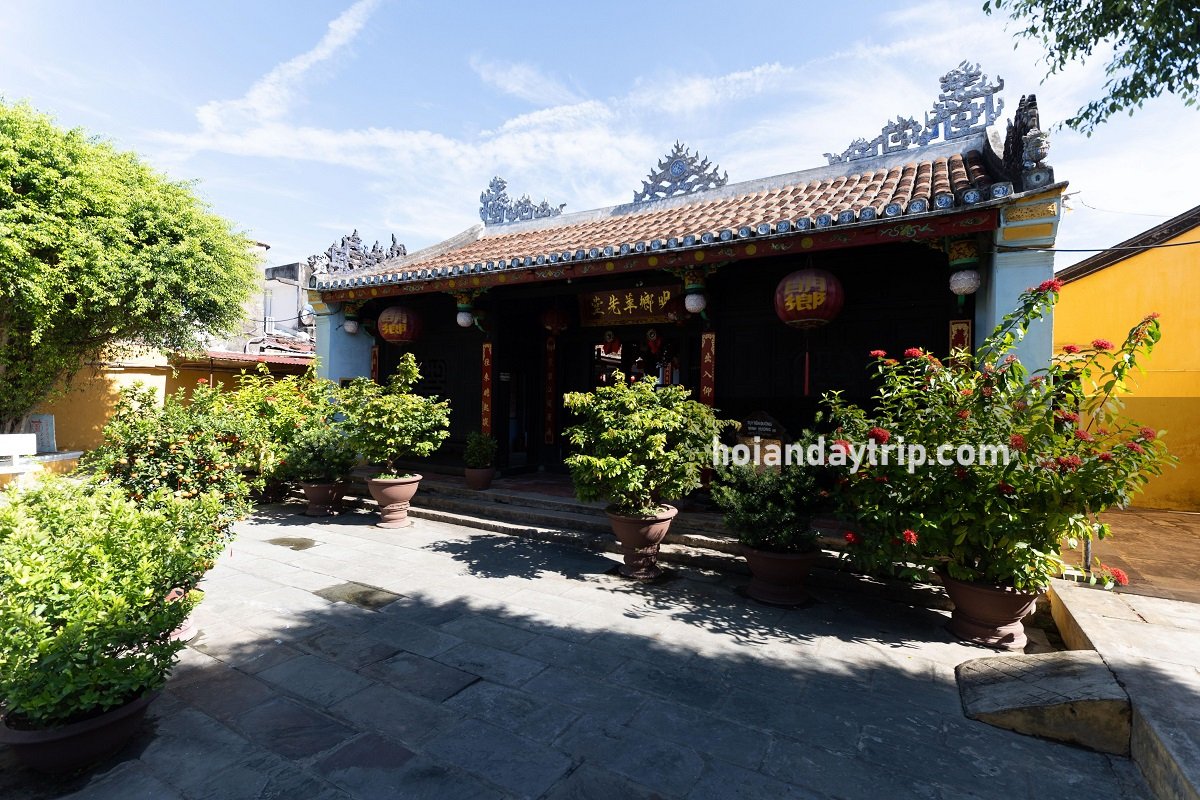
After an open yard, visitors will see tien duong – the front hall. Its wooden doors and carvings on the structure are amongst the best works from local carpenters. Across the other yard, the main hall (chinh dien) is the most important part of Minh Huong Communal House. It’s to used to worship tien hien (the ancestors or those who found the communities in town), and hau hien (the predecessors or those who contributed a lot to the community). Like other Chinese ancestry temples, no statues are seen, and red tablets with names are seen instead. Two side houses – ‘west’ and ‘east’ houses are where people store different things or prepare offsprings for special occasions of the community.
Around the temple, it’s possible to see many ancient urns, bells, Chinese porcelains, and especially, 5 informative stone steles carved in the reign of Tu Duc, Khai Dinh, and Minh Mang emperors.
Festivals and ceremonies at Minh Huong Communal House are the new year festival, the spring ceremony on the 12nd day of the 2nd lunar month, the new moon ceremony on every 1st day of lunar months or the full moon ceremony on every 15th day of lunar months. Daily worship is continued by old men.
HOIAN DAY TRIP Company daily organizes tours and transfers to Hoi An Old Town. Contact us by +84968009827 (hotline/whatsapp/line/zalo) or hoiandaytripcompany@gmail.com or browse www.hoiandaytrip.com to see tours and make a reservation. Thank you very much!


Tips to Visit Minh Huong Communal House
– It’s needed to buy entry ticket for Hoi An Ancient Town and then Minh Huong Communal House. The nearest ticket booth is in crossroad of Tran Phu Street and Hoang Dieu Street. The price is 120,000 VND for adult and children above 15 years ago. See more information & details
– No dress code regulation is required to visitors at Minh Huong Communal House. However, to see other attractions in town (such as temples, assembly halls), wearing long pants and shirts covering armpits/shoulders/navel is necessary.
– Follow rules, regulations and signs while visiting Minh Huong Communal House.
– Do not enter private areas and touch on old antiquities in Minh Huong Communal House.
– Vietnamese traditional costume ao dai dress is highly recommended. Any garment made of see-through material is not respectful.
– In the dry season, from February to the end of August, visitors should bring sun cream, hat/cap/umbrella, sun glasses, and bottles of water to drink. If don’t have, it’s easy to buy at shops near Minh Huong Communal House.
– In the rainy season, from September to January, visitors should bring rain poncho/jacket or umbrella, sandals or waterproof shoes. Don’t forget to check the weather forecast usually when traveling during this period.
– From October to December, the town may be flooded, so visitors need to keep updating the weather before going to Hoi An.
– The best way to visit the Hoi An Old Town is walking, so make sure that you have good/comfortable shoes or sandals.
– Smartphone or camera is needed for taking pictures. For more experiences, visitors can consider renting Vietnamese traditional costume (for example, ao dai long dress for ladies) or even booking a private photographer (contact us by +84968009827 (hotline/whatsapp/line/zalo) if you need).
– Don’t forget bringing cash to pay for entry fee tickets and small things because many places in Vietnam don’t accept payment by cards.
– It’s better to visit Minh Huong Communal House with a local guide. Contact us by +84968009827 (hotline/whatsapp/line/zalo) if you need a professional guide in Hoi An.
– Visitors should buy souvenirs at Minh Huong Communal House to support local family who owns and preserves it.
HOIAN DAY TRIP Company daily organizes tours and transfers to Hoi An Old Town. Contact us by +84968009827 (hotline/whatsapp/line/zalo) or hoiandaytripcompany@gmail.com or browse www.hoiandaytrip.com to see tours and make a reservation. Thank you very much!
How to Get to Minh Huong Communal House
Minh Huong Communal House is within the Hoi An Old Town world heritage area. To get there, visitors can walk or use the bicycle, car, taxi, E-taxi, hotel shuttle bus, motorcycle, or minivan.
From hotels or places in Minh An/Cam Pho/Son Phong areas, Minh Huong Communal House is within a walking distance. We advise going along main roads because of wide pavements (can avoid the traffic, especially if traveling with kids). To get around and sightsee other attractions in the Old quarters, walking is needed and the best way as well.
If like to use the bicycle, visitors can cycle to Minh Huong Communal House anytime during the day. From Minh An, Cam Pho, Cam Chau, Son Phong, and a part of Cam Nam, the distance is less than 3km. From An Bang beach area, it will be 5 km. At many hotels in Hoi An, the bicycle is free to use for the guests.
If can’t walk or ride the bicycle, getting a taxi or E-taxi is the most convenient way to reach Minh Huong Communal House. Visitors will pay 15,000-20,000 VND for each kilometer. E-taxi charges the passenger by both distance and number of people.
The nearest car parking lot to Quan Cong Temple/ Minh Huong Communal House/Hainan Assembly Hall/Chaozhou Assembly Hall is at the crossroad Phan Chu Trinh street vs Hoang Dieu street (aka Hoang Dieu parking lot). From there, a very short walk is needed to see the ticket office, and then go to temples.
Because Minh Huong Communal House isn’t in the pedestrian area, therefore visitors can go to it anytime during the day. It’s possible to park around its entrance (sure, free). However, we still recommend parking in a place with a service. The reason is that you will need to see/do something in the town as well (for example, picking up custom suits, eating,…).
Some beachside resorts organize free shuttle bus to the Hoi An Old Town everyday, so please remember to check its timetable, pick up and drop off points. After coming to town, just walk to the communal house.
From Da Nang city, the distance to Hoi An Old Town is some 30km. It will be longer if stay in Son Tra peninsula and shorter if stay in Non Nuoc beach area. Motorcycle, car, taxi, van, and bus are all possible ways to get to the town and Minh Huong Communal House.
HOIAN DAY TRIP Company daily organizes tours and transfers to Hoi An Old Town. Contact us by +84968009827 (hotline/whatsapp/line/zalo) or hoiandaytripcompany@gmail.com or browse www.hoiandaytrip.com to see tours and make a reservation. Thank you very much!
Itinerary to Visit Hoi An Old Town for First Timer
First of all, to enter and visit the Hoi An Old Town (the part inscribed by Unesco), visitors need to buy an entry ticket. Its price is 120,000 VND per adult and children above 15 years old and free of charge for smaller kids. Entry to 5 attractions is also included for free. See more information & details
If possible, first time visitors should go with a local guide, to know better about history and culture. Contact us by +84968009827 (call/whatsapp) to book a private English-speaking guide.
We suggest this itinerary for first timers:
Total distance: 1,65 kilometers
– Starting point: the Japanese style gate (the west end of Nguyen Thi Minh Khai Street). A model of the Red Seal Ship Model (Japanese merchant’s ship) and a ticket office are in a close distance.
– Walk along Nguyen Thi Minh Khai Street. On this road, visitors will have the chance to sightsee Cam Pho Communal House (ticket required), Japanese Culture Gallery (ticket required), Phung Hung Old House (one of the best heritage houses, ticket required), Nguyen Tuong Family Chapel (in the alleyway, ticket required).
– Visit the Japanese Covered Bridge, the symbol of Hoi An. This place definitely is a must see attraction.
– Walk along Tran Phu Street, the most beautiful road in Hoi An, until Hoi An Central Market. On this road, visitors will have the chance to sightsee so many historical attractions. From the bridge to the market, there are Cantonese Assembly Hall (ticket required), Museum of Sa Huynh Culture (ticket required), Duc An Old House (ticket required), Kazik Park (free), Quan Thang Old House (ticket required), Museum of Trade Ceramics (ticket required), Trung Hoa Assembly Hall (ticket required), Fujian Assembly Hall (ticket required), Quan Cong Temple (ticket required), Quan Am Pagoda (ticket required), Hoi An Central Market (free to enter), a couple of rooftop coffee shops, Instagrammable spots, shophouses selling lanterns, food, souvenirs and fashion items.
– Walk southwards and along Tieu La Street (east side of Hoi An Central Market). On this road, there are many vendors and stalls selling a diversity of local products, giving a good chance to know about local life and photograph.
– Walk westwards and along Bach Dang Street (the riverside street). On this road, visitors will see Hoi An Traditional Performance House (ticket required if want to watch shows) and Museum of Folklore (ticket required).
– Turn into Le Loi Street and then turn left, walking along Nguyen Thai Hoc Street. On this road, visitors will see Tan Ky Old House (one of the best heritage houses, ticket required) and Diep Dong Nguyen Old House (not yet opened to visitors, see from outside).
– The ending point: the crossroad near the north end of An Hoi Bridge or the west end of Nguyen Thai Hoc Street. In the evening, from here, visitors can walk cross the bridge and then turn right to see the entrance of the Hoi An Night Market, the biggest night market in Hoi An.
For more details and the map, please browse https://hoiandaytrip.com/hoi-an-self-guided-walking-tour
Guided Tours to Hoi An Ancient Town Vietnam
From Hoi An
– Hoi An Old Town Walking Tour – 2 Hour Express Tour with Local
– Hoi An Half Day Walking Tour with Traditional Art Performance
– Hoi An City Tour: Old Town, Coconut Village & Lunch
– Hoi An Morning Walking Tour with Local Breakfast & Coffee
– Hoi An Afternoon Walking Tour with Thu Bon River Sunset Cruise
– Hoi An Night Tour with Lantern Boat Ride & Dinner
– Hoi An History & Food Tour – Famous Landmarks & Specialty Dishes
– Hoi An Instagram Tour: Best Photo Spots & Rooftop Café
– Hoi An Old Town Food Tour with Night Boat Ride
– Hoi An Old Town Private Walking Tour with Local Expert
– Hoi An City Tour by Electric Car
HOIAN DAY TRIP CO.,LTD daily organizes tours in Hoi An and Da Nang. Contact us by +84968009827 (hotline/whatsapp/line/zalo) or browse www.hoiandaytrip.com to see tours and make a reservation. Thank you very much!
From Da Nang
– Hoi An Half Day Tour from Da Nang
– Hoi An Night Tour from Da Nang
– Hoi An Night Tour from Da Nang with Coconut Forest Basket Boat Ride
– Hoi An Night Tour from Da Nang with Hoi An Memories Show
– Marble Mountain & Hoi An Day Tour from Da Nang
– Marble Mountain & Hoi An Night Tour from Da Nang
– Hoi An Full Day Tour from Da Nang
– Hoi An City Tour from Airport
– Marble Mountain, Monkey Mountain & Hoi An Day Tour from Da Nang
– Hoi An Full Day Tour from Da Nang with Chinese Speaking Guide
– My Son Sanctuary & Hoi An Tour – World Heritage Site Tour
– Golden Bridge/Ba Na Hills Tour & Hoi An Tour from Da Nang
– Marble Mountain & Hoi An Tour from Da Nang Cruise Port
– Marble Mountain & Hoi An Tour from Chan May Cruise Port
– Marble Mountain & Hoi An Day Tour from Intercontinental Danang Resort
– Marble Mountain & Hoi An Day Tour from Lang Co
HOIAN DAY TRIP CO.,LTD daily organizes tours in Hoi An and Da Nang. Contact us by +84968009827 (hotline/whatsapp/line/zalo) or browse www.hoiandaytrip.com to see tours and make a reservation. Thank you very much!
Places to Visit near Minh Huong Communal House
– Bridges: Japanese Covered Bridge (Pagoda Bridge), Moonlight Bridge, An Hoi Bridge (Bridge of Lights), Cam Nam Bridge
– Museums: Museum of Sa Huynh Culture, Museum of Sa Folklore, Museum of Trade Ceramics, Museum of Traditional Medicine, Hoi An Museum of History & Culture, Japanese Culture Gallery, Black Sesame Soup Demonstration, Museum of Local Products
– Chinese assembly halls: Cantonese Assembly Hall, Fujian Assembly Hall, Trung Hoa Assembly Hall, Hainan Assembly Hall, Teochew Assembly Hall
– Heritage houses: Tan Ky Old House, Phung Hung Old House, Duc An Old House, Quan Thang Ancient House, Diep Dong Nguyen House, Thai Phien Ancient House
– Temples & pagodas: Quan Cong Temple (Ong Pagoda), Ba Mu Temple, Phap Bao Pagoda, Quan Am Pagoda, Hoi An Confucius Temple, Cao Dai Temple of Hoi An, Hoi An Ancestral Temple, Cam Pho Confucius Temple, Minh Huong Confucius Temple, Vien Giac Pagoda, Hy Hoa Temple
– Family chapels: Tran Family Chapel, Nguyen Tuong Family Chapel
– Communal houses: Cam Pho Communal House, Hoi An Communal House, Minh Huong Communal House, Tu Le Communal House, Xuan Lam Communal House, Son Phong Communal House
– Markets: Hoi An Central Market, Hoi An Cloth/Fabric Market, Hoi An Night Market (Nguyen Hoang Night Market), Cam Pho Market
– Theatres: Hoi An Traditional Art Performance House, Hoi An Lune Center for Performing Arts (now where Teh Dar Show takes place), Hoi An Memories Land Theme Park (now where Hoi An Memories Show takes place)
– Famous streets: Tran Phu Street, Phan Chu Trinh Street, Nguyen Thai Hoc Street, Bach Dang Street/Wharf, Nguyen Thi Minh Khai Street, Hoi An Lantern Streets
– Other points of interest: Red Seal Ship Model, Hoi An Evanlegical Church, Thong Dang Prison & Park, Kazik Park (Memory Statue of Kazimierz Kwiatkowski), Hoai River (Hoi An River), Song Hoai Square, An Hoi Sculpture Park, Hoi An Catholic Church, Hoi An Prison, Hoi An Central Park, Ba Le Well, Hoi An Lantern Park, An Hoi Island, Cam Nam Island, Thu Bon River, Da Ken Tree
Photos, Videos about Minh Huong Communal House
Here are beautiful photos and videos about Minh Huong Communal House: