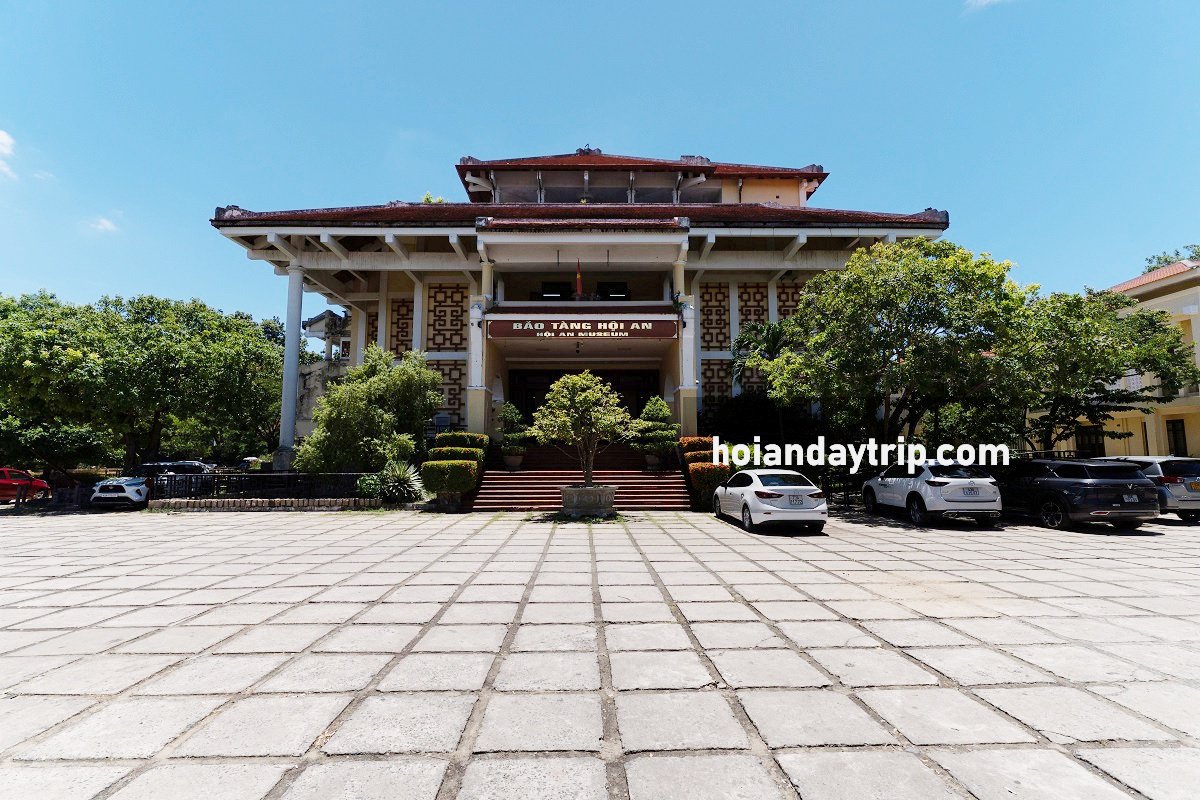
The Hoi An Museum (or Hoi An Museum of History and Culture) is an interesting attraction in Hoi An Old Town. It introduces famous porcelain/ceramic ‘brands’ in Vietnam that were traded with foreign merchants in Hoi An in the past. History of the town/city from beginning to present is also told briefly, accompanied with meaningful artifacts. Although lesser known than other museums, this museum is still worth seeing. Now, let’s HoiAn Day Trip Company tell you everything that you need to know about the Hoi An Museum.
You may also like: Museums in Hoi An Vietnam
• Content by Tam Le, founder of HOIAN DAY TRIP CO.,LTD
• Designed by Giang Cong Minh, co-founder of LS E&C LTD and his team
• Photo by Dang Cong Loi, Dao Xuan Son, Tam Le & others

Must Knows about Hoi An Museum of History & Culture
– Location/address: 10B Tran Hung Dao St, Minh An ward, Hoi An city, Quang Nam province, Vietnam
– Vietnamese name: Bao Tang Van Hoa Lich Su Hoi An
– Other name(s): Hoi An Ancient Town Museum
– Opening hours: 7 am to 5 pm everyday, except Saturday and Sunday
– Ticket price: 120,000 VND for adults & children above 15 years old, free for smaller kids (see more details)
– Reason(s) to visit: one of the most interesting museums in Hoi An
– Best time to visit: anytime during the day
– Time to spend: 30 mins
– Travel blog: https://hoiandaytrip.com/hoi-an-museum
– Recognition(s):
– Tour guide: contact +84968009827 (hotline/whatsapp/line/zalo)
– Food & drink: not available
– Shopping: not available
– Fact: Hoi An Museum of History and Culture is the largest museum in Hoi An
Hoi An Museum of History & Culture on Map
History of Hoi An Museum of History & Culture
The Hoi An Museum was established on 10th November 1989. At that time, Quan Am Pagoda on Nguyen Hue street was used to exhibit artifacts. This Buddhist temple is behind Quan Cong Temple and not too far from the Hoi An Central Market. It’s used to worship two Mahayana bodhisattvas regarded as guardians of the pagoda, and in the centre, a trio of buddhas: Amitabha (left), Lady Buddha or Guan Yin (middle, main saint) and Mahasthamaprapta or Dashizhi (right). In a corner, Kṣitigarbha or Dizang is also honored. See more information & details
In August 2015, the Hoi An Museum of History and Culture was moved to its current location, at 10B Tran Hung Dao St, Minh An ward. This decision aims to have better spaces for preservation and exhibition of historical artifacts as well as to use Quan Am Pagoda as a place of worship like in the past.
In late 2019, the Hoi An Museum was in renovation lasting 120 days and costing almost 2,5 billions dong.
The main building of the Hoi An Museum of History and Culture spans an area of 1,600 m2, making it the largest museum in Hoi An, and includes three floors. Its ground has an area of up to 6,000m2. A part of it has been used for car parking.
HOIAN DAY TRIP Company daily organizes tours and transfers to Hoi An Old Town. Contact us by +84968009827 (hotline/whatsapp/line/zalo) or hoiandaytripcompany@gmail.com or browse www.hoiandaytrip.com to see tours and make a reservation. Thank you very much!

Exhibitions of Hoi An Museum of History & Culture
The Hoi An Museum is home to 3,482 artifacts on display and 8,740 artifacts in preservation. Amongst them, there are the highest-rated stone sculptures from competitions at Hoi An, and wooden sculptures crafted by renowned local carpenters, such as Huynh Ri or Huynh Suong in Kim Bong Village. This village is home to those who constructed impressive wooden buildings in town.
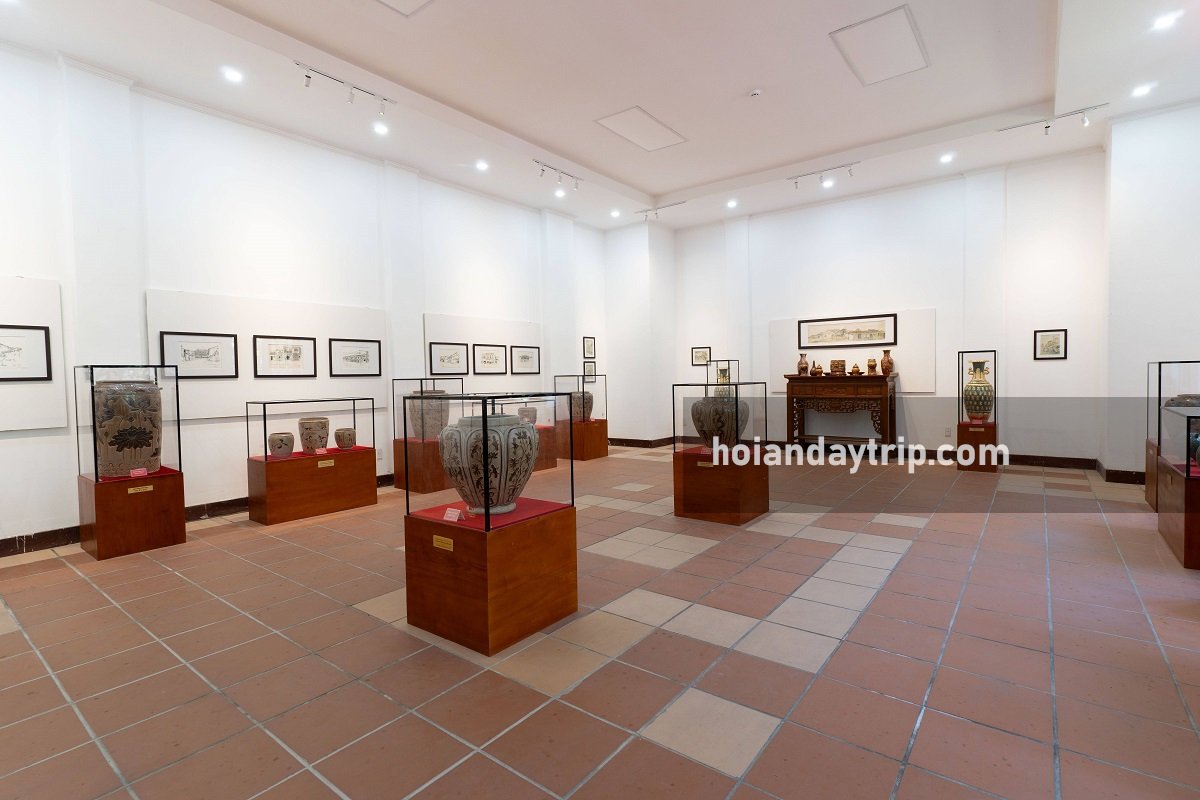
On the ground floor of the Hoi An Museum, near the entrance and ticket checking spot, is the exhibition of Chu Dau ceramics. A large portion of artifacts here belong to shipwrecks discovered and excavated in late 1990s, near Cham Islands, an offshore archipelago in Hoi An. Chu Dau is the name of a pottery village in northern Vietnam where blue-and-white ceramics were produced to export to many countries around the world, in the 15th and 16th centuries. Hoi An played the role as a port where foreign merchants met locals to buy them. Nowadays, Chu Dau ceramics are seen in Asia, Middle East, and Eastern Africa. In town, visitors can go to Museum of Trade Ceramics to see more vases, bowls, plates,…with similar story, age and production skills.
The site of Chu Dau pottery village was just discovered in 1983. Today, production activities here stopped.
In the back and to the left, there is the exhibition of Bat Trang porcelain/ceramics. Bat Trang is a reputable living pottery village in the outskirts of Hanoi capital. Production of pottery and ceramics here started from the 14th century or older. In later centuries, its porcelain/ceramics became highly-valuable products to export, including blue-and-white, brown, ivory white, jade green, and crackle glazes. Foreign merchants came to Vietnam to buy them, and Hoi An was one of the major ports. Lots of Bat Trang porcelains are discovered at archaeological sites or preserved in ancient buildings around Hoi An today.
On the second floor of the Hoi An Museum, visitors will have the chance to learn about the history of Hoi An over time, from Sa Huynh culture to Champa kingdom to Dai Viet kingdom. According to archaeological findings, the first inhabitants lived in Hoi An around 3,100 years ago. Between 1,000 BC and 200, Sa Huynh culture existed here and left behind many traces under the ground, especially burial jars. Sa Huynh means ‘yellow sand’ in Vietnamese language and the term ‘Sa Huynh culture’ has been used since 1936 after publication by French scholars. See more information & details
Between the 2nd and early 14th centuries, Cham people were land owners at Hoi An and Champa kingdom. This town served as a trading port under the name ‘Champapura’ where Chams traded with Chinese, Persians, Indians, and more. By that, they received cultural influences from India, such as Hinduism, inscriptions, building techniques, cuisine,… At the Hoi An Museum, visitors will see stone sculptures depicting Hindu gods or photos about surviving Hindu temples, such as My Son Sanctuary.
The theme of the next exhibition is about French and American wars in the area. The colonial period lasted about 60 years in the country in the 19th and 20th centuries. And after that, the Vietnam War involving the US army, lasted over 20 years in the 20th century. During these wars, Vietnamese people in the area of Hoi An had a resilient and brave spirit, with a strong and unchanging belief to bring peace back to their hometown. Typically, Bay Mau Coconut Forest played its role as a hiding place for guerillas and communists for many decades; Many locals here become national heroes.
Outdoors, there are war machines collected in the Vietnam War which occurred in the area during the 1960s and 1970s.
HOIAN DAY TRIP Company daily organizes tours and transfers to Hoi An Old Town. Contact us by +84968009827 (hotline/whatsapp/line/zalo) or hoiandaytripcompany@gmail.com or browse www.hoiandaytrip.com to see tours and make a reservation. Thank you very much!


Tips to Visit Hoi An Museum of History & Culture
– It’s needed to buy entry ticket for Hoi An Ancient Town and then sightsee Hoi An Museum of History & Culture. The nearest ticket booth is near Hoi An Communal House on Le Loi Street. The price is 120,000 VND for adult and children above 15 years ago. See more information & details
– No dress code regulation is required to visitors at Hoi An Museum of History & Culture. However, to see other attractions in town (such as temples, assembly halls), wearing long pants and shirts covering armpits/shoulders/navel is necessary.
– Follow rules, regulations and signs while visiting Hoi An Museum of History & Culture.
– Introductions and explanations are available in either Vietnamese or English. Other languages are not available yet.
– Visitors must turn off flashlights when taking photos by phone or camera while visiting Hoi An Museum of History & Culture.
– Visitors should be careful when walking upstairs to the 2nd floor of Hoi An Museum of History & Culture. Senior visitors and wheelchair users can see round the ground floor, and not see the upper floors.
– No smoking, no eating and no drinking in the museum.
– Toilets in the back of the first floor, to use for free.
– Do not enter private areas and touch on old antiquities in Hoi An Museum of History & Culture.
– Vietnamese traditional costume ao dai dress is highly recommended. Any garment made of see-through material is not respectful.
– In the dry season, from February to the end of August, visitors should bring sun cream, hat/cap/umbrella, sun glasses, and bottles of water to drink. If don’t have, it’s easy to buy at shops near Hoi An Museum of History & Culture.
– In the rainy season, from September to January, visitors should bring rain poncho/jacket or umbrella, sandals or waterproof shoes. Don’t forget to check the weather forecast usually when traveling during this period.
– From October to December, the town may be flooded, so visitors need to keep updating the weather before going to Hoi An.
– The best way to visit the Hoi An Old Town is walking, so make sure that you have good/comfortable shoes or sandals.
– Smartphone or camera is needed for taking pictures. For more experiences, visitors can consider renting Vietnamese traditional costume (for example, ao dai long dress for ladies) or even booking a private photographer (contact us by +84968009827 (hotline/whatsapp/line/zalo) if you need).
– Don’t forget bringing cash to pay for entry fee tickets and small things because many places in Vietnam don’t accept payment by cards.
– It’s better to visit Hoi An Museum of History & Culture with a local guide. Contact us by +84968009827 (hotline/whatsapp/line/zalo) if you need a professional guide in Hoi An.
– Visitors should buy souvenirs at Hoi An Museum of History & Culture to support local family who owns and preserves it.
HOIAN DAY TRIP Company daily organizes tours and transfers to Hoi An Old Town. Contact us by +84968009827 (hotline/whatsapp/line/zalo) or hoiandaytripcompany@gmail.com or browse www.hoiandaytrip.com to see tours and make a reservation. Thank you very much!

How to Get to Hoi An Museum of History & Culture
The Hoi An Museum of History and Museum is at 10B Tran Hung Dao St, Minh An ward, Hoi An city, Vietnam. It lies within the Hoi An Ancient Town world heritage site.
From Hoi An, visitors can go to the Hoi An Museum of History and Culture by walking, bicycle, motorcycle, taxi/car, electric bus, shuttle bus of the hotel/resort, cyclo, bus/minivan. This attraction is NOT in the pedestrian zone, therefore cars can get there anytime during the day. Parking for bicycle and motorcycle is free. If cycle, please lock your bicycle to keep it safe. The nearest ticket office is at 27 Le Loi St (near Hoi An Communal House), within a walking distance. Visitors will need to walk back to visit the Hoi An Museum or see it anytime convenient later.
From Da Nang, the distance to the Hoi An Museum of History and Culture is some 30 kilometers, to the south. Visitors often choose a car or ride the motorbike by themselves. Contact us by +84968009827 (hotline/whatsapp/zalo/line) to book a private roundtrip transfer by car.
HOIAN DAY TRIP Company daily organizes tours and transfers to Hoi An Old Town. Contact us by +84968009827 (hotline/whatsapp/line/zalo) or hoiandaytripcompany@gmail.com or browse www.hoiandaytrip.com to see tours and make a reservation. Thank you very much!
Itinerary to Visit Hoi An Old Town for First Timer
First of all, to enter and visit the Hoi An Old Town (the part inscribed by Unesco), visitors need to buy an entry ticket. Its price is 120,000 VND per adult and children above 15 years old and free of charge for smaller kids. Entry to 5 attractions is also included for free. See more information & details
If possible, first time visitors should go with a local guide, to know better about history and culture. Contact us by +84968009827 (call/whatsapp) to book a private English-speaking guide.
We suggest this itinerary for first timers:
Total distance: 1,65 kilometers
– Starting point: the Japanese style gate (the west end of Nguyen Thi Minh Khai Street). A model of the Red Seal Ship Model (Japanese merchant’s ship) and a ticket office are in a close distance.
– Walk along Nguyen Thi Minh Khai Street. On this road, visitors will have the chance to sightsee Cam Pho Communal House (ticket required), Japanese Culture Gallery (ticket required), Phung Hung Old House (one of the best heritage houses, ticket required), Nguyen Tuong Family Chapel (in the alleyway, ticket required).
– Visit the Japanese Covered Bridge, the symbol of Hoi An. This place definitely is a must see attraction.
– Walk along Tran Phu Street, the most beautiful road in Hoi An, until Hoi An Central Market. On this road, visitors will have the chance to sightsee so many historical attractions. From the bridge to the market, there are Cantonese Assembly Hall (ticket required), Museum of Sa Huynh Culture (ticket required), Duc An Old House (ticket required), Kazik Park (free), Quan Thang Old House (ticket required), Museum of Trade Ceramics (ticket required), Trung Hoa Assembly Hall (ticket required), Fujian Assembly Hall (ticket required), Quan Cong Temple (ticket required), Quan Am Pagoda (ticket required), Hoi An Central Market (free to enter), a couple of rooftop coffee shops, Instagrammable spots, shophouses selling lanterns, food, souvenirs and fashion items.
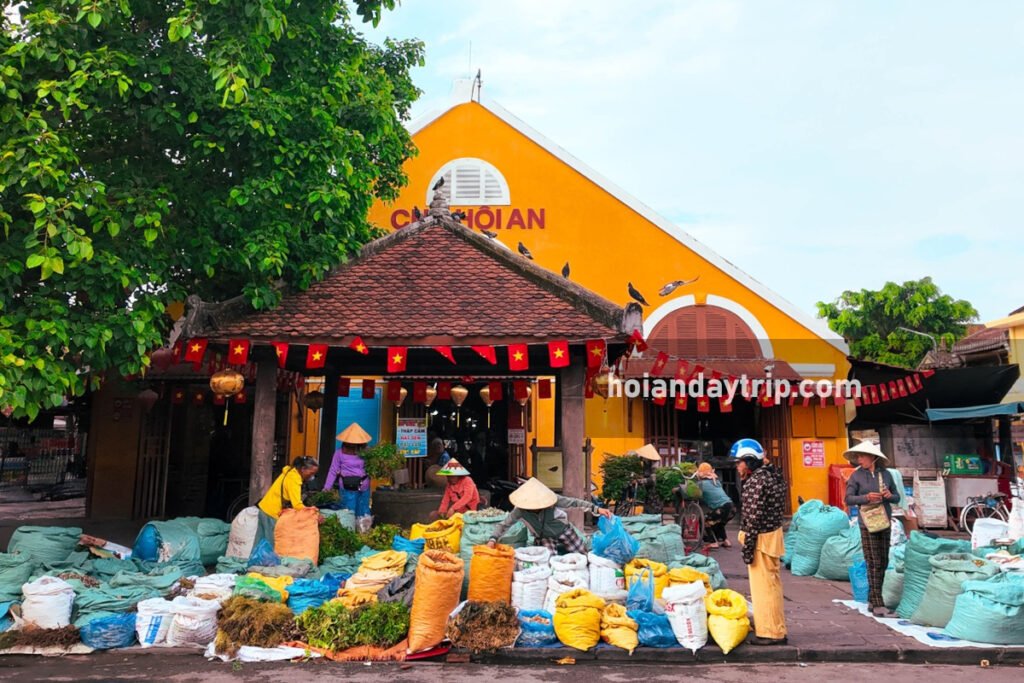
– Walk southwards and along Tieu La Street (east side of Hoi An Central Market). On this road, there are many vendors and stalls selling a diversity of local products, giving a good chance to know about local life and photograph.
– Walk westwards and along Bach Dang Street (the riverside street). On this road, visitors will see Hoi An Traditional Performance House (ticket required if want to watch shows) and Museum of Folklore (ticket required).
– Turn into Le Loi Street and then turn left, walking along Nguyen Thai Hoc Street. On this road, visitors will see Tan Ky Old House (one of the best heritage houses, ticket required) and Diep Dong Nguyen Old House (not yet opened to visitors, see from outside).
– The ending point: the crossroad near the north end of An Hoi Bridge or the west end of Nguyen Thai Hoc Street. In the evening, from here, visitors can walk cross the bridge and then turn right to see the entrance of the Hoi An Night Market, the biggest night market in Hoi An.
For more details and the map, please browse https://hoiandaytrip.com/hoi-an-self-guided-walking-tour
Guided Tours to Hoi An Ancient Town Vietnam
From Hoi An
– Hoi An Old Town Walking Tour – 2 Hour Express Tour with Local
– Hoi An Half Day Walking Tour with Traditional Art Performance
– Hoi An City Tour: Old Town, Coconut Village & Lunch
– Hoi An Morning Walking Tour with Local Breakfast & Coffee
– Hoi An Afternoon Walking Tour with Thu Bon River Sunset Cruise
– Hoi An Night Tour with Lantern Boat Ride & Dinner
– Hoi An History & Food Tour – Famous Landmarks & Specialty Dishes
– Hoi An Instagram Tour: Best Photo Spots & Rooftop Café
– Hoi An Old Town Food Tour with Night Boat Ride
– Hoi An Old Town Private Walking Tour with Local Expert
– Hoi An City Tour by Electric Car
HOIAN DAY TRIP CO.,LTD daily organizes tours in Hoi An and Da Nang. Contact us by +84968009827 (hotline/whatsapp/line/zalo) or browse www.hoiandaytrip.com to see tours and make a reservation. Thank you very much!
From Da Nang
– Hoi An Half Day Tour from Da Nang
– Hoi An Night Tour from Da Nang
– Hoi An Night Tour from Da Nang with Coconut Forest Basket Boat Ride
– Hoi An Night Tour from Da Nang with Hoi An Memories Show
– Marble Mountain & Hoi An Day Tour from Da Nang
– Marble Mountain & Hoi An Night Tour from Da Nang
– Hoi An Full Day Tour from Da Nang
– Hoi An City Tour from Airport
– Marble Mountain, Monkey Mountain & Hoi An Day Tour from Da Nang
– Hoi An Full Day Tour from Da Nang with Chinese Speaking Guide
– My Son Sanctuary & Hoi An Tour – World Heritage Site Tour
– Golden Bridge/Ba Na Hills Tour & Hoi An Tour from Da Nang
– Marble Mountain & Hoi An Tour from Da Nang Cruise Port
– Marble Mountain & Hoi An Tour from Chan May Cruise Port
– Marble Mountain & Hoi An Day Tour from Intercontinental Danang Resort
– Marble Mountain & Hoi An Day Tour from Lang Co
HOIAN DAY TRIP CO.,LTD daily organizes tours in Hoi An and Da Nang. Contact us by +84968009827 (hotline/whatsapp/line/zalo) or browse www.hoiandaytrip.com to see tours and make a reservation. Thank you very much!
Places to Visit near Hoi An Museum of History & Culture
– Bridges: Japanese Covered Bridge (Pagoda Bridge), Moonlight Bridge, An Hoi Bridge (Bridge of Lights), Cam Nam Bridge
– Museums: Museum of Sa Huynh Culture, Museum of Folklore, Museum of Trade Ceramics, Museum of Traditional Medicine, Hoi An Museum of History & Culture, Japanese Culture Gallery, Black Sesame Soup Demonstration, Museum of Local Products
– Chinese assembly halls: Cantonese Assembly Hall, Fujian Assembly Hall, Trung Hoa Assembly Hall, Hainan Assembly Hall, Teochew Assembly Hall
– Heritage houses: Tan Ky Old House, Phung Hung Old House, Duc An Old House, Quan Thang Ancient House, Diep Dong Nguyen House, Thai Phien Ancient House
– Temples & pagodas: Quan Cong Temple (Ong Pagoda), Ba Mu Temple, Phap Bao Pagoda, Quan Am Pagoda, Hoi An Confucius Temple, Cao Dai Temple of Hoi An, Hoi An Ancestral Temple, Cam Pho Confucius Temple, Minh Huong Confucius Temple, Vien Giac Pagoda, Hy Hoa Temple
– Family chapels: Tran Family Chapel, Nguyen Tuong Family Chapel
– Communal houses: Cam Pho Communal House, Hoi An Communal House, Minh Huong Communal House, Tu Le Communal House, Xuan Lam Communal House, Son Phong Communal House
– Markets: Hoi An Central Market, Hoi An Cloth/Fabric Market, Hoi An Night Market (Nguyen Hoang Night Market), Cam Pho Market
– Theatres: Hoi An Traditional Art Performance House, Hoi An Lune Center for Performing Arts (now where Teh Dar Show takes place), Hoi An Memories Land Theme Park (now where Hoi An Memories Show takes place)
– Famous streets: Tran Phu Street, Phan Chu Trinh Street, Nguyen Thai Hoc Street, Bach Dang Street/Wharf, Nguyen Thi Minh Khai Street, Hoi An Lantern Streets
– Other points of interest: Red Seal Ship Model, Hoi An Evanlegical Church, Thong Dang Prison & Park, Kazik Park (Memory Statue of Kazimierz Kwiatkowski), Hoai River (Hoi An River), Song Hoai Square, An Hoi Sculpture Park, Hoi An Catholic Church, Hoi An Prison, Hoi An Central Park, Ba Le Well, Hoi An Lantern Park, An Hoi Island, Cam Nam Island, Thu Bon River, Da Ken Tree
Photos, Videos about Hoi An Museum of History & Culture
Here are beautiful photos and videos about Hoi An Museum of History & Culture in Hoi An: