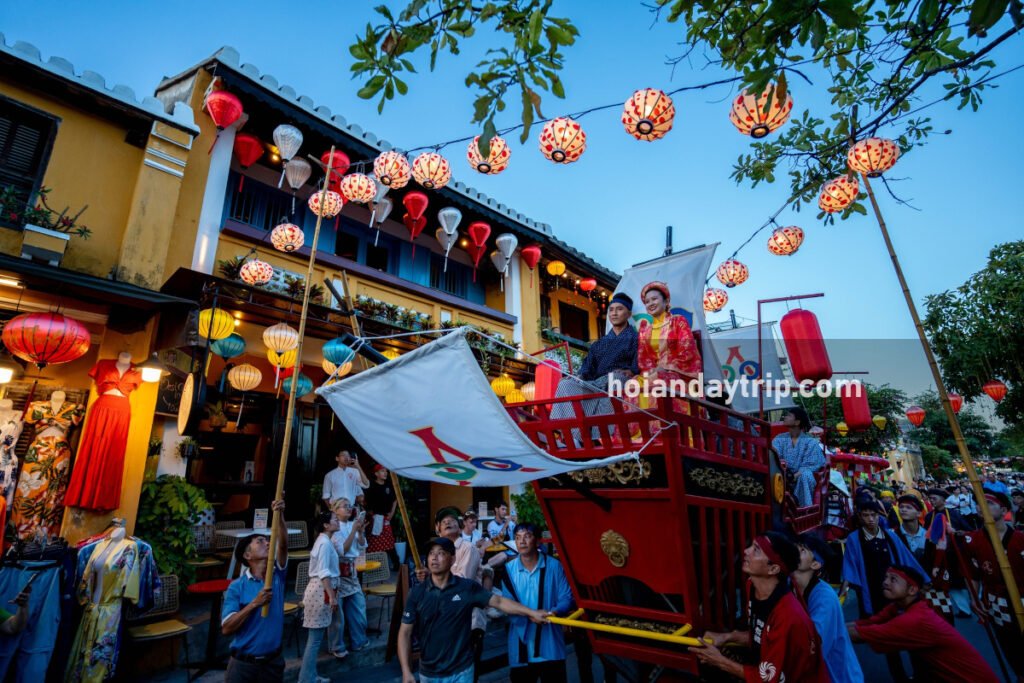
The Hoi An Communal House is the most important place for the Vietnamese community in the Hoi An Old Town. The whole town is named after the village where it’s centered. Here, many gods and goddesses have been worshipped. Stories and mythologies about them are really awesome to learn about. About architecture . Now, let’s HoiAn Day Trip Company tell you everything that you need to know about the Hoi An Communal House.
You may also like: Hoi An Communal House, Minh Huong Communal House
• Content by Tam Le, founder of HOIAN DAY TRIP CO.,LTD
• Designed by Giang Cong Minh, co-founder of LS E&C LTD and his team
• Photo by Dang Cong Loi, Dao Xuan Son, Tam Le & others
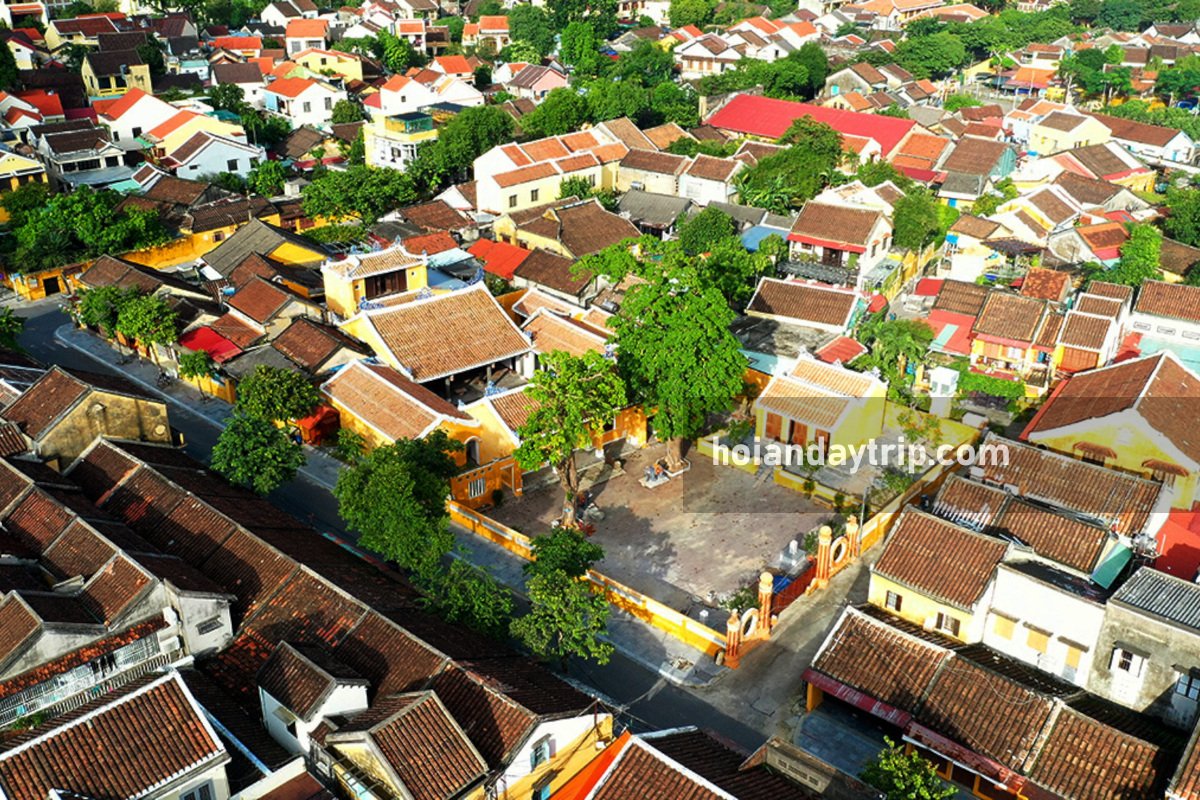
Must Knows about Hoi An Communal House
– Location/Address: 27 Le Loi St, Hoi An ward, Hoi An city, Quang Nam province, Vietnam
– Name meaning: Hoi An means ‘peaceful meeting place’
– How to pronounce:
– Other name(s): the Elephant Communal House, Dinh Lang Hoi An
– Opening hours: 7 am to 7 pm daily
– Ticket price: free
– Reason(s) to visit:
– Best time to visit: anytime during the day
– Time to spend: 15-20 mins
– Travel blog: https://hoiandaytrip.com/hoi-an-communal-house
– Recognition(s): provincial cultural heritage
– Food & drink: not available
– Shopping: not available
– Fact: a kindergarten here once it’s restored and reopened to visitors
Hoi An Communal House on Map
History of Hoi An Communal House
The Hoi An Communal House was built in the 15th century by the Vietnamese community living in Hoi An village, one of the oldest villages in the town. The whole town was named after it. Hoi An means ‘peaceful meeting place’. In the 1960s, due to the war, many locals came to this place to live. They gave it a nickname ‘Elephant Communal House’ because there is a pair of stone elephants standing at its entrance.
In 1818, the Hoi An Communal House was restored for the first time. In 1907, it’s moved to its current location on Le Loi St. In 1942, some buildings were added into its ground, and since then, its architecture was nearly unchanged. After Vietnam reunification, this communal house was restored in 1996, 2007, and 2020.
From 1981 to 2019, the Hoi An Communal House accommodated a kindergarten. In 2020, it served as an office of local police force. In many times between 1975 and 2020, teaching and learning activities occurred here, besides some communal activies.
At the Hoi An Communal House, the local community has been worshipping many gods and goddesses. In history, Vietnamese emperors conferred them great titles. Today, this building still preserves 16 official imperial sheets showing information about them.
The main deity is the Four Holy Mothers/Queens (Tu Vi Thanh Cuong) or Dai Can Goddess. According to ‘Recent Records of O Chau’ written by Duong Van An in 1553, this goddess is the princess of the Southern Tong dynasty (1127-1279). The Four Holy Mothers/Queens include herself, her sisters and her mother. One day, their family are chased (to kill) to the sea, and then have to jump into the water to escape. Fortunately, they grab a boat plank and drift to a Buddhist temple. Later, monks here rescue and take care of them. Because the princess looks beautiful, a monk becomes sexually immoral. She refuses sleeping with him, making him feel so ashamed and then kills himself by jumping into the sea. As think that he was the one saving their lives before, they choose the same way to die. Their bodies are washed ashore along the Vietnamese coast, and after seeing them, local people build a temple to worship them (it’s Con Temple in Nghe An province). During the history, these goddesses appear and help kings to defeat invaders or bless fisherman safe trips on the ocean.
Other deities are worshipped at the Hoi An Communal House are Thanh Hoang (the City God or God of the Moat and the Walls), Ngu Hanh Tien Nuong (the Five Element Fairy Ladies), Phiem Ai Goddess, Tho Dia (Lord of the Land), Bach Ma (the White Horse God), Bo Bo Goddess, Bach Tho Kim Tinh (the White Rabbit Golden Star). Here are some information about them:
– The Five Element Fairy Ladies: include Kim Duc Thanh Phi goddess (white, west), Moc Duc Thanh Phi goddess (green, east), Thuy Duc Thanh Phi goddess (black, north), Hoa Duc Thanh Phi goddess (red, south) and Tho Duc Thanh Phi goddess (yellow, central). This traditional belief originates from the Five elements theory in China and matriarchy culture of Vietnamese and Cham people in the area. The goddesses bless good weather, good harvest, good health and good life.
– Phem Ai Goddess (or Phuong Chao Goddess, Cho Duoc Goddess): She was Nguyen Thi Cua, borned in 1800 at Phuong Chao village, Phien Ai commune (today Dai Loc district). In 1819, she passed away. People in her hometown and in the village where she opened a market (Cho Duoc Market), built temples to worship her. According to them, she appeared many times to save people, and punish wicked persons.
On 15th December 2021, the Communal House of Hoi An was inscribed to be the provincial cultural heritage of Quang Nam.
The most important events in the communal hall are the spring ceremony on the 10th day of the third lunar month (te xuan) and the autumn ceremony on the 10th day of the eight lunar month (te thu).
HOIAN DAY TRIP Company daily organizes tours and transfers to Hoi An Old Town. Contact us by +84968009827 (hotline/whatsapp/line/zalo) or hoiandaytripcompany@gmail.com or browse www.hoiandaytrip.com to see tours and make a reservation. Thank you very much!
Architecture of Hoi An Communal House
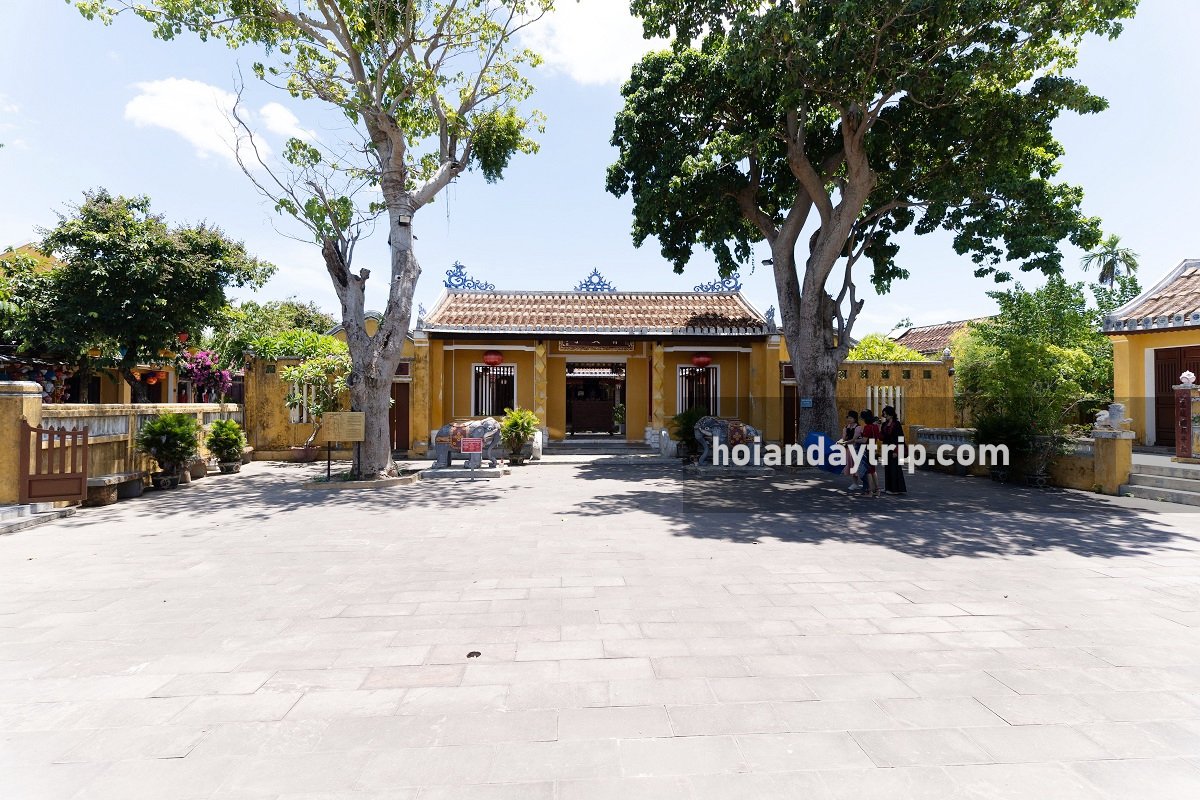
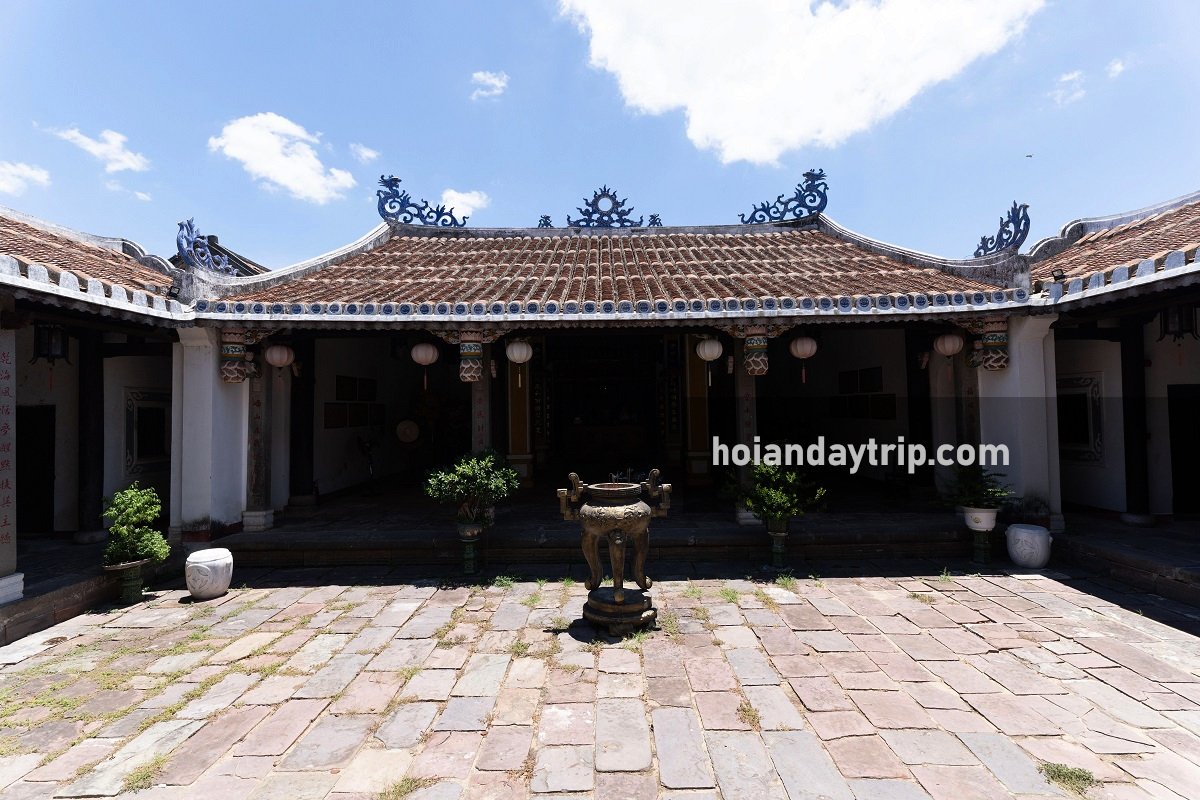
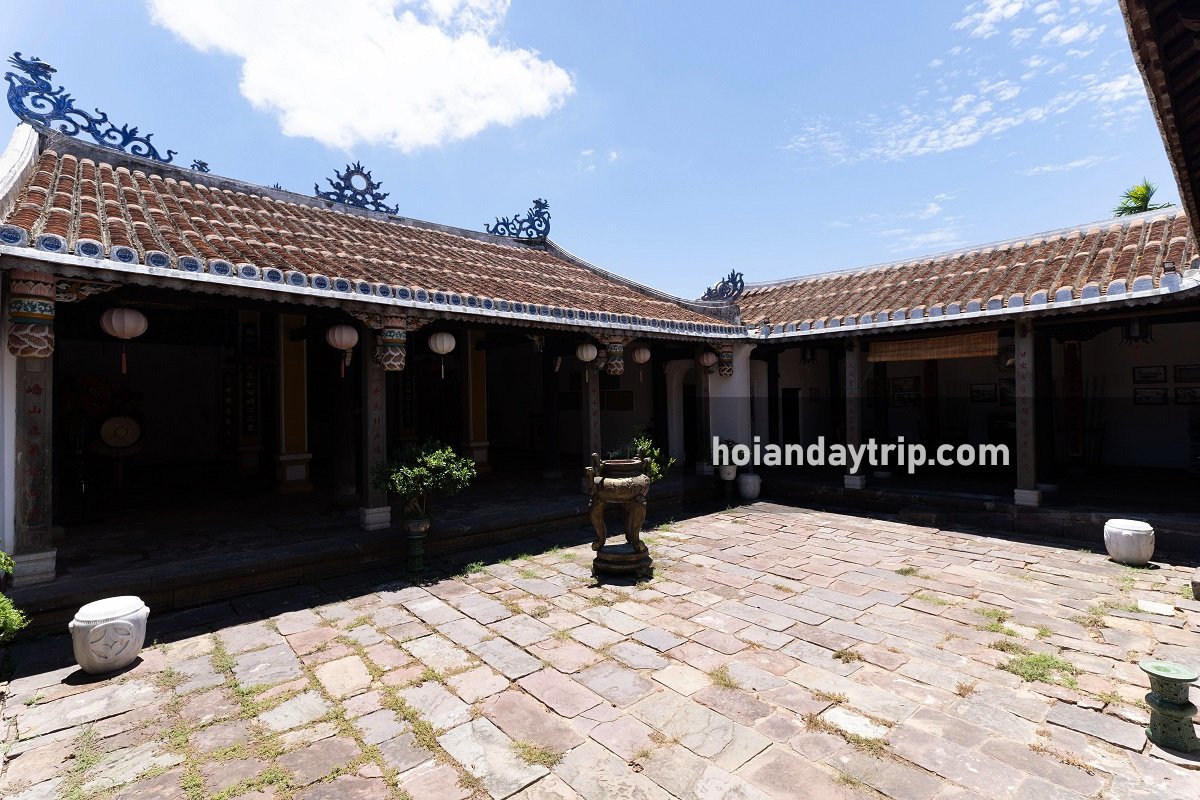
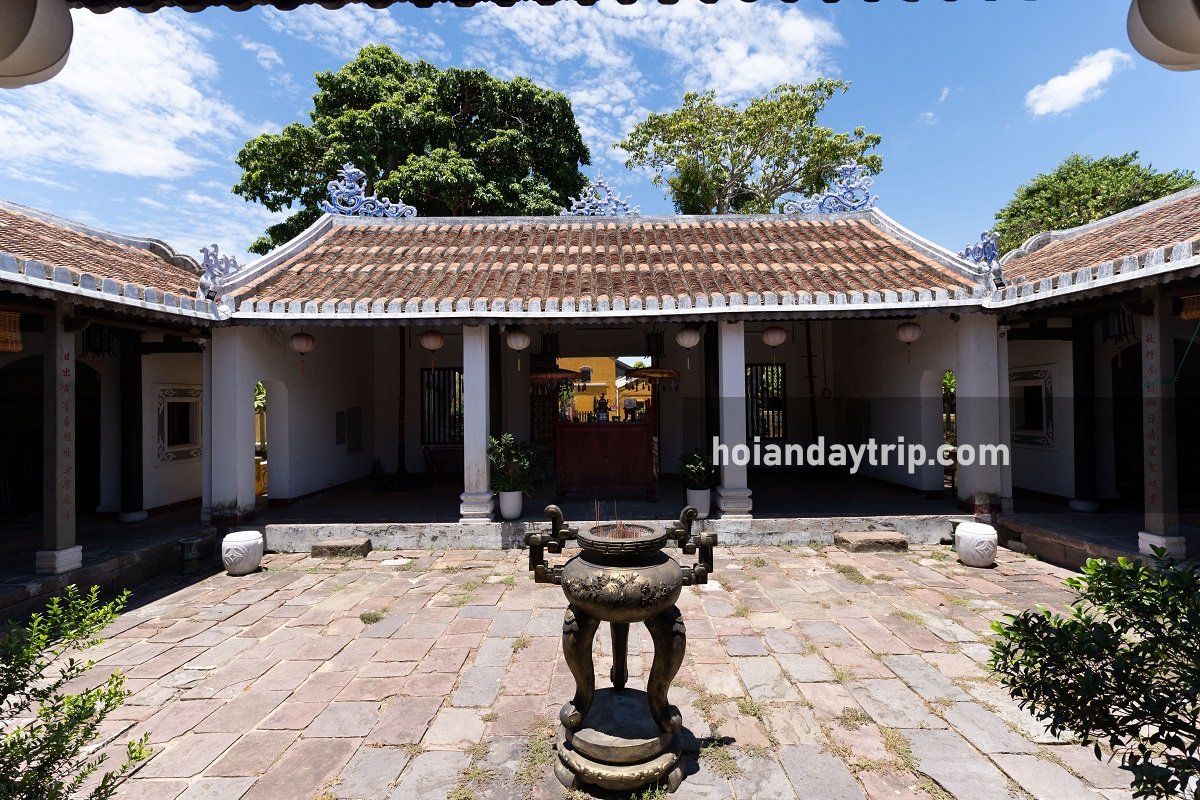
Within an area of 1,320 m2, the Hoi An Communal House has many buildings, including the Entrance Gate, the Goddess Temple, the Entrance Hall, the East House and the West House, the Main Worshipping Hall, the Back Hall.
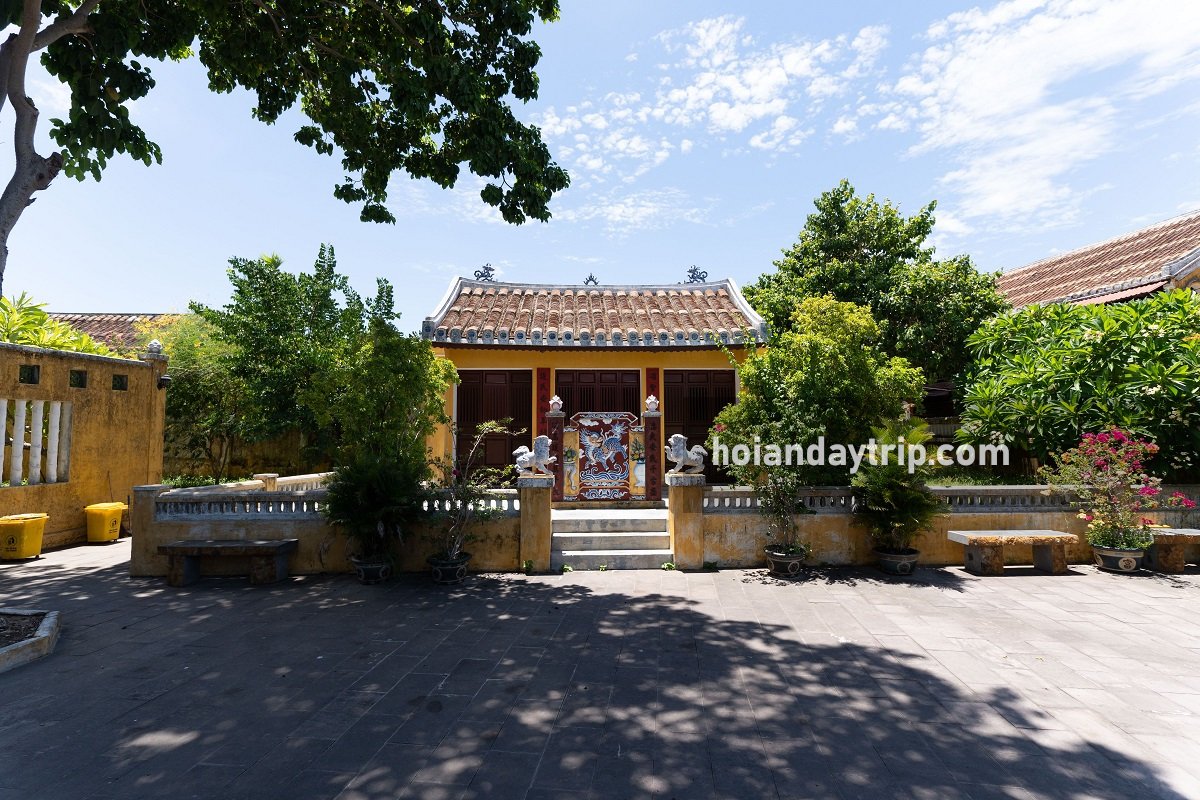
The Goddess Temple is on the right hand side of the yard behind the main gate. It’s dedicated to worship of Phuong Chao Goddess, the City God (Thanh Hoang) and the Five Element Fairy Ladies (Ngu Hanh Tien Son). It has a screen in the front, to protect it from evils and devils from outside. Its decoration features an unicorn between a tray of fruits and a vase of flowers.
There are two stone elephants, two tall and old trees in the front of the Entrance Hall. This Hall has only an entrance in the middle, with a board of 3 Chinese words meaning ‘Communal House of Hoi An (village)’. Its roof is covered by tiles and decorated by rising dragons and the sun.
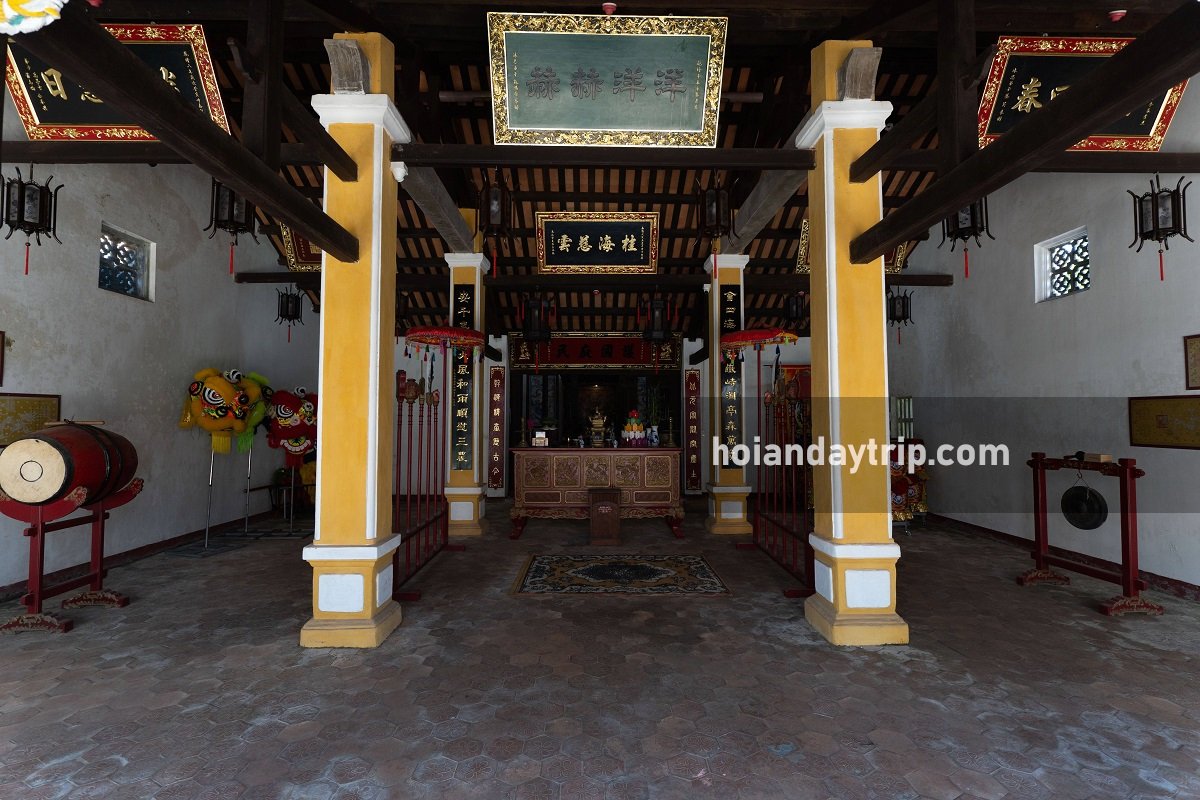
After the Entrance Hall, there is a courtyard, the East House, the West House and the Main Worshipping Hall. This hall is used to honor Dai Can Goddess (or the Four Holy Mothers/Queens), the main deity. Behind it, the Back Hall has altars to worship other gods and goddesses.
HOIAN DAY TRIP Company daily organizes tours and transfers to Hoi An Old Town. Contact us by +84968009827 (hotline/whatsapp/line/zalo) or hoiandaytripcompany@gmail.com or browse www.hoiandaytrip.com to see tours and make a reservation. Thank you very much!
Tips to Visit Hoi An Communal House
– To see Hoi An Communal House, visitors need to buy a ‘Hoi An Old Town ticket’ because it’s within Unesco world heritage area. However, don’t have to show the ticket and the entry to 5 attractions still remains. The nearest ticket office is on Le Loi St, right next to this building. See more information & details
– Visitors need to wear respectively if want to visit Hoi An Communal House because it’s a holy site. In other words, it’s needed to wear long pants or shorts covering upper knees, T-shirts or shirts covering armpits, navel, shoulder and breast.
– Vietnamese traditional costume ao dai dress is highly recommended. Any garment made of see-through material is not respectful.
– In the dry season, from February to the end of August, visitors should bring sun cream, hat/cap/umbrella, sun glasses, and bottles of water to drink. If don’t have, it’s easy to buy at shops near the Hoi An Communal House.
– In the rainy season, from September to January, visitors should bring rain poncho/jacket or umbrella, sandals or waterproof shoes. Don’t forget to check the weather forecast usually when traveling during this period.
– From October to December, the town may be flooded, so visitors need to keep updating the weather before going to Hoi An.
– The best way to visit the Hoi An Old Town is walking, so make sure that you have good/comfortable shoes or sandals.
– Smartphone or camera is needed for taking pictures. For more experiences, visitors can consider renting Vietnamese traditional costume (for example, ao dai long dress for ladies) or even booking a private photographer.
– Don’t forget bringing cash to pay for entry fee tickets and small things because many places in Vietnam don’t accept payment by cards.
– Toilets are near the second gate (outside) and behind the second worshipping area. Visitors may give a small money to pay for cleaning (usually 5,000 VND).
– There are many chairs and seats inside Hoi An Communal House, to have a break and learn about the history of the place.
– It’s better to visit Hoi An Communal House with a local guide. Contact us by +84968009827 (hotline/whatsapp/line/zalo) if need a professional guide in Hoi An.
HOIAN DAY TRIP Company daily organizes tours and transfers to Hoi An Old Town. Contact us by +84968009827 (hotline/whatsapp/line/zalo) or hoiandaytripcompany@gmail.com or browse www.hoiandaytrip.com to see tours and make a reservation. Thank you very much!
How to Get to Hoi An Communal House
The Hoi An Communal House is at 27 Le Loi street, Minh An ward, Hoi An, Vietnam. It lies within the Hoi An Ancient Town world heritage site area.
From Hoi An, visitors can go to the Hoi An Communal House by walking, bicycle, motorcycle, taxi/car, electric bus, shuttle bus of the hotel/resort, cyclo, bus/minivan. This building is in the pedestrian zone during many hours of the day (9-11:30 am, 3 to 9:30 pm), so it’s still needed to have a short walk if don’t cycle. The nearest place to drop off or park if go by car/taxi is the crossroad of Le Loi St and Tran Hung Dao St (near the Hoi An Museum of History & Culture). The nearest place to drop off or park if go by motorbike is the crossroad of Le Loi St and Phan Chu Trinh St (near the Tran Family Chapel). The parking fee is 5,000-10,000 VND/bike/time.
From Da Nang, the distance to the Hoi An Communal House in Hoi An is some 30 kilometers, to the south. Visitors often choose a car or ride the motorbike by themselves. Contact us by +84968009827 (hotline/whatsapp/zalo/line) to book a private roundtrip transfer by car.
HOIAN DAY TRIP Company daily organizes tours and transfers to Hoi An Old Town. Contact us by +84968009827 (hotline/whatsapp/line/zalo) or hoiandaytripcompany@gmail.com or browse www.hoiandaytrip.com to see tours and make a reservation. Thank you very much!
Itinerary to Visit Hoi An Old Town for First Timer
First of all, to enter and visit the Hoi An Old Town (the part inscribed by Unesco), visitors need to buy an entry ticket. Its price is 120,000 VND per adult and children above 15 years old and free of charge for smaller kids. Entry to 5 attractions is also included for free. See more information & details
If possible, first time visitors should go with a local guide, to know better about history and culture. Contact us by +84968009827 (call/whatsapp) to book a private English-speaking guide.
We suggest this itinerary for first timers:
Total distance: 1,65 kilometers
– Starting point: the Japanese style gate (the west end of Nguyen Thi Minh Khai Street). A model of the Red Seal Ship Model (Japanese merchant’s ship) and a ticket office are in a close distance.
– Walk along Nguyen Thi Minh Khai Street. On this road, visitors will have the chance to sightsee Cam Pho Communal House (ticket required), Japanese Culture Gallery (ticket required), Phung Hung Old House (one of the best heritage houses, ticket required), Nguyen Tuong Family Chapel (in the alleyway, ticket required).
– Visit the Japanese Covered Bridge, the symbol of Hoi An. This place definitely is a must see attraction.
– Walk along Tran Phu Street, the most beautiful road in Hoi An, until Hoi An Central Market. On this road, visitors will have the chance to sightsee so many historical attractions. From the bridge to the market, there are Cantonese Assembly Hall (ticket required), Museum of Sa Huynh Culture (ticket required), Duc An Old House (ticket required), Kazik Park (free), Quan Thang Old House (ticket required), Museum of Trade Ceramics (ticket required), Trung Hoa Assembly Hall (ticket required), Fujian Assembly Hall (ticket required), Quan Cong Temple (ticket required), Quan Am Pagoda (ticket required), Hoi An Central Market (free to enter), a couple of rooftop coffee shops, Instagrammable spots, shophouses selling lanterns, food, souvenirs and fashion items.
– Walk southwards and along Tieu La Street (east side of Hoi An Central Market). On this road, there are many vendors and stalls selling a diversity of local products, giving a good chance to know about local life and photograph.
– Walk westwards and along Bach Dang Street (the riverside street). On this road, visitors will see Hoi An Traditional Performance House (ticket required if want to watch shows) and Museum of Folklore (ticket required).
– Turn into Le Loi Street and then turn left, walking along Nguyen Thai Hoc Street. On this road, visitors will see Tan Ky Old House (one of the best heritage houses, ticket required) and Diep Dong Nguyen Old House (not yet opened to visitors, see from outside).
– The ending point: the crossroad near the north end of An Hoi Bridge or the west end of Nguyen Thai Hoc Street. In the evening, from here, visitors can walk cross the bridge and then turn right to see the entrance of the Hoi An Night Market, the biggest night market in Hoi An.
For more details and the map, please browse https://hoiandaytrip.com/hoi-an-self-guided-walking-tour
Guided Tours to Hoi An Ancient Town Vietnam
From Hoi An
– Hoi An Old Town Walking Tour – 2 Hour Express Tour with Local
– Hoi An Half Day Walking Tour with Traditional Art Performance
– Hoi An City Tour: Old Town, Coconut Village & Lunch
– Hoi An Morning Walking Tour with Local Breakfast & Coffee
– Hoi An Afternoon Walking Tour with Thu Bon River Sunset Cruise
– Hoi An Night Tour with Lantern Boat Ride & Dinner
– Hoi An History & Food Tour – Famous Landmarks & Specialty Dishes
– Hoi An Instagram Tour: Best Photo Spots & Rooftop Café
– Hoi An Old Town Food Tour with Night Boat Ride
– Hoi An Old Town Private Walking Tour with Local Expert
– Hoi An City Tour by Electric Car
HOIAN DAY TRIP CO.,LTD daily organizes tours in Hoi An and Da Nang. Contact us by +84968009827 (hotline/whatsapp/line/zalo) or browse www.hoiandaytrip.com to see tours and make a reservation. Thank you very much!
From Da Nang
– Hoi An Half Day Tour from Da Nang
– Hoi An Night Tour from Da Nang
– Hoi An Night Tour from Da Nang with Coconut Forest Basket Boat Ride
– Hoi An Night Tour from Da Nang with Hoi An Memories Show
– Marble Mountain & Hoi An Day Tour from Da Nang
– Marble Mountain & Hoi An Night Tour from Da Nang
– Hoi An Full Day Tour from Da Nang
– Hoi An City Tour from Airport
– Marble Mountain, Monkey Mountain & Hoi An Day Tour from Da Nang
– Hoi An Full Day Tour from Da Nang with Chinese Speaking Guide
– My Son Sanctuary & Hoi An Tour – World Heritage Site Tour
– Golden Bridge/Ba Na Hills Tour & Hoi An Tour from Da Nang
– Marble Mountain & Hoi An Tour from Da Nang Cruise Port
– Marble Mountain & Hoi An Tour from Chan May Cruise Port
– Marble Mountain & Hoi An Day Tour from Intercontinental Danang Resort
– Marble Mountain & Hoi An Day Tour from Lang Co
HOIAN DAY TRIP CO.,LTD daily organizes tours in Hoi An and Da Nang. Contact us by +84968009827 (hotline/whatsapp/line/zalo) or browse www.hoiandaytrip.com to see tours and make a reservation. Thank you very much!
Places to Visit near Hoi An Communal House
– Bridges: Japanese Covered Bridge (Pagoda Bridge), Moonlight Bridge, An Hoi Bridge (Bridge of Lights), Cam Nam Bridge
– Museums: Museum of Sa Huynh Culture, Museum of Folklore, Museum of Trade Ceramics, Museum of Traditional Medicine, Hoi An Museum of History & Culture, Japanese Culture Gallery, Black Sesame Soup Demonstration, Museum of Local Products
– Chinese assembly halls: Cantonese Assembly Hall, Fujian Assembly Hall, Trung Hoa Assembly Hall, Hainan Assembly Hall, Teochew Assembly Hall
– Heritage houses: Tan Ky Old House, Phung Hung Old House, Duc An Old House, Quan Thang Ancient House, Diep Dong Nguyen House, Thai Phien Ancient House
– Temples & pagodas: Quan Cong Temple (Ong Pagoda), Ba Mu Temple, Phap Bao Pagoda, Quan Am Pagoda, Hoi An Confucius Temple, Cao Dai Temple of Hoi An, Hoi An Ancestral Temple, Cam Pho Confucius Temple, Minh Huong Confucius Temple, Vien Giac Pagoda, Hy Hoa Temple
– Family chapels: Tran Family Chapel, Nguyen Tuong Family Chapel
– Communal houses: Cam Pho Communal House, Hoi An Communal House, Minh Huong Communal House, Tu Le Communal House, Xuan Lam Communal House, Son Phong Communal House
– Markets: Hoi An Central Market, Hoi An Cloth/Fabric Market, Hoi An Night Market (Nguyen Hoang Night Market), Cam Pho Market
– Theatres: Hoi An Traditional Art Performance House, Hoi An Lune Center for Performing Arts (now where Teh Dar Show takes place), Hoi An Memories Land Theme Park (now where Hoi An Memories Show takes place)
– Famous streets: Tran Phu Street, Phan Chu Trinh Street, Nguyen Thai Hoc Street, Bach Dang Street/Wharf, Nguyen Thi Minh Khai Street, Hoi An Lantern Streets
– Other points of interest: Red Seal Ship Model, Hoi An Evanlegical Church, Thong Dang Prison & Park, Kazik Park (Memory Statue of Kazimierz Kwiatkowski), Hoai River (Hoi An River), Song Hoai Square, An Hoi Sculpture Park, Hoi An Catholic Church, Hoi An Prison, Hoi An Central Park, Ba Le Well, Hoi An Lantern Park, An Hoi Island, Cam Nam Island, Thu Bon River, Da Ken Tree
Photos, Videos about Hoi An Communal House
Here are beautiful photos and videos about Hoi An Communal House: