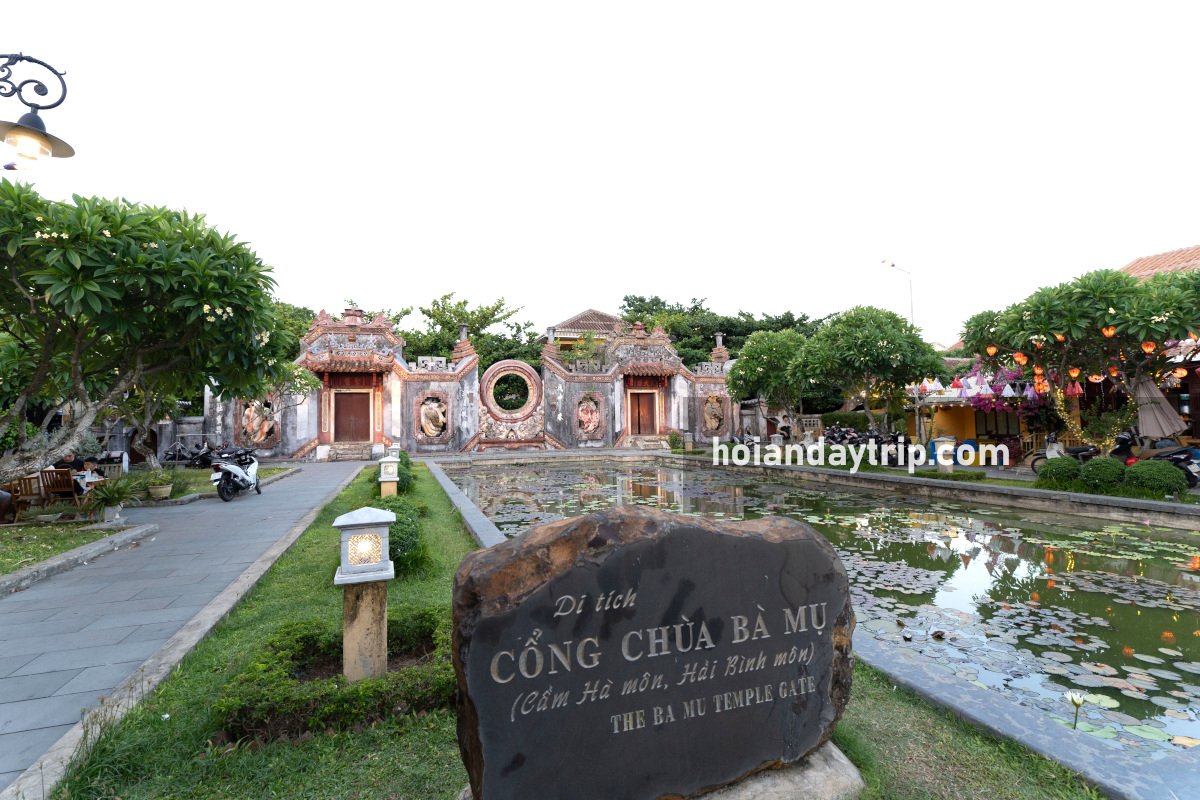
Ba Mu Temple used to be one of the greatest monuments in Hoi An Old Town. Today, only its entrance gate remains. After the renovation that happened a few years ago, Ba Mu Temple Gate became an Instagrammable spot. Both daytime and nighttime, this heritage building is lovely and perfect for taking pictures. Now, let’s HoiAn Day Trip Company tell you everything that visitors need to know about Ba Mu Temple in Hoi An.
You may also like: Hoi An Temples and Pagodas
• Content by Tam Le, founder of HOIAN DAY TRIP CO.,LTD
• Designed by Giang Cong Minh, co-founder of LS E&C LTD and his team
• Photo by Dang Cong Loi, Dao Xuan Son, Tam Le & others
Must Knows about Ba Mu Temple (Hoi An)
– Location/Address: 675 Hai Ba Trung St, Minh An ward, Hoi An city, Quang Nam province, Vietnam
– Name meaning: Ba Mu means ‘(12) midwives’
– Other name(s): Ba Mu Pagoda, Ba Mu Temple Gate, Triple Gate of Ba Mu Pagoda
– Opening hours: 24hrs a day, 7 days a week
– Ticket price: free
– Reason(s) to visit: one of the most stunning heritage buildings in Hoi An, popular Instagrammable spot in Hoi An
– Best time to visit: early morning, evening
– Time to spend: 15-30 mins
– Travel blog: https://hoiandaytrip.com/ba-mu-temple-hoi-an
– Recognition(s): Unesco world heritage site (1999)
– Tour guide: contact +84968009827 (hotline/whatsapp/line/zalo)
– Food & drink: yes available
– Shopping: yes available
– Fact: Vietnamese people call this building as a pagoda but no Buddha is worshipped here
Ba Mu Temple on Map
Better to Know about Ba Mu (Twelve Midwives)
Worshipping Ba Mu or the Twelve Midwives is a folk belief of Chinese and Vietnamese communities in Hoi An. Besides the Ba Mu Temple, these ladies are also honored at the second worshipping hall of the Fujian Assembly Hall. Each one of them holds a job in birth and foster care. They are:
- Tran Tu Nuong (childbirth)
- Van Tu Nuong (pregnancy)
- Lam Tu Nuong (conception)
- Luu That Nuong (shaping male or female form for the baby)
- Lam Nhat Nuong (care of the fetus)
- Ly Dai Nuong (labor)
- Hua Dai Nuong (opening of flowers and pistils)
- Cao Tu Nuong (confinement)
- Tang Ngu Nuong (take care of newborn babies)
- Ma Ngu Nuong (take care of baby’s holding)
- Truc Ngu Nuong (take care of holding the baby)
- Nguyen Tam Nuong (witnessing and supervising the birth)
In the mythology, three sisters Van Tieu, Bich Tieu, and Quynh Tieu are students of Quy Linh Thanh Mau (or the Saint Mother of the Golden Spirit). Because their younger brother was killed by Jiang Ziya (12th century BC, military general/monarch), so they wanted revenge through a battle which may have caused the death of many soldiers of the Zhou dynasty in China. Later, they failed and died. When Jiang Ziya invests gods and goddesses under request of the Jade Emperor, these women became the Three fairies and helped 12 midwives to take care of newborns.
In some places, people believe that midves of the Twelve Midwives create ears, eyes, mouths,… or teach babies to smile, cry, eat, stand up or walk. When the baby is 3 days old, parents must prepare a tray of offspring for the midwives. When he or she is one month old, 100 days old, and one year old, it’s needed to do the same to thank them.
In Hoi An, at the Fujian Assembly Hall, on the 1st day of the second lunar month, local people bring offsprings to the Twelve Midwives. They want to pray for safe pregnancy, healthy childs, giving birth smoothly, many children or for a son. On the next day, the main ceremony takes place, and after that, food and gifts will be given to kids in the community.
HOIAN DAY TRIP Company daily organizes tours and transfers to Hoi An Old Town. Contact us by +84968009827 (hotline/whatsapp/line/zalo) or hoiandaytripcompany@gmail.com or browse www.hoiandaytrip.com to see tours and make a reservation. Thank you very much!

History of Ba Mu Temple in Hoi An
Cam Hai Nhi Cung (meaning ‘Cam Hai Twin Temples’) or Ba Mu Temple in Hoi An was built in 1626 by Chinese people, but later moved to its current location. Although the exact year was not found yet, some historians believe that it’s moved in 1686.
Ba Mu Temple actually comprised a pair of temples, and each had its own entrance. Cam Ha Cung Temple was to the left, used to worship Baosheng Dadi (Chinese God of Medicine), Taishan Laoyun (the Supreme Venerable Sovereign), Xuantian Shangdi (the Black or Mysterious Heavenly Highest Deity) and 36 military generals investitured to gods in Chinese history. The Black Emperor is linked with Chinese and Japanese belief in a water monster which causes flooding in town yearly.
Hai Binh Cung Temple was to the right, used to worship Thien Hau Goddess (Chinese Goddess of Sea) and the Twelve Midwives (generally called Ba Mu). The goddess is the patron saint of all Chinese communities because she blesses safe voyages for merchants and seafarers.
Vietnamese people normally called Cam Ha Cung Temple as ‘Uncle Pagoda’ (Chua Ong Chu) because its main deity as god, and Hai Binh Cung Temple as ‘Midwive Pagoda’ (Chua Ba Mu) because its main deity as goddess. By the way unexplained clearly, ‘Midwive Pagoda’ became a common name for the whole complex in Hoi An, and has been lived up to date.
The name of Cam Hai Twin Temples are combined by first words of its temples, Cam Ha and Hai Binh. Furthermore, the name of Cam Ha Temple is a combination between Cam Pho and Thanh Ha communes because it’s built on their border line.
In 1922, in the reign of Khai Dinh king, Ba Mu Temple was restored (last time in Vietnamese feudal period). This information was mentioned on a memorial stele at Quan Am Pagoda at 13 Nguyen Hue St.
In 1930, French people added three monuments of Hoi An into Indochina Federation’s typical heritage list, including Ba Mu Temple (French: Pagode de la Maternitéouou Temple), the Japanese Bridge, and the Teochew Assembly Hall. The temple was one of the greatest buildings in town at that time.
During the French and American wars, religious activities at Ba Mu Temple were interrupted. Due to fire and lack of maintenance, it’s heavily damaged and then collapsed. This was a sad event for local communities in which they could not save their ancestor’s cultural heritage. In 1965, a buddhist school was established here. In front of its gate, there was a small camp of the United States army.
Over time, only the entrance gate of Ba Mu Temple remains. All buildings behind it were burnt by fire and destroyed by wars. In 2000, the remaining gate was documented by the local authorities, after Hoi An became a Unesco world heritage site. In 2005, Nguyen Duy Dieu secondary school was built on the ruins of temples. In 2007, Hoi An city invested in research about the gate and two years later, the renovation started. Twenty-four temporary houses were removed to build the park and lotus pond in its front. The cost of the whole project was 6,5 billions Vietnamese dong.
In December 2018, restoration at Ba Mu Temple Gate was done. On 4th December 2018, a ceremony took place here to inaugurate and open it to the public, on occasion of the 19th anniversary of Hoi An Ancient Town world heritage recognition.
HOIAN DAY TRIP Company daily organizes tours and transfers to Hoi An Old Town. Contact us by +84968009827 (hotline/whatsapp/line/zalo) or hoiandaytripcompany@gmail.com or browse www.hoiandaytrip.com to see tours and make a reservation. Thank you very much!
Architecture of Ba Mu Temple’s Gate
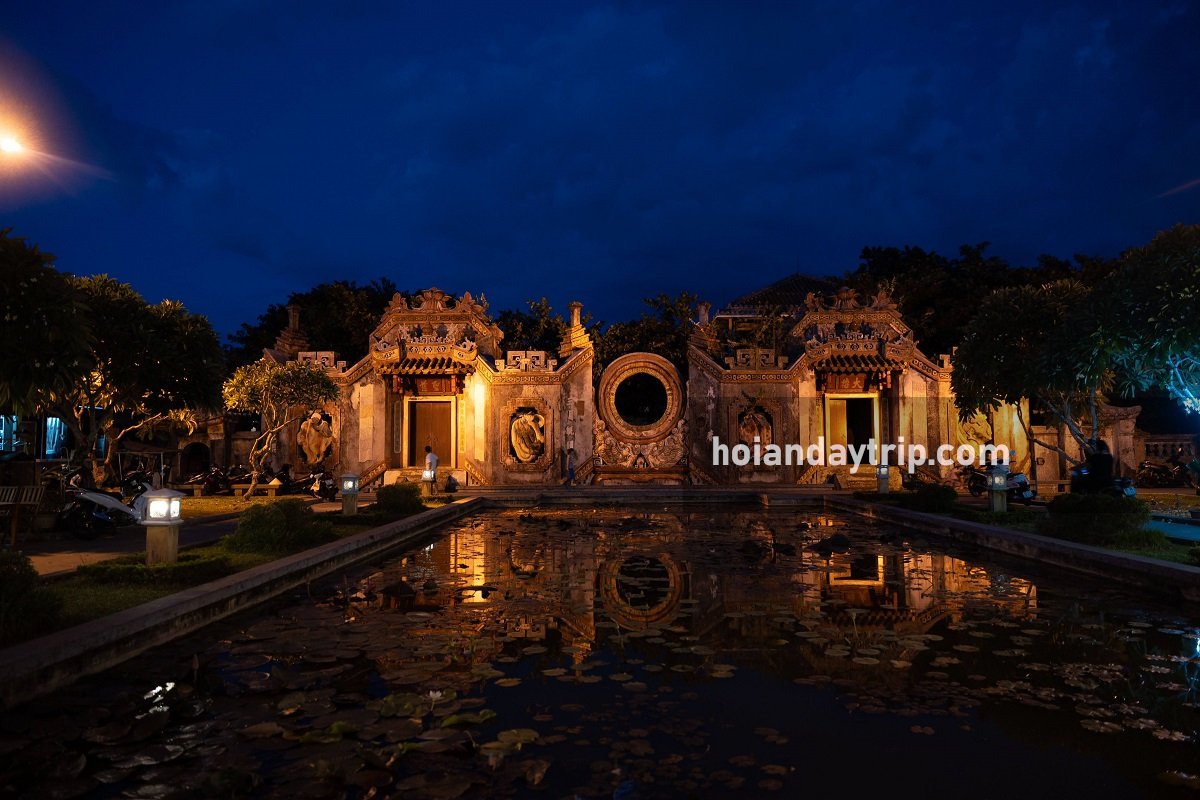
Ba Mu Temple Gate was designed by a male mandarin Truong Chi Thi (commonly the designer was unknown). This three-arched gate has two doors, all closed now because of a school behind. Generally, it looks like a sheet of paper rolled at both ends (cuon thu), making it different from any other gates in town. In the middle, there is a circle depicting the full moon which symbolizes the fullness, completeness, perfection, and union. On the full moon night monthly, local people in Hoi An celebrate the Lantern Festival with tourists. Mangos and Buddha’s hand fruit are used to decorate the gate.
In the front, a rectangular water lily pond is designed, bringing such beautiful reflections of the antique building on its surface, at any time of the day. Thanks to unique architecture, many visitors come to Ba Mu Temple Gate to take photos, especially ones wearing Vietnamese traditional costume ao dai and conical hats. No doubt, this is one of the most Instagrammable spots in Hoi An.
At night, Ba Mu Temple Gate becomes glorious and attractive when it’s lit by golden lights. The reflection on the pond is lovely again. Here, there are a couple of café, restaurants, and cocktail bars where visitors can have food/drink with a view to the whole park. The atmosphere is definitely laid-back and romantic.
HOIAN DAY TRIP Company daily organizes tours and transfers to Hoi An Old Town. Contact us by +84968009827 (hotline/whatsapp/line/zalo) or hoiandaytripcompany@gmail.com or browse www.hoiandaytrip.com to see tours and make a reservation. Thank you very much!
Tips to Visit Ba Mu Temple in Hoi An
– Although visitors can freely go to Ba Mu Temple because it lies within the Hoi An Old Town world heritage site area. The ticket price to enter the town is 120,000 VND each for adults and children above 15 years old. A ticket office is right in its entrance on Hai Ba Trung St. This temple is not in the list of over 20 heritage buildings that require showing the ticket, so visitors still can go to 5 of them as usual. See more information & details
– Ba Mu Temple in Hoi An today is not a living temple, so visitors don’t have a chance to pray or do ceremonies here. Instead, can go to the Fujian Assembly Hall at 46 Tran Phu St, Hoi An.
– No dress code regulations are needed to visit Ba Mu Temple.
– In the surroundings, visitors can find some coffee shops, restaurants, and chill bars with a view to Ba Mu Temple, both day and night.
– In the dry season, visitors should bring sun cream, sun glasses, hat/cap or umbrella, and bottles of water.
– In the wet season, visitors should bring rain poncho/jacket or umbrella, sandal or waterproof shoes.
– The best costume to take pictures at Ba Mu Temple is ao dai, the Vietnamese traditional long dress. If have a conical leaf hat, that would be great. See more information & details
– There is one public toilet at Ba Mu Temple.
HOIAN DAY TRIP Company daily organizes tours and transfers to Hoi An Old Town. Contact us by +84968009827 (hotline/whatsapp/line/zalo) or hoiandaytripcompany@gmail.com or browse www.hoiandaytrip.com to see tours and make a reservation. Thank you very much!
How to Get to Ba Mu Temple’s Gate in Hoi An
Ba Mu Temple Gate is at 675 Hai Ba Trung St, Minh An ward, Hoi An, Vietnam. It lies within the Hoi An Ancient Town, a Unesco world heritage site.
From Hoi An, visitors can walk, cycle, take a taxi/car/electric car, use hotel shuttle bus, or ride the scooter. All ways are convenient, not long and expensive. Because Ba Mu Temple is in the pedestrian zone of the world heritage, if don’t walk or cycle, visitors will need to stop at Phap Bao Pagoda, and then walk for 1 minute.
From Da Nang, the distance to Hoi An Ancient Town is some 30 km. Visitors often choose a car or motorbike to get there. Contact us by whatsapp +84968009827 (hotline/whatsapp/line/zalo) if you need a roundtrip transfer by car.
HOIAN DAY TRIP Company daily organizes tours and transfers to Hoi An Old Town. Contact us by +84968009827 (hotline/whatsapp/line/zalo) or hoiandaytripcompany@gmail.com or browse www.hoiandaytrip.com to see tours and make a reservation. Thank you very much!
Itinerary to Visit Hoi An Old Town for First Timer
First of all, to enter and visit the Hoi An Old Town (the part inscribed by Unesco), visitors need to buy an entry ticket. Its price is 120,000 VND per adult and children above 15 years old and free of charge for smaller kids. Entry to 5 attractions is also included for free. See more information & details
If possible, first time visitors should go with a local guide, to know better about history and culture. Contact us by +84968009827 (call/whatsapp) to book a private English-speaking guide.
We suggest this itinerary for first timers:
Total distance: 1,65 kilometers
– Starting point: the Japanese style gate (the west end of Nguyen Thi Minh Khai Street). A model of the Red Seal Ship Model (Japanese merchant’s ship) and a ticket office are in a close distance.
– Walk along Nguyen Thi Minh Khai Street. On this road, visitors will have the chance to sightsee Cam Pho Communal House (ticket required), Japanese Culture Gallery (ticket required), Phung Hung Old House (one of the best heritage houses, ticket required), Nguyen Tuong Family Chapel (in the alleyway, ticket required).
– Visit the Japanese Covered Bridge, the symbol of Hoi An. This place definitely is a must see attraction.
– Walk along Tran Phu Street, the most beautiful road in Hoi An, until Hoi An Central Market. On this road, visitors will have the chance to sightsee so many historical attractions. From the bridge to the market, there are Cantonese Assembly Hall (ticket required), Museum of Sa Huynh Culture (ticket required), Duc An Old House (ticket required), Kazik Park (free), Quan Thang Old House (ticket required), Museum of Trade Ceramics (ticket required), Trung Hoa Assembly Hall (ticket required), Fujian Assembly Hall (ticket required), Quan Cong Temple (ticket required), Quan Am Pagoda (ticket required), Hoi An Central Market (free to enter), a couple of rooftop coffee shops, Instagrammable spots, shophouses selling lanterns, food, souvenirs and fashion items.
– Walk southwards and along Tieu La Street (east side of Hoi An Central Market). On this road, there are many vendors and stalls selling a diversity of local products, giving a good chance to know about local life and photograph.
– Walk westwards and along Bach Dang Street (the riverside street). On this road, visitors will see Hoi An Traditional Performance House (ticket required if want to watch shows) and Museum of Folklore (ticket required).
– Turn into Le Loi Street and then turn left, walking along Nguyen Thai Hoc Street. On this road, visitors will see Tan Ky Old House (one of the best heritage houses, ticket required) and Diep Dong Nguyen Old House (not yet opened to visitors, see from outside).
– The ending point: the crossroad near the north end of An Hoi Bridge or the west end of Nguyen Thai Hoc Street. In the evening, from here, visitors can walk cross the bridge and then turn right to see the entrance of the Hoi An Night Market, the biggest night market in Hoi An.
For more details and the map, please browse https://hoiandaytrip.com/hoi-an-self-guided-walking-tour
Guided Tours to Hoi An Ancient Town Vietnam
From Hoi An
– Hoi An Old Town Walking Tour – 2 Hour Express Tour with Local
– Hoi An Half Day Walking Tour with Traditional Art Performance
– Hoi An City Tour: Old Town, Coconut Village & Lunch
– Hoi An Morning Walking Tour with Local Breakfast & Coffee
– Hoi An Afternoon Walking Tour with Thu Bon River Sunset Cruise
– Hoi An Night Tour with Lantern Boat Ride & Dinner
– Hoi An History & Food Tour – Famous Landmarks & Specialty Dishes
– Hoi An Instagram Tour: Best Photo Spots & Rooftop Café
– Hoi An Old Town Food Tour with Night Boat Ride
– Hoi An Old Town Private Walking Tour with Local Expert
– Hoi An City Tour by Electric Car
HOIAN DAY TRIP CO.,LTD daily organizes tours in Hoi An and Da Nang. Contact us by +84968009827 (hotline/whatsapp/line/zalo) or browse www.hoiandaytrip.com to see tours and make a reservation. Thank you very much!
From Da Nang
– Hoi An Half Day Tour from Da Nang
– Hoi An Night Tour from Da Nang
– Hoi An Night Tour from Da Nang with Coconut Forest Basket Boat Ride
– Hoi An Night Tour from Da Nang with Hoi An Memories Show
– Marble Mountain & Hoi An Day Tour from Da Nang
– Marble Mountain & Hoi An Night Tour from Da Nang
– Hoi An Full Day Tour from Da Nang
– Hoi An City Tour from Airport
– Marble Mountain, Monkey Mountain & Hoi An Day Tour from Da Nang
– Hoi An Full Day Tour from Da Nang with Chinese Speaking Guide
– My Son Sanctuary & Hoi An Tour – World Heritage Site Tour
– Golden Bridge/Ba Na Hills Tour & Hoi An Tour from Da Nang
– Marble Mountain & Hoi An Tour from Da Nang Cruise Port
– Marble Mountain & Hoi An Tour from Chan May Cruise Port
– Marble Mountain & Hoi An Day Tour from Intercontinental Danang Resort
– Marble Mountain & Hoi An Day Tour from Lang Co
HOIAN DAY TRIP CO.,LTD daily organizes tours in Hoi An and Da Nang. Contact us by +84968009827 (hotline/whatsapp/line/zalo) or browse www.hoiandaytrip.com to see tours and make a reservation. Thank you very much!
Places to Visit near Cam Pho Communal House
– Bridges: Japanese Covered Bridge (Pagoda Bridge), Moonlight Bridge, An Hoi Bridge (Bridge of Lights), Cam Nam Bridge
– Museums: Museum of Sa Huynh Culture, Museum of Sa Folklore, Museum of Trade Ceramics, Museum of Traditional Medicine, Hoi An Museum of History & Culture, Japanese Culture Gallery, Black Sesame Soup Demonstration, Museum of Local Products
– Chinese assembly halls: Cantonese Assembly Hall, Fujian Assembly Hall, Trung Hoa Assembly Hall, Hainan Assembly Hall, Teochew Assembly Hall
– Heritage houses: Tan Ky Old House, Phung Hung Old House, Duc An Old House, Quan Thang Ancient House, Diep Dong Nguyen House, Thai Phien Ancient House
– Temples & pagodas: Quan Cong Temple (Ong Pagoda), Ba Mu Temple, Phap Bao Pagoda, Quan Am Pagoda, Hoi An Confucius Temple, Cao Dai Temple of Hoi An, Hoi An Ancestral Temple, Cam Pho Confucius Temple, Minh Huong Confucius Temple, Vien Giac Pagoda, Hy Hoa Temple
– Family chapels: Tran Family Chapel, Nguyen Tuong Family Chapel
– Communal houses: Cam Pho Communal House, Hoi An Communal House, Minh Huong Communal House, Tu Le Communal House, Xuan Lam Communal House, Son Phong Communal House
– Markets: Hoi An Central Market, Hoi An Cloth/Fabric Market, Hoi An Night Market (Nguyen Hoang Night Market), Cam Pho Market
– Theatres: Hoi An Traditional Art Performance House, Hoi An Lune Center for Performing Arts (now where Teh Dar Show takes place), Hoi An Memories Land Theme Park (now where Hoi An Memories Show takes place)
– Famous streets: Tran Phu Street, Phan Chu Trinh Street, Nguyen Thai Hoc Street, Bach Dang Street/Wharf, Nguyen Thi Minh Khai Street, Hoi An Lantern Streets
– Other points of interest: Red Seal Ship Model, Hoi An Evanlegical Church, Thong Dang Prison & Park, Kazik Park (Memory Statue of Kazimierz Kwiatkowski), Hoai River (Hoi An River), Song Hoai Square, An Hoi Sculpture Park, Hoi An Catholic Church, Hoi An Prison, Hoi An Central Park, Ba Le Well, Hoi An Lantern Park, An Hoi Island, Cam Nam Island, Thu Bon River, Da Ken Tree
Photos, Videos about Ba Mu Temple in Hoi An
Here are beautiful photos and videos about Ba Mu Temple in Hoi An: