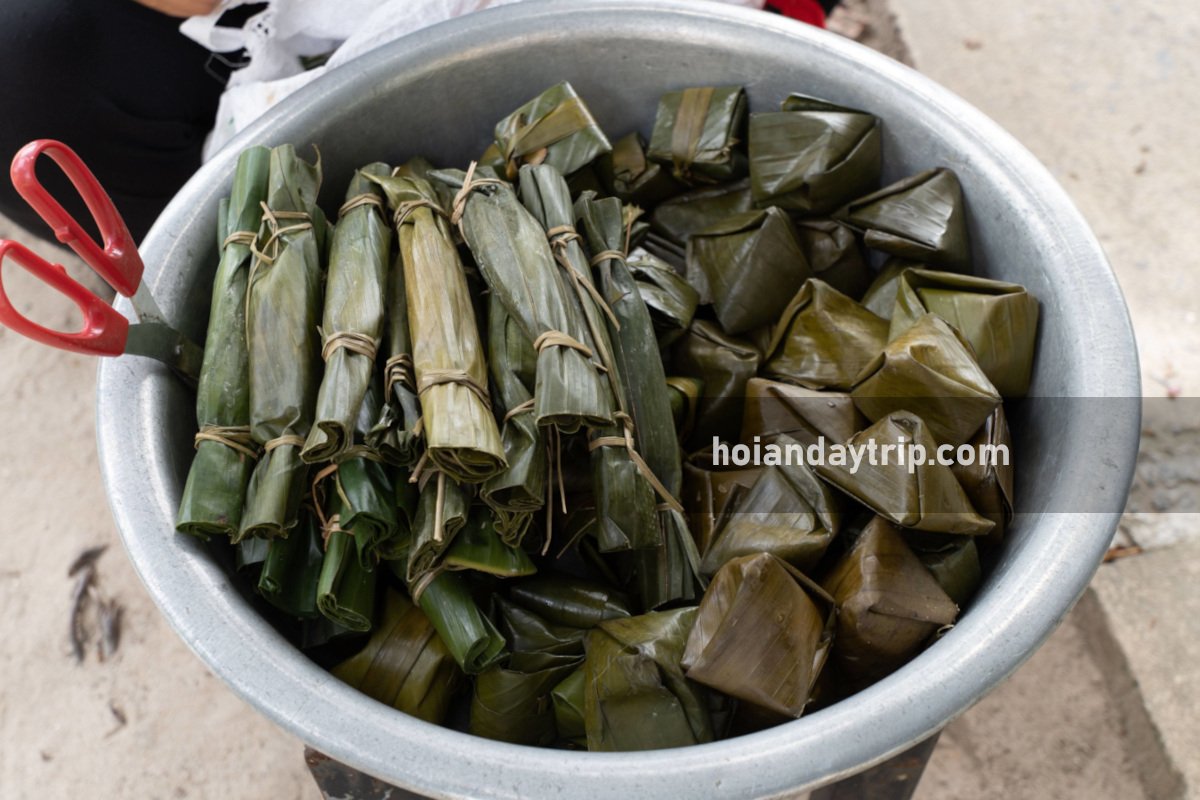
Ramie leaf rice cake (Banh it la gai) is one of the best street foods in Hoi An and specialty food in Cham Islands, Vietnam. In this article, HoiAn Day Trip Company will provide more information about it.
You may also like: Street Food in Hoi An, Vietnam
• Content by Tam Le, founder of HOIAN DAY TRIP CO.,LTD
• Designed by Giang Cong Minh, co-founder of LS E&C LTD and his team
• Photo by Dang Cong Loi, Dao Xuan Son, Tam Le & others
Must Knows about Ramie Leaf Rice Cake (Banh It La Gai)
– Other name(s):
– Origin: Vietnam
– Ingredients: (see below)
– Where to find: (see below)
– Served for: snack
– Price: 10,000-20,000 VND per cake
– Vegetarian: yes
– Foodie guide: https://hoiandaytrip.com/ramie-leaf-rice-cake-hoi-an/
– Fact: Ramie leaf rice cake (Banh it la gai) is the specialty food in Cham Islands (an offshore archipelago of Hoi An)
HOIAN DAY TRIP Company daily organizes food tours in Hoi An Vietnam. Contact us by +84968009827 (hotline/whatsapp/line/zalo) or hoiandaytripcompany@gmail.com or browse www.hoiandaytrip.com to see tours and make a reservation. Thank you very much!
Ingredients of Ramie Leaf Rice Cake in Hoi An
The ingredients of ramie leaf rice cake (Banh it la gai) in Hoi An are:
– wrapper ingredients: the wrapper is the distinctive, chewy, dark part of the cake. The key ingredients are:
Lá gai (ramie leaves): These are the namesake ingredient. The leaves are boiled, puréed, and mixed with the flour. They impart a unique, slightly earthy flavor and give the cake its characteristic deep black or very dark green color after steaming.
Bột nếp (glutinous rice flour): this is the main starch that provides the cake’s signature sticky and chewy (mochi-like) texture.
Đường (sugar): usually brown sugar, palm sugar, or sometimes white sugar, to sweeten the dough.
Gừng (fresh ginger): often a small amount is added to the ramie leaf paste for a fresh aroma.
Dầu an (cooking oil): a small amount is sometimes mixed into the dough or used to grease the hands/surface while forming the cakes to prevent sticking.
– Filling ingredients: the filling is typically sweet and rich, encased inside the black wrapper.
Đậu xanh (hulled mung beans): The most traditional filling. The beans are cooked until soft, mashed, and then sautéed with sugar.
Dừa nạo sợi (shredded coconut): often mixed with the mung bean paste, or sometimes used as the main filling for a nuttier flavor.
Đường (sugar): used to sweeten the mung bean and coconut mixture.
Muối (salt): a pinch of salt is usually added to enhance the overall sweetness.
– Wrapping materials:
Lá chuối (banana leaves): Used to wrap the individual cakes before steaming.
HOIAN DAY TRIP Company daily organizes food tours in Hoi An Vietnam. Contact us by +84968009827 (hotline/whatsapp/line/zalo) or hoiandaytripcompany@gmail.com or browse www.hoiandaytrip.com to see tours and make a reservation. Thank you very much!
How to Eat Ramie Leaf Rice Cake in Hoi An
Here is a guide on how to order and enjoy it like a local:
The best way to eat Vietnamese Bánh Ít Lá Gai is straightforward, emphasizing its delightful texture and traditional pairing.
– peel the banana leaf wrapper: the cake is wrapped in a banana leaf (lá chuối) before steaming.
Unwrap carefully: gently peel the banana leaf back. The sticky rice dough can sometimes cling to the leaf, so take your time to strip away the wrapper without tearing up the cake itself. Some people will gently tear the leaf in strips to help with the unwrapping.
A note on oil: a thin layer of cooking oil or pork fat is often brushed on the cake before wrapping to help prevent it from sticking to the leaf.
– temperature and serving:
Warm is best: while it can be eaten at room temperature, it is often said to be best enjoyed when it is warm (mới ra lò – fresh out of the steamer). Warmth enhances the soft, chewy texture of the sticky rice dough and the aromatic sweetness of the ramie leaf and filling.
The texture: expect a delightful texture that is soft, very chewy (dẻo), and slightly sticky on the outside, which gives way to a smooth, sweet, and nutty filling (usually mung bean or coconut).
3. Traditional pairing: the cake is a sweet treat (bánh ngọt) and is traditionally enjoyed as a dessert or a snack.
Pair with hot tea: The most common and recommended way to balance the sweetness and richness of the cake is to eat it alongside a cup of warm, plain green tea (trà nóng). The light bitterness of the tea provides a wonderful contrast to the sweet and dense cake, making it an ideal combination for a relaxing break or gathering.
– cultural context: Bánh Ít Lá Gai holds cultural significance and is often prepared and served during special occasions, such as Tết (Lunar New Year), family anniversaries (giỗ), and weddings, though it is also commonly sold and eaten as an everyday snack.
HOIAN DAY TRIP Company daily organizes food tours in Hoi An Vietnam. Contact us by +84968009827 (hotline/whatsapp/line/zalo) or hoiandaytripcompany@gmail.com or browse www.hoiandaytrip.com to see tours and make a reservation. Thank you very much!
Where to Eat Ramie Leaf Rice Cake in Hoi An?
Visitors can go to these places in Hoi An to find ramie leaf rice cake:
– Hoi An Night Market on Nguyen Hoang Street
– Other main markets in Hoi An such as Tan An Market (Tiger Market), Ba Le Market,…
HOIAN DAY TRIP Company daily organizes food tours in Hoi An Vietnam. Contact us by +84968009827 (hotline/whatsapp/line/zalo) or hoiandaytripcompany@gmail.com or browse www.hoiandaytrip.com to see tours and make a reservation. Thank you very much!
Best Food Tours in Hoi An Vietnam
Here are the best food tours with local guide in Hoi An Vietnam:
– Hoi An Old Town Food Tour with Lantern Boat Ride & Night Market
– Hoi An Night Walking Food Tour (Best Food Tour in Hoi An)
– Hoi An Night Market Food Tour with Lantern Boat Ride
– Hoi An Morning Walking Food Tour with Local Market
– Hoi An Street Food Walking Tour
– Hoi An History & Food Tour – Famous Landmarks & Specialty Dishes
– Hoi An Food Tour by Motorbike
HOIAN DAY TRIP Company daily organizes food tours in Hoi An Vietnam. Contact us by +84968009827 (hotline/whatsapp/line/zalo) or hoiandaytripcompany@gmail.com or browse www.hoiandaytrip.com to see tours and make a reservation. Thank you very much!
Other Foods to Try in Hoi An
Besides ramie leaf rice cake, visitors will see these dishes in Hoi An: Mi Quang noodles, White rose dumplings, Hoi An style Banh Mi sandwich, Hoi An style chicken rice, Cao Lau noodles, Fried wonton, Hoi An style Pho (beef noodle soup), Banh xeo (crispy rice pancake), Banh xoai (mango cake), Banh uot thit nuong (Hoi An grilled pork), Nem lui (Hoi An pork skewers), Banh dap (smashing rice paper), Stir-fried baby clams with rice cracker, Banh beo (steamed rice cake), Banh trang nuong (grilled rice paper or rice paper pizza), Chuoi nep nuong (grilled banana sticky rice), Hoi An banana pancake, Che (sweet soup), Black sesame soup, Kem cuon (ice cream rolls), Dau hu (tofu pudding), Bo la lot (grilled beef wrapped in betel leaf), Bun thit nuong (grilled pork noodle), Bun mam nem (fermented anchovy rice noodle), Banh canh (thick noodle soup), Chao ngheu (clam porridge), Banh trang cuon thit heo (rice paper rolls), Banh bot loc (tapioca cake), Banh da lon (pig skin cake), Banh it la gai (Ramie leaf rice cake), Banh to (ancestor cake), Green/Mung bean cake, Banh can (mini pancake), Banh cam (fried sesame balls), Banh tieu (hollow donut), Banh phu the (husband and wife cake), Banh bo (cow cake), Banh u tro (Lye water rice dumpling), Mot herbal tea, Da tron (pig skin salad), Banh khoai mon (taro cake), Com tam (broken rice), Bun dau mam tom (rice noodle, shrimp paste and fried tofu), Bun cha ca (fish cake noodle), Trung lon (fetal duck egg or balut),…
HOIAN DAY TRIP Company daily organizes food tours in Hoi An Vietnam. Contact us by +84968009827 (hotline/whatsapp/line/zalo) or hoiandaytripcompany@gmail.com or browse www.hoiandaytrip.com to see tours and make a reservation. Thank you very much!
Better to Know about Eating Local in Hoi An
– Local family-run restaurants always serve better local foods than tourist restaurants. Places inside small alleyways potentially are hidden gems. The price is even more affordable at these lesser known spots.
– Restaurants where you can see a queue or crowds, food or drinks there are absolutely better or safer than others. Vietnamese people also avoid places without people eating, such as roadside eateries.
– Hot foods are often safe to eat for non-Vietnamese people. Refuse cold food (especially ones sold on the street, markets) or things you don’t see people cooking.
– Make sure that you learn some basic Vietnamese words or sentences to order foods, such as xin chao (hello, hi), cho toi mot (something) (I want one…), toi an chay (I am vegetarian), khong cay (no spicy), cam on (thank you), tam biet (goodbye) or numbers (mot/one, hai/two, ba/three, bon/four, nam/five, sau/six, bay/seven, tam/eight, chin/nine, and muoi/ten).
– Ask any local people you know (tour guide, driver, hotel receptionists, bellmen, etc) to receive their recommendation for good places to eat local.
– Raw vegetables are popularly used in local dishes, such as noodles or noodle soup or sandwich. They are often washed by tap water or unwashed. If can not drink tap water, remove or refuse them. Likewise, in most iced drinks (such as coffee or herbal tea), people add ice made by tap water also.
– On the 1st day and 14th-15th days of each lunar month, Hoi An citizens eat vegetarians. Many local restaurants and street businesses will be closed by that.
– If you don’t eat pork or beef, due to diet or religious restrictions, be careful when want to try local food here, if don’t see the ingredient description. Pork and beef are very popular meats, so they will be in numerous dishes. Street vendors may say ‘no pork’ or ‘no beef’ for better business, but please check before buying!
– Consider joining a food tour guided by locals who know much better about dishes in the city, including things never mentioned in guidebooks or on the internet.
– If have an allergy (milk, egg, peanut, wheat,…), ask anybody you know before trying or search for ingredients on the internet. By the way, fish sauce is popularly used to marinate Vietnamese foods, so make sure that you know this information if you’re fish allergic.
– Food portion (or size) here is often not really big (locals prefer eating with their family at home). You may try double or some different dishes for main meals.
– If don’t see the price on the menu, please ask in advance to avoid overcharging, especially when you are not a local. In Vietnamese, how much is bao nhieu.
– Most popular cutleries are chopsticks and spoons. To know how to use it, browse here
HOIAN DAY TRIP Company daily organizes food tours in Hoi An Vietnam. Contact us by +84968009827 (hotline/whatsapp/line/zalo) or hoiandaytripcompany@gmail.com or browse www.hoiandaytrip.com to see tours and make a reservation. Thank you very much!
Photos, Videos about Ramie Leaf Rice Cake in Hoi An
Here are photos, videos about ramie leaf rice cake in Hoi An Vietnam: