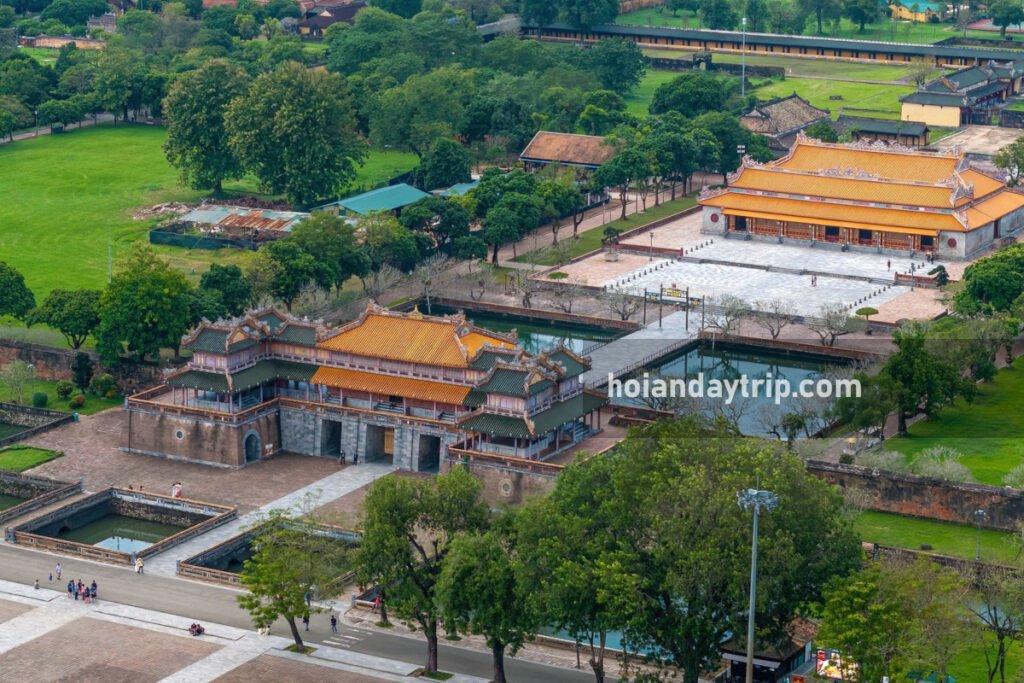
The Forbidden Purple City is the innermost wall in the Hue Citadel. It lies within the Imperial City (Royal Palace), and is strictly protected like its name. Before World War II, this rectangular city had some grand palaces, imposing pavilions, and hundreds of other buildings and structures. Later fire and bombings caused the loss and damages of almost everything here. Today, major architectural heritages have been rebuilt and some of which are finished. Now let’s HoiAn Day Trip Company provide all information about Hue’s Forbidden Purple City.
You may also like:
• Content by Tam Le, founder of HOIAN DAY TRIP CO.,LTD
• Designed by Giang Cong Minh, co-founder of LS E&C LTD and his team
• Photo by Dang Cong Loi, Dao Xuan Son, Tam Le & others
Must Knows about Hue Forbidden Purple City
– Location/Address: Hue Imperial City, 23 Thang 8 St, Hue City, Vietnam
– Other name(s): Hue Forbidden City, Tu Cam Thanh
– Opening hours: 6:30 AM to 5:30 PM (summer/dry season), 7 AM to 5 PM (winter/rainy season)
– Entrance fee: 200,000 VND for adult (2024)
– Reason(s) to visit:
– Time to spend: 1-2 hours
– Best time to visit: anytime of the day
– Tour guide: contact +84968009827 (hotline/whatsapp/line/zalo)
– Travel blog: https://hoiandaytrip.com/hue-forbidden-purple-city
– Recognition(s): Unesco world heritage site (1993)
Hue Forbidden Purple City on Map
History of Hue Forbidden Purple City
The Forbidden Purple City and the Imperial City of Hue were built in the summer in 1804, by request of Gia Long king, the founder of Nguyen dynasty (1802-1945). At that time, the forbidden city was named ‘Cung Thanh’. Three years later, it’s completed. In 1822, Minh Mang king named it ‘Tu Cam Thanh’, meaning ‘Forbidden Purple City’. In Mandarin Chinese, ‘Tu’ means ‘the son of heaven’ or ‘purple’. Therefore, the city isn’t purple like many people believe. In fact that it is yellow, the color symbolizing the emperor (or the earth).
Expanding up to approx 114,000 m2, the Forbidden Purple City is a rectangular area that is enclosed by a 3,72-meters-tall brick wall. Its longer sides are 324 meters long, and its shorter sides are 290 meters long. Its main gate, ‘Dai Cung Mon’ is to the south, and just behind Thai Hoa Palace where very important national events and meetings occur. This gate was destroyed in the wartime. The forbidden city has nine other gates to connect with other parts. In history, about 50 buildings existed within it. Nowadays, after fire and wars, king’s palaces and pavilions here have collapsed.
Within the walls of the Forbidden Purple City, there were palaces, residences, theatre, pavilions, gardens, and other buildings. Here, the king and his family members lived, worked, and entertained. Other persons include guardians, concubines, and eunuches who had to stay the whole life to serve the owners.
What to See in Hue Forbidden Purple City?
Today, visitors can go to these standing monuments and sites to visit in Hue’s Forbidden Purple City:
– Kien Trung Palace: this is the last palace in the Hue’s Imperial City about both location and age. It’s constructed from 1921 to 1923 by request of Khai Dinh king. Therefore, its architecture and decoration have a fusion between eastern and western elements, making it different from other palaces. His son Bao Dai king and his family stayed here until the fall of Nguyen dynasty in 1945. In 2019, this palace was reconstructed and after 5 years, it’s opened to the public, becoming a must see building. See more information & details
– Truong Lang (the Long Corridors): these covered corridors connect major buildings inside the Forbidden Purple City, with a total length of nearly 1km. During past wars, all of them were destroyed, and in 2016, the most important corridors are restored (around the palaces, from palaces to western residences). During the day, many visitors come here to take pictures, with traditional costumes. Along the corridor between Kien Trung Palace and Dien Tho Palace, the biography of all Nguyen kings are introduced.
– Duyet Thi Duong Royal Theatre: this theatre was built in 1826, in Minh Mang king’s reign, to serve entertaining performances for emperors, high-ranking mandarins, royal family members, and ambassadors. The most popular one is Tuong singing (referring to Vietnamese classic opera). Nowadays, Nha Nhac (court music), a Unesco-recognized intangible cultural heritage is performed here. See more information & details
– the West House of Can Chanh Palace (Ta Vu): this house was built in 1819, by Minh Mang king, as a side building of Can Thanh Palace (Palace of the Audience). If stand behind Thai Hoa Palace, it’s on the right hand side. It’s restored 2 times in 1899, and in 1923 before the 40th birthday anniversary of Khai Dinh king. Nowadays, this house exhibits Hue’s cultural heritages, such as the Complex of Hue monuments (world heritage site), court music, literature on imperial architecture. Visitors can have a seat and watch a video about the royal music here. Outside, there is a shop selling souvenirs, cold beverages, and books.
– the East House of Can Chanh Palace (Huu Vu): this house was built in 1819, by Minh Mang king, as a side building of Can Thanh Palace (Palace of the Audience). If stand behind Thai Hoa Palace, it’s on the left hand side. It’s restored 2 times in 1899, and in 1923 before the 40th birthday anniversary of Khai Dinh king. Nowadays, this house is a shop selling souvenirs, cold beverages, and books as well as a studio where visitors can rent fake royal clothes to wear and take a picture while sitting on a throne. The photography service costs from 120,000 VND/photo.
– Thai Binh Pavilion (Pavillion of the Peacefulness): this 10-meters-tall pavilion was built in 1887, under Dong Khanh king’s reign, for emperors to relax or read books. It’s restored in 2010. The highlight here is sophisticated ceramic mosaics. A short walk from here, visitors can go to lakeshores or beautiful gardens.
– Nhat Thanh Pavilion: this tall pavilion is next to Thai Binh Pavilion and Duyet Thi Duong Royal Theatre. It’s built in 1841 by Thieu Tri king, but was destroyed in 1947 and 1968. It’s restored in 2018. In the past, kings, queens, empresses, and other royal family members came here to read books, write poetries, chant,…
– Thieu Phuong Garden: this tranquil royal garden is next to Thai Binh Pavilion and Duyet Thi Duong Royal Theatre. It’s built in 1828 by Minh Mang king, and improved in 1841 by his first son Thieu Tri king. It comprises many mini landscapes arranged along a network of corridors like a swastika symbol (卍).
– bronze urns: there are 7 ancient bronze urns (about 300 years old) in the Hue Forbidden Purple City, all casted by Nguyen lords. According to local stories, techniques to make these urns were introduced and developed by a Portuguese man. He also helped the lords to produce weapons in the past. The urns symbolize the power of kingship and strength of the nation. In 2016, they are recognized to be Vietnam’s national treasure.
– tennis court of Bai Dai king:
– foundation of Can Chanh Palace (Palace of the Audience): this palace was built by Gia Long king in 1804, and used for meetings between the king and mandarins on 5th, 10th, 20th, and 25th days of each lunar month. As same as Thai Hoa Palace that lies in its front, Can Thanh Palace is the finest royal building in Hue’s Imperial City and Forbidden Purple City, but sadly, was destroyed in 1947. The city and historians are going to restore it in the near future.
– foundation of Can Thanh Palace: this palace was built in 1811 by Gia Long king, and destroyed in 1947 by fire. During its life, it serve as the residence of the king. So, it stands behind Can Chanh Palace where he meets up mandarins, and in front of Khon Thai Palace where his wife lives (should be the imperial noble consort or hoang quy phi). Not far away, there are residences for his children (princes and princesses), a theatre for entertainments, pavilions and gardens to relax. A covered corridor connects the palace with Dien Tho Residence where his mother lives.
– foundation of Khon Thai Palace: this palace was built in 1804 by Gia Long king, and destroyed in 1947 by fire. It served as the residence of hoang quy phi (the imperial noble consort, king’s wife).
Tips to Visit Hue Forbidden Purple City
– The Nine Dynastic Urns are inside the Hue Imperial City (particularly The Mieu Temple), so visitors must wear respectively if want to visit. Please wear long pants which cover the upper knees, the shirt which covers navel, breast, shoulder, and armpits. The ones of see-through fabric are not suitable.
– In the dry season, visitors should bring sun cream, sun glasses, hat/cap/umbrella, and some bottles of water.
– In the rainy season, visitors should bring rain poncho/jacket or umbrella, sandal or waterproof shoes.
– Visitors can take pictures with all urns of the Nine Dynastic Urns.
How to Get to Hue Forbidden Purple City
The Nine Dynastic Urns (Cuu Dinh) is within the Hue Imperial City/Hue Citadel, on the northern bank of the Perfume River, in Phu Xuan district of Hue city.
HOIAN DAY TRIP Company daily organizes tours and transfers in Hue, Da Nang, and Hoi An. Contact us by +84968009827 (hotline/whatsapp/line/zalo) or browse www.hoiandaytrip.com to see tours and make a reservation. Thank you very much!
Places to Visit Near Hue Forbidden Purple City
Within the Hue Imperial City, visitors can go to these places: Thai Hoa Palace, The Mieu Temple, the Nine Dynastic Urns (Cuu Dinh), Thai Mieu Temple, Dien Tho Palace, Truong Sanh Residence, Kien Trung Palace, Thai Binh Pavilion, Duyet Thi Duong Royal Theater, Thieu Phuong Garden, Co Ha Gardens, the Nine Holy Cannons (Cuu Vi Than Cong) …
Near Ngo Mon Gate, visitors can go to these places: Museum of Royal Antiquities (distance: 650m), Imperial Academy or Quoc Tu Giam (distance: 500m), Ho Chi Minh House (distance: 1,3 km), Flag Tower or Ky Dai (distance: 100m), the Nine Holy Cannons (distance: 150m), Phu Van Lau or Pavillion of Edicts (distance: 600m), Nghenh Luong Dinh or Pavillion of the Welcoming (distance: 650m), Tinh Tam Lake (distance: 2 km), Xa Tac Esplanade or the Altar of Land and Grain (distance: 1,1 km), the Imperial Library or Tang Thu Lau (distance: 2 km).
Not far away from the Hue Imperial City, visitors can go to these places: Dong Ba Market (distance: 1,5 km), Truong Tien Bridge (distance: 1 km), An Hien Garden House (distance: 3 km), Thien Mu Pagoda (distance: 4 km), Hue’s Night Walking Street (distance: 2,5 km), Hai Ba Trung Walking Street (distance: 2 km).
Photos, Videos about Hue Forbidden Purple City
Here are beautiful photos and videos about Forbidden Purple City in Hue: