In this article, HoiAn Day Trip Company will suggest a self guided food tour in Hoi An for those who want to roam around the town and try local must-try dishes without guide.
You may also like: Hoi An Self Guided Walking Tour
• Content by Tam Le, founder of HOIAN DAY TRIP CO.,LTD
• Designed by Giang Cong Minh, co-founder of LS E&C LTD and his team
• Photo by Dang Cong Loi, Dao Xuan Son, Tam Le & others
Best Area in Hoi An for A Food Tour
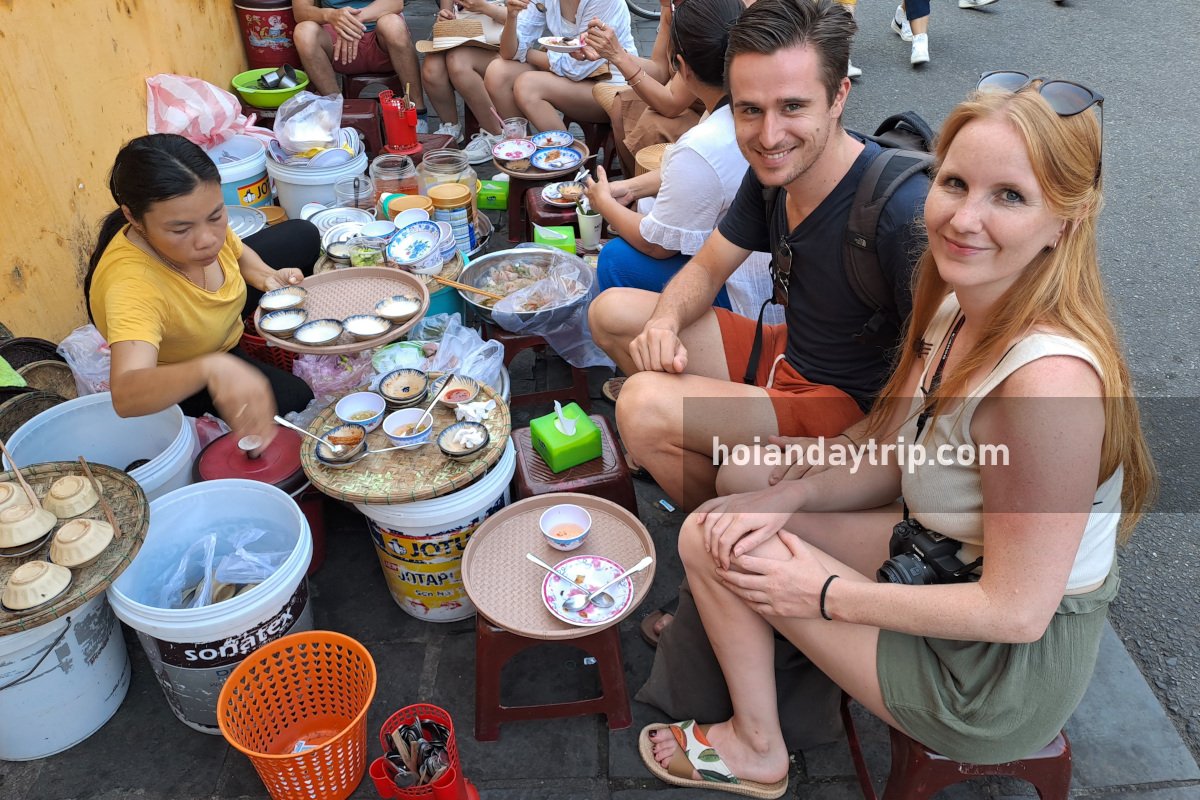
The best area for a self guided food tour in Hoi An is the Hoi An Old Town. This is the oldest part of the city, and boasts a historical role as an international trading port from the 15th to the 19th centuries. Like the architecture, the cuisine here is blended between Vietnamese, Chinese, Japanese and other populations. There are numerous dishes that originate from Hoi An’s Old Town but not found anywhere else in the country, thanks to cultural exchanges in the past. In addition, visitors can see lots of restaurants and street food vendors in a small area.
HOIAN DAY TRIP company daily organizes food tours in Hoi An. Contact us by +84968009827 (hotline/whatsapp/line/zalo) or hoiandaytripcompany@gmail.com or browse www.hoiandaytrip.com to see tours and make a reservation. Thank you very much!

Best Self Guided Food Tour in Hoi An
We suggest starting your self guided food tour in Hoi An at White Rose restaurant (Nha hang Bong Hong Trang), 533 Hai Ba Trung Street. It opens from 7:30 AM until 8:30 PM, and widely known for local delicacies like white rose dumplings and fried wonton.
+white rose dumplings are a delicate, local specialty featuring translucent rice-flour skin wrapped around a savory shrimp and pork filling, steamed to resemble a beautiful white flower. These unique dumplings, served with crispy fried shallots and a tangy dipping sauce, are a must-try culinary experience found almost exclusively in this ancient Vietnamese town. See more information & details
+ fried wonton is a unique local adaptation of the Chinese dumpling, where a wheat or rice flour wrapper is filled with shrimp and pork, and then deep-fried until perfectly golden and crispy. These savory wontons are famously served flat and topped with a vibrant, salsa-like mixture of sweet-and-sour sauce, fresh shrimp, tomatoes, and vegetables, often earning the nickname of a “Vietnamese pizza.” See more information & details
Walking along Hai Ba Trung Street (towards the Old Town), visitors will find Com ga Hien (593 Hai Ba Trung Street).
+ Hội An chicken rice, or Cơm Gà Hội An, is the town’s famous culinary specialty, featuring fragrant, buttery rice cooked with chicken broth and turmeric for a distinct golden color. It is topped with tender, hand-shredded chicken that is mixed with a lime juice and herb dressing, and served alongside pickled vegetables and a small bowl of savory chicken broth. See more information & details
From Com ga Hien to the 3rd place – Cao lau Thanh (restaurant), turn right, go straight, and turn right to enter Thai Phien Street.
+ Cao Lầu is an exclusive noodle dish from Hội An, distinguished by its thick, chewy noodles traditionally made using water from a specific local well and ash from an island tree. This unique blend of flavors and textures—featuring the special noodles, char siu pork, fresh herbs, and a light savory sauce—makes it a must-try culinary symbol of the ancient town.
The 4th place in our recommended Hoi An self guided food tour is Banh mi Madam Khanh (Banh Mi Queen).
+ Hoi An-style Bánh Mì is internationally renowned for its uniquely crispy-crusted and airy baguette, which is typically packed with a generous and flavorful mix of fillings. The sandwich is celebrated for its perfect balance of savory meats (like char siu pork or pate), fresh herbs, pickled vegetables, and a signature rich, house-made sauce.
Near Ba Mu Temple on Hai Ba Trung Street, visitors can find a couple of vendors selling Banh xoai or Mango cake.
The last place in the itinerary is the Hoi An Night Market on Nguyen Hoang Street. It is a culinary paradise where foodies can sample the rich flavors of Central Vietnam, especially street dishes. This place opens from 6:00 PM (or when it becomes dark), therefore visitors should time well the self guided food tour to include it.
+ for more street foods, we recommend trying Banh uot thit nuong (grilled pork skewers with rice papers, raw vegetables, and savory sauce, see more details) or other BBQ options like grilled beef in betel leaf (bo la lot), grilled seafood.
+ for dessert, the best dishes are ice cream rolls (kem cuon), banana pancake, Vietnamese traditional sweet soup (che).
HOIAN DAY TRIP company daily organizes food tours in Hoi An. Contact us by +84968009827 (hotline/whatsapp/line/zalo) or hoiandaytripcompany@gmail.com or browse www.hoiandaytrip.com to see tours and make a reservation. Thank you very much!
Best Food Tours in Hoi An Vietnam
Here are the best food tours with local guide in Hoi An Vietnam:
– Hoi An Old Town Food Tour with Lantern Boat Ride & Night Market
– Hoi An Night Walking Food Tour (Best Food Tour in Hoi An)
– Hoi An Night Market Food Tour with Lantern Boat Ride
– Hoi An Morning Walking Food Tour with Local Market
– Hoi An Street Food Walking Tour
– Hoi An History & Food Tour – Famous Landmarks & Specialty Dishes
– Hoi An Food Tour by Motorbike
HOIAN DAY TRIP Company daily organizes food tours in Hoi An Vietnam. Contact us by +84968009827 (hotline/whatsapp/line/zalo) or hoiandaytripcompany@gmail.com or browse www.hoiandaytrip.com to see tours and make a reservation. Thank you very much!
Better to Know about Eating Local in Hoi An
– Local family-run restaurants always serve better local foods than tourist restaurants. Places inside small alleyways potentially are hidden gems. The price is even more affordable at these lesser known spots.
– Restaurants where you can see a queue or crowds, food or drinks there are absolutely better or safer than others. Vietnamese people also avoid places without people eating, such as roadside eateries.
– Hot foods are often safe to eat for non-Vietnamese people. Refuse cold food (especially ones sold on the street, markets) or things you don’t see people cooking.
– Make sure that you learn some basic Vietnamese words or sentences to order foods, such as xin chao (hello, hi), cho toi mot (something) (I want one…), toi an chay (I am vegetarian), khong cay (no spicy), cam on (thank you), tam biet (goodbye) or numbers (mot/one, hai/two, ba/three, bon/four, nam/five, sau/six, bay/seven, tam/eight, chin/nine, and muoi/ten).
– Ask any local people you know (tour guide, driver, hotel receptionists, bellmen, etc) to receive their recommendation for good places to eat local.
– Raw vegetables are popularly used in local dishes, such as noodles or noodle soup or sandwich. They are often washed by tap water or unwashed. If can not drink tap water, remove or refuse them. Likewise, in most iced drinks (such as coffee or herbal tea), people add ice made by tap water also.
– On the 1st day and 14th-15th days of each lunar month, Hoi An citizens eat vegetarians. Many local restaurants and street businesses will be closed by that.
– If you don’t eat pork or beef, due to diet or religious restrictions, be careful when want to try local food here, if don’t see the ingredient description. Pork and beef are very popular meats, so they will be in numerous dishes. Street vendors may say ‘no pork’ or ‘no beef’ for better business, but please check before buying!
– Consider joining a food tour guided by locals who know much better about dishes in the city, including things never mentioned in guidebooks or on the internet.
– If have an allergy (milk, egg, peanut, wheat,…), ask anybody you know before trying or search for ingredients on the internet. By the way, fish sauce is popularly used to marinate Vietnamese foods, so make sure that you know this information if you’re fish allergic.
– Food portion (or size) here is often not really big (locals prefer eating with their family at home). You may try double or some different dishes for main meals.
– If don’t see the price on the menu, please ask in advance to avoid overcharging, especially when you are not a local. In Vietnamese, how much is bao nhieu.
– Most popular cutleries are chopsticks and spoons. To know how to use it, browse here
HOIAN DAY TRIP Company daily organizes food tours in Hoi An Vietnam. Contact us by +84968009827 (hotline/whatsapp/line/zalo) or hoiandaytripcompany@gmail.com or browse www.hoiandaytrip.com to see tours and make a reservation. Thank you very much!