Dien Tho Residence is one of the most important and last surviving buildings in the Hue Imperial City. It serves the daily life of the king’s mother and grandmother. Today, visitors can see grand wooden buildings surrounded by fruit trees and beautiful flowers. It’s really worth sightseeing. In this article, HoiAn Day Trip Company provides everything that you need to know about Dien Tho Residence in Hue.
You may also like: Truong Sanh Residence
• Content by Tam Le, founder of HOIAN DAY TRIP CO.,LTD
• Designed by Giang Cong Minh, co-founder of LS E&C LTD and his team
• Photo by Dang Cong Loi, Dao Xuan Son, Tam Le & others

Must Knows about Dien Tho Residence
– Location/Address: Hue Imperial City, 23 Thang 8 St, Hue City, Vietnam
– Other name(s): Dien Tho Palace, Cung Dien Tho
– Opening hours: 6:30 AM to 5:30 PM (summer/dry season), 7 AM to 5 PM (winter/rainy season)
– Entrance fee: 200,000 VND for adult (2024)
– Reason(s) to visit: residence where the mother and grandmother of Nguyen kings lived, one of last surviving buildings in Hue Imperial City
– Time to spend: 30 to 60 mins
– Best time to visit: anytime of the day
– Tour guide: contact +84968009827 (hotline/whatsapp/line/zalo)
– Travel blog: https://hoiandaytrip.com/dien-tho-residence-hue-vietnam
– Recognition(s): Unesco world heritage site (1993)
– Food & drink: yes available
– Shopping: yes available
Dien Tho Residence on Map
History of Dien Tho Residence
In April 1804, the first king of Nguyen dynasty Gia Long constructed Truong Tho Residence (Residence of the Eternal Longevity) for his mother Mrs Nguyen Thi Hoan. It’s completed 7 months later. In 1811, she passed away and after her death, this residence was dismantled. Its materials were used to build the residence for the crown prince Nguyen Phuc Dam (later Minh Mang king) in 1816.
In April 1820, Minh Mang king requested to build a new residence for his mother Thua Thien queen (Mrs Ho Thi Hoa). It’s completed at the end of that year although a disease occurred meanwhile. He named this construction ‘Tu Tho Residence’. The queen stayed here until her death in 1846.
In 1847, Tu Duc king requested to replace ‘Tu Tho Residence’ by a new residence which was for his mother Tu Du queen. Its name at that time was Gia Tho Residence. However, due to some reasons, this building was finished in April 1849. One month later, the queen came here to stay, and she had lived for 53 years, until 1902 when she passed away.
In 1901, Thanh Thai king renamed the residence to ‘Ninh Tho Residence’ and used it for his mother Tu Minh queen. Nearly 5 years later, the queen died. In 1907, Thanh Thai king passed away and then his 8th son Nguyen Phuc Vinh San prince was crowned, becoming Duy Tan king. This king again used the residence for his mother until her death. In 1916, Khai Dinh king requested to restore it and gave it a new name ‘Dien Tho Residence’ (which has been used up to this day). Of course, his mother stayed here.
In 1944, Tu Cung empress (1890-1980), mother of Bao Dai king, stayed in Dien Tho Residence. In the next year, this king abdicated, becoming the last king of Vietnam, and she needed to leave. After that, she lived in An Dinh Palace, not far away from the Imperial City. In 1955, the palace belonged to Ngo Dinh Diem, the first president of South Vietnam. She bought a nearby house from one of Khai Dinh king’s wifes to stay until her death on 10th November 1980 (today at 145 Phan Dinh Phung St). In 2015, this house was used as the memorial site to the last empress of Vietnam, and a café.
During its life, Dien Tho Residence served 8 empresses and 4 grandempresses. In 1993, as a part of Hue Imperial City, it’s inscribed as a Unesco world heritage site.
Architecture of Dien Tho Residence
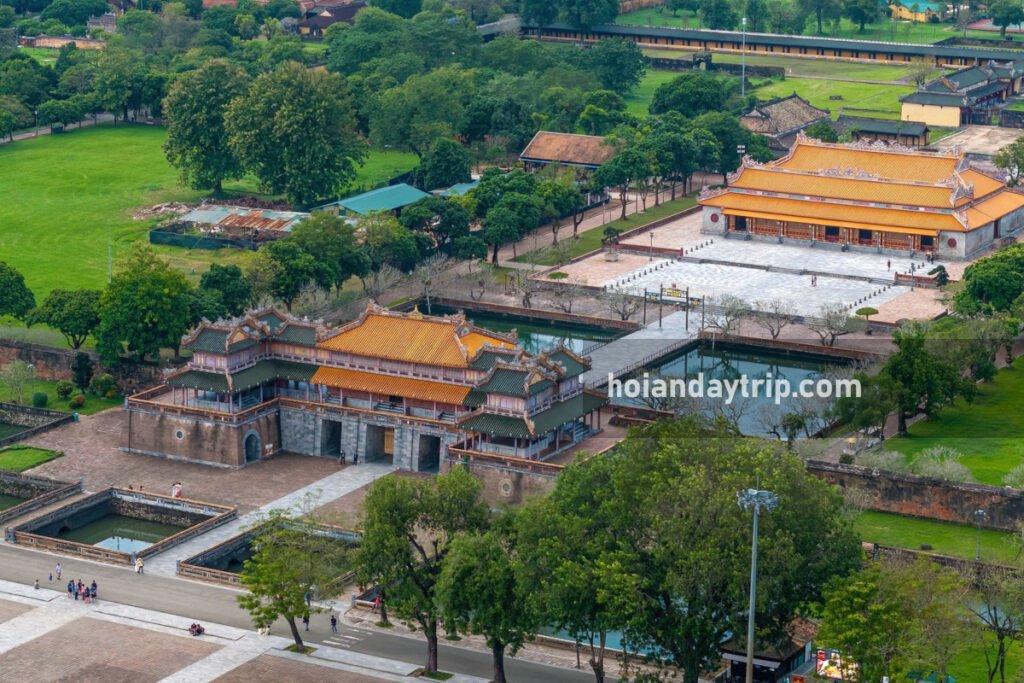
Dien Tho Residence comprises about 20 buildings within a protective wall surrounding a rectangular piece of land (dimension: 150m x 100m). It lies in the northwestern part of the Hue’s Imperial City, between Truong Sanh Residence and Phung Tien Palace/Temple where emperors of Nguyen dynasty were worshipped (same to The Mieu Temple, but here women could join ceremonies, burnt in 1947). It has four entrances, with the east entrance leading to the Forbidden Purple City/Can Thanh Palace where kings live, by a covered walkway, and the south entrance as the main entrance. Visitors often visit Dien Tho Residence via the east gate, because of convenience.
The main building of the Palace is ‘Dien Tho Palace’. In its front, there is a protective screen that is largest in Hue. Because the king often visits it to see his mother and grandmother, this hall is covered by a yellow tile roof (the one only for king’s places in the dynasty). On its top, there are phoenixes, symbolizing queens and other wifes of the king as well as the power of the royal family.
Dien Tho Palace has 7 compartments, and two large rooms. After restoration by request of Khai Dinh king who had influences from the west, its floor was paved by imported tiles, glass was installed for its windows and doors, and glass lamps were added. After wars, lots of things in this building have been lost, but today visitors can see tables & chairs used in queen’s meals or greeting guests, wooden beds, a full set of imperial gown which queens would wear in important events, entertaining game dau ho, personal belongings, etc. On the way to the café, it’s possible to see a souvenir and beverage shop.
Next to it, there is Ta Tra House or ‘Left House’ where people wait to see Nguyen empresses and grandempresses. Firstly, it’s built of brick and wood, comprising three compartments, and in 1927, it’s built with cement. In 1968, this place was heavily damaged by bombings and fire. In 2013 and 2014, it’s restored completely with a total cost of 11,1 billions dong. Now, visitors can see many antique things here, including the carriage of Bao Dai king’s wife, wooden bed, tables & chairs, and especially, the rickshaw of Thanh Thai king’s mother. It’s collected after an auction in France in June 2014, with a price of 55,800 EUR or approx 1,5 billions dong. It became one of the first Vietnamese antiquities ‘returning home’ by that way.
In 1927, Bao Dai king (13rd/last Nguyen emperor) constructed a new villa for his mother Hoang Thi Cuc (1890-1980) due to her severe rheumatism. The main Dien Tho was too humid. This villa has two storeys, following a French style, and named ‘Tinh Minh Pavilion’. Previously, there was a theatre that existed here (one of the oldest theatres in Hue). Now, its ground floor is used to exhibit photos and objects about Bao Dai king, his wife Nam Phuong queen and their children. To know further, we recommend you visit An Dinh Palace where they lived before going to the Imperial City. In 1950, after his abdication (1945), the villa served as a temporary living house for Bao Dai king who was appointed to be ‘supreme advisor’ for the new government led by Ho Chi Minh president.
Behind Dien Tho Residence, there is Tho Ninh Palace. It’s smaller than the main hall because it serves for other wifes of the king (who are not king’s biological mother). It had 7 compartments by 1930, and after that, it’s restored and just has 3 compartments like today. Here, visitors can see some calabash trees (cay dao tien, Crescentia cujete) which have exotic ball-like fruits.
One of the most interesting buildings in Dien Tho Residence is Ta Truong Du Pavilion. It’s built in 1849, on a rectangular lake embellished by a mini limestone mountain with small trees, lotus & water lily flowers, and golden fishes. This pavilion has a ‘house’, now becoming a small café, and a covered structure. Here, visitors can take a break, enjoy a cold drink, feed fishes, and enjoy a sense of tranquility. On the way to the café, visitors can see paintings portraying famous pagodas and royal tombs in Hue, such as Thien Mu Pagoda, Khai Dinh Tomb, Minh Mang Tomb.
Dien Tho Residence also has a temple named ‘Am Phuoc Tho’ (literally ‘Shrine of the Blessing and Longevity’) or Khuong Ninh Cac. It has two levels, with the ground floor used to worship three goddesses in Vietnamese folk belief. Upstairs, people worship buddhas, Quan Cong (a military general in ancient times), and other figures. Empresses came here to pray and chant everyday in the past, while kings don’t follow religions. Sometimes, they went to Thien Mu Pagoda, a national Buddhist temple of Hue. To visit the upper floor, visitors need to take their shoes off.
In gardens of the Dien Tho Residence have many fruit trees, such as stairfruit, jackfruit, tamarind, pomelo, lychee, mango, water apple, and yew plum pine (Podocarpus macrophyllus) which symbolizes long life or external life.
Tips to Visit Dien Tho Residence
– In the dry season, from February to the end of August, visitors should bring sun cream, sun glasses, and some bottles of water.
– In the rainy season, from September to January, visitors should bring rain poncho or jacket, umbrella, sandal or waterproof shoes.
– The Meridian Gate of Hue (Ngo Mon) lies within the Imperial City, so visitors still need to wear respectively if want to visit. In other words, please wear long pants to cover upper knees, shirt to cover armpits, navel, chest and shoulder.
– Staircases leading to the pavilion of the Meridian Gate of Hue are steep and not wheelchair accessible like other traditional tall buildings in Vietnam. On rainy days, steps will be wet and slightly slippery.
– Do not touch on any ancient artifacts and photos in the Meridian Gate of Hue.
– If just want to see the Meridian Gate of Hue (Ngo Mon) from outside, there is no ticket required. It’s free!
– Traditional dress of Vietnamese people Ao Dai is highly recommended. It can be the best costume to wear and have awesome photos then!
– It’s better to visit with a local guide who knows the history well. Contact us by +84968009827 (hotline/whatsapp/line/zalo) to book.
How to Get to Dien Tho Residence
Dien Tho Residence (Cung Dien Tho) is within the Hue Imperial City/Hue Citadel, on the northern bank of the Perfume River, in Phu Xuan district of Hue city.
HOIAN DAY TRIP Company daily organizes tours and transfers in Hue, Da Nang, and Hoi An. Contact us by +84968009827 (hotline/whatsapp/line/zalo) or browse www.hoiandaytrip.com to see tours and make a reservation. Thank you very much!
Places to Visit Near Dien Tho Residence
Within the Hue Imperial City, visitors can go to these places: Thai Hoa Palace, The Mieu Temple, the Nine Dynastic Urns (Cuu Dinh), Thai Mieu Temple, Dien Tho Palace, Truong Sanh Residence, Kien Trung Palace, Thai Binh Pavilion, Duyet Thi Duong Royal Theater, Thieu Phuong Garden, Co Ha Gardens, the Nine Holy Cannons (Cuu Vi Than Cong) …
Near Ngo Mon Gate, visitors can go to these places: Museum of Royal Antiquities (distance: 650m), Imperial Academy or Quoc Tu Giam (distance: 500m), Ho Chi Minh House (distance: 1,3 km), Flag Tower or Ky Dai (distance: 100m), the Nine Holy Cannons (distance: 150m), Phu Van Lau or Pavillion of Edicts (distance: 600m), Nghenh Luong Dinh or Pavillion of the Welcoming (distance: 650m), Tinh Tam Lake (distance: 2 km), Xa Tac Esplanade or the Altar of Land and Grain (distance: 1,1 km), the Imperial Library or Tang Thu Lau (distance: 2 km).
Not far away from the Hue Imperial City, visitors can go to these places: Dong Ba Market (distance: 1,5 km), Truong Tien Bridge (distance: 1 km), An Hien Garden House (distance: 3 km), Thien Mu Pagoda (distance: 4 km), Hue’s Night Walking Street (distance: 2,5 km), Hai Ba Trung Walking Street (distance: 2 km).
Photos, Videos about Dien Tho Residence
Here are beautiful photos and videos about Dien Tho Residence in Hue: