Thien Mu Pagoda (or Pagoda of the Celestial Lady) is one of the most famous tourist attractions in Hue city, Vietnam. It’s built in 1601, on the top of a hill by the Perfume River, and not far away from the Imperial City. Its 7-storey octagonal tower is amongst symbolic images of Hue. For that reason, this ancient Buddhist temple is always an attraction in all local tours, including boat trips. Now, let’s HoiAn Day Trip Company provide all information about Thien Mu Pagoda in Hue city, Vietnam.
You may also like:
• Content by Tam Le, founder of HOIAN DAY TRIP CO.,LTD
• Designed by Giang Cong Minh, co-founder of LS E&C LTD and his team
• Photo by Dang Cong Loi, Dao Xuan Son, Tam Le & others
Must Knows about Thien Mu Pagoda
– Location/Address: Nguyen Phuc Nguyen St, Huong Long ward, Phu Xuan district, Hue City, Vietnam
– Other name(s): Linh Mu Pagoda, Pagoda of the Celestial Lady
– Opening hours: 7 AM to 8 PM daily
– Entrance fee: free
– Reason(s) to visit: the oldest, grandest, and most famous Buddhist temple in Hue city
– Time to spend: 1 hours
– Best time to visit: anytime of the day
– Tour guide: contact +84968009827 (hotline/whatsapp/line/zalo)
– Travel blog: https://hoiandaytrip.com/thien-mu-pagoda-hue-vietnam
– Recognition(s): Unesco world heritage site (1993)
– Fact:
Thien Mu Pagoda on Map
History of Thien Mu Pagoda in Hue
According to some unofficial sources of information, on the hill where Thien Mu Pagoda sits today, was a Hindu temple built by Cham people.
In 1601, Thien Mu Pagoda was built by request of Nguyen Hoang lord, who ruled the southern part of Vietnam from 1558 to 1613. He chose Hue to be the capital city of Dang Trong (meaning ‘Inner Circuit’). One day, he went on a boat trip on the Perfume River and stopped at a village near Thien Mu Pagoda. Here, local inhabitants told him a story. Every night an old lady wearing a red shirt and green pants, descending from heaven, appeared on an adjacent hilltop. She said that a great lord would come and construct a pagoda at that place, and then the country could be peaceful and prosperous. Right after hearing this story, Nguyen Hoang lord considered him as the one mentioned, and he requested to build the pagoda. He named it ‘Thien Mu’ which means ‘celestial lady’.
In 1710, Nguyen Phuc Chu lord funded the casting of a giant bell (called ‘the Great Bell of Thien Mu Pagoda). It’s heaviest in the country until today.
In 1715, Nguyen Phuc Chu lord visited Thien Mu Pagoda again. He was inspired by the scenery here, and composed a poem with 1,250 words, with title ‘Ngu Kien Thien Mu Tu’ (literally ‘lord’s visit to Thien Mu Pagoda). After that, this poem was carved on a stone stele standing on a giant tortoise.
In 1862, Tu Duc king (the 4th Nguyen king) renamed Thien Mu Pagoda to ‘Linh Mu Pagoda’ because he thought that this temple could have all blessings from Heaven, instead of him. If he was blessed, he could have biological children as he wished for a very long time. The word changed, ‘Linh’ means ‘holy’ in Vietnamese language, so the temple still retained its sacredness. In 1689, Linh Mu Pagoda was renamed ‘Thien Mu Pagoda’. Local people believed the reason was that his way was ‘not working’ and he still had no kids to succeed.
In 1943, Thien Mu Pagoda was damaged heavily due to typhoons. From 2003 to 2007, 18 buildings in Thien Mu Pagoda were under renovation. Total cost was up to 26 billion dongs.
In 1993, Thien Mu Pagoda was one of sites within the Complex of Hue Monuments that was inscribed by Unesco to a world heritage site.
Things to See & Do in Thien Mu Pagoda
Phuoc Duyen Tower
In the front of Thien Mu Pagoda, close to the Perfume River, Phuoc Duyen Tower is a 21-meters-tall and 7-storey octagonal brick tower. It’s one of the unofficial symbols of Hue, the old capital city of Vietnam.
In 1844, Thieu Tri king designed and requested to build ‘Tu Nhan Tower’, ‘Huong Nguyen Pavillion’ and four pillars in its front, and two stele houses on the sides. In 1845, Tu Nhan Tower was renamed ‘Phuoc Duyen Tower’, on occasion of the great longevity celebration when his grandfather reached 80 years old. This tower has 7 storeys, each one has an altar to worship a different buddha, and in the highest storey, Sakyamuni Buddha (Phat Thich Ca Mau Ni) is worshipped. Today, its door is closed to protect precious statues and objects inside, from thieves.
During its life, Phuoc Duyen Tower was renovated many times, such as in 1867 (because buddha statues were damaged by termites), in 1899 (to celebrate the 90th birthday anniversary of an empress), in 1907 (because of being struck by lightning), in 1959.
To the left of Phuoc Duyen Tower, visitors can see a small pavilion, housing a stone stele on which a poem composed by Thieu Tri king to praise the scenery at Thien Mu Pagoda, was carved in 1846. Poem’s name is ‘Thien Mu chung thanh’ or ‘the bell sound at Thien Mu Pagoda’. He also listed it to be one of top 20 most beautiful sceneries in Hue city. Close to this pavilion, there is the pavilion of the Great Bell of Thien Mu Pagoda which was casted by request of Nguyen Phuc Chu lord in 1710. It weighs up to nearly 2,000 kilograms, and has a height of 2,5m.
To the right hand side of Phuoc Duyen Tower, there is the pavilion accommodating a stone stele on which Thien Mu Pagoda legend and information about the tower were carved in 1846, by request of Thieu Tri king. Close to this pavilion, there is the pavilion of the Stele of the ‘Lord Builds Thien Mu Pagoda’ (Ngu Kien Thien Mu Tu). It’s carved in 1715, has a height of 3,98 meters, and stands on a giant stone tortoise. On its surface, visitors can see 1,250 Chinese words which inform about the great restoration that happened in that year at the pagoda. By that, we can know the importance of Buddhism in the reign of Nguyen Phuc Chu lord. Due to its rich information and high art values, this stele was recognized as Vietnam’s national treasure in 2020.
Right behind Phuoc Duyen Tower, there is a memorial stele dating from 1919, in the reign of Khai Dinh king (the 12nd Nguyen emperor). Huong Nguyen pavilion in the tower’s front, was collapsed after a terrible typhoon in 1904, and then its materials were used to build a worshipping house. Nowadays, only a foundation is seen. Many visitors stand here to take pictures with the tower behind.
Dai Hung Hall
Dai Hung Hall (literally the Hall of the ‘Great Hero’) is a major building in Thien Mu Pagoda. It’s built in 1601 by Nguyen Hoang lord, and then restored in 1957 by Thich Don Hau monk. At that time, its wood columns were replaced by cement ones, but in the restoration project from 2003 to 2007, conservationists used wood again. Its roofs are covered by local tiles, to adapt to high temperatures in the summer and heavy rains in the rainy season. On their ridges, people used flying dragons to decorate.
The main room of Dai Hung Hall is used to worship three buddhas, including Sakyamuni Buddha (Phat Thich Ca Mau Ni), Bahaisajyaguru (Phat Duoc Su or ‘Medicine Buddha’), and Amitabha Buddha (Phat A Di Da). Additionally, Maitreya Buddha (Phat Di Lac or ‘Laughing Buddha’) is also worshipped here.
Visitors need to take the shoes off if want to go to Dai Hung Hall. Those who do not pray, must stay outside the innermost room which is exclusive for worshipping, praying, and chanting.
In the front of Dai Hung Hall, there is a three-arched gate with two stories. Each door has two of the Defenders of the Justice. The Jade Emperor (Ngoc Hoang) is worshipped upstairs, and his statue looks inwards, to the buddha hall. To the left of this triple gate, there is the Drum Tower, and to the right, there is the Bell Tower. Because the Great Bell isn’t used anymore, for preservation reasons, the bell at the Bell Tower has been in use today.
Between the Gate and the Buddha Hall, that’s a garden, and two houses are built at both sides of it. These houses protect big statues portraying ‘Ten Kings of Hell’. The ones have a fierce face, different posings, hold different objects, and control different wide animals.
Behind Dai Hung Hall, there is a bonsai garden, monk’s library, monk’s living quarters, the Hall of Maitreya Buddha, the Hall of Lady Buddha, and gardens.
Car of Thich Quang Duc Monk
After visiting and praying at Dai Hung Hall, visitors will see the car that was linked with the event ‘Thich Quang Duc monk’s self-immolation’ on 11st June 1963. This blue car is ‘Austin A95 Wesminter’ with plate number DBA 599, and was produced by an English company. Thich Quang Duc monk was taken by it to the crossroad of Phan Dinh Phung St and Le Van Duyet St in Saigon (former name of Ho Chi Minh city), and left it there, before he sat down in lotus meditative position and was burned himself to death by gasoline. He wanted to protest against the regime of Ngo Dinh Diem, first president of the South Vietnam Republic, and his unfair policy to Buddhism, Buddhists and monks (maybe because he’s a Catholic). This was just one of many events in the Buddhist crisis that occurred across South Vietnam in the same year. Duc is known by many people worldwide as the ‘burning monk’.
The car was owned by a buddhist at Thien Mu Pagoda, named Tran Quang Thuan, who took Thich Quang Duc monk to the burning spot. After the event, it’s confisticated by South Vietnam police. In 1964, Thuan donated it to the pagoda, and monks here wrote a letter to get it back and use it as a reminder. After that, it’s transported from Saigon to Hue.
The moment of Thich Quang Duc self-immolation is depicted on the painting hung up on the wall behind the car. Interestingly, this painting reproduces the picture taken by Malcolm Browne (1931-2012), an American journalist and photographer. In 1964, it helped him to win the Pulitzer Award for International Reporting. According to him, he received a call from one monk the night before the event happened (the monk just said that something important might occur at 7 am on the next day). He told about six other journalists, but all of them ignored it. For that reason, he and one more journalist working for The New York Times, presented. Later, the photograph was published on the front page of the newspaper, and made reigning USA president John Kenny exclaim ‘Oh my God!’.
At another corner, visitors will see another picture, about the heart relic of Thich Quang Duc monk after the event. When his body was burnt, it still remained intact. After that, it’s put into a crematorium under a temperature of 4,000 Celsius degrees and becomes a hard block, instead of being ash. Since then, this heart has been preserved by Vietnamese monks, with a title ‘the Heart of Boddhisattva’, as a symbol of compassion. Thich Quang Duc monk was also referred to as a bodhisattva by them too. Due to some reasons, it’s moved to the National Bank and preserved in its underground level until 2017. In 2017, the National Pagoda of Vietnam (at 244 3 Thang 2 St, District 10, Ho Chi Minh City) was inaugurated, and became the new home to the heart relic.
Thich Quang Duc self-immolation is a critical point in the collapse of Ngo Dinh Diem’s regime in South Vietnam, a turning point in the Vietnam war. He was assassinated in a joint military and political coup a few months after the event.
Thich Quang Duc (1897-1963) (birth name: Lam Van Tuc) was borned at Hoi Khanh village, Van Ninh district, Khanh Hoa province, Vietnam. At age of 7, he went to a Buddhist temple and learnt Buddha teachings (Mahayana) from his biological uncle. When he was 15, he became a monk, and then practiced at different pagodas and held leadership positions in local buddhist associations. In 1934, he moved to southern Vietnam, and then stayed in Cambodia for a couple of years, to learn about Theravada Buddhism. When returned to Vietnam, he came to lots of pagodas to preach, and built dozens of new pagodas. In 1963, he burnt himself in the heart of Saigon city, shocking people all over the world.
Stupa of Thich Don Hau Monk
The last building in Thien Mu Pagoda is the Stupa of Thich Don Hau monk (1902-1992, 88 years old), who had contributions to the pagoda, Hue city, and Vietnam. He was borned in Quang Tri province, in the family with a father as a doctor. His mother passed away when he reached the age of 9. His birth name is Diep Truong Thuan.
The Stupa of Thich Don Hau monk was built
Here are events in the life of Thich Don Hau monk:
– In 1945, he stayed in Thien Mu Pagoda and was appointed to be chief monk. Two years later, this pagoda was occupied by French people, and then he was captured and jailed. He was almost shot to death by them, but fortunately, was released thanks to the intervention of Tu Cung empress, mother of Bao Dai king.
– In 1963, he participated in leading a struggle movement by Buddhists, against the Ngo Dinh Diem regime and then was arrested on the night of 20 August.
– In 1975, he was elected to be a member of the 4th National Assembly of Vietnam. After that, he held important positions in national and regional buddhist associations.
Sunset at Thien Mu Pagoda
Thien Mu Pagoda is one of the best spots to see the sunset on the Perfume River. The only place in the pagoda providing the view to the river, is near Phuoc Duyen Tower. Here, visitors can take great pictures or make videos. Along the river bank below, it’s busier because there are vendors selling food (such as tofu pudding), with seats over there. In addition, many people can go stand up paddle boarding or even go swimming (because the river isn’t polluted).
Tips to Visit Thien Mu Pagoda in Hue
– All buildings of Thien Mu Pagoda are arranged along an axis, therefore visitors just need to walk straight
– In the dry season, from February to the end of August, visitors should bring sun cream, sun glasses, hat/cap/umbrella, and bottles of water.
– In the rainy season, from September to January, visitors should bring rain poncho/jacket or umbrella, sandals or waterproof shoes.
– There is a way on which wheelchair users can use to go up to Thien Mu Pagoda and visit around then. However, it’s sloppy, so it’s still need help from somebody else.
Dress Code at Thien Mu Pagoda
To visit Thien Mu Pagoda, visitors need to comply with a dress code (unless, the staff won’t let people go in although they paid the ticket). More particularly, visitors need to wear long pants as long as lower knees are covered, to wear shirts as long as it covers armpits, navel, and doesn’t show the breast (esp, women). Costumes made of see-through materials are not accepted too. Long or short sleeve shirts are up to personal liking, both accepted. Vietnamese national costume – Ao Dai (meaning: long dress) is highly encouraged. Visitors can rent it in shops along the road to the Imperial City (near Nguyen Hoang parking lot).
On a hot day, visitors can wear shorts but when staying inside the Hue Imperial City, use a long piece of cloth to cover. It’s accepted.
At temples or worshipping places, visitors need to take shoes off, remove hat/cap, remove sunglasses, close the umbrella (or take off rain poncho and hang up at regulated places), to respect gods/historical figures worshipped. Inside the palaces/temples, no camera or no photo, and it’s needed to keep silent.
How to Get to Thien Mu Pagoda in Hue
Thien Mu Pagoda is on Nguyen Phuc Nguyen St, Huong Long ward, Hue city. It’s 6 km away from Hue city downtown, and 4km from the Imperial City. It’s on the west bank of the Perfume River.
To get to Thien Mu Pagoda from Hue city centre, visitors can walk, ride the bicycle or motorcycle, or take a taxi/private car hire. It takes about 15 mins by car/taxi or motorbike, and 20-30 mins if cycle. For safety and experience reasons, visitors should ride along cycling paths inside the park along the Perfume River, instead of Kim Long St/Nguyen Phuc Nguyen St. Parking costs 5,000-10,000 VND/bike/time at shops near the pagoda. It’s better to have a private car hire if planning to go to many attractions on the same day. Contact us by +84968009827 (hotline/whatsapp/zalo/line) to book private transfers by car in Hue, Da Nang, and Hoi An.
We advise visitors to sightsee Thien Mu Pagoda together with other attractions on the bank of the river, for convenience. There are the Imperial City/Forbidden Purple City, Museum of Royal Antiquities, Dong Ba Market, Truong Tien Bridge, and An Hien Garden House. If see all, duration of the trip is from ½ day to full day.
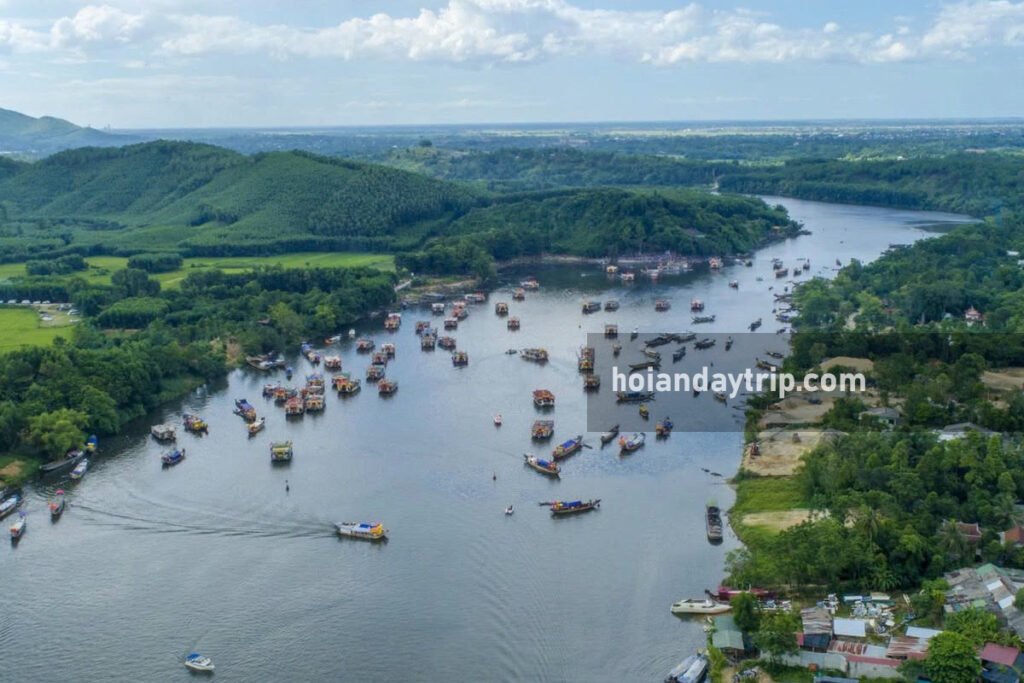
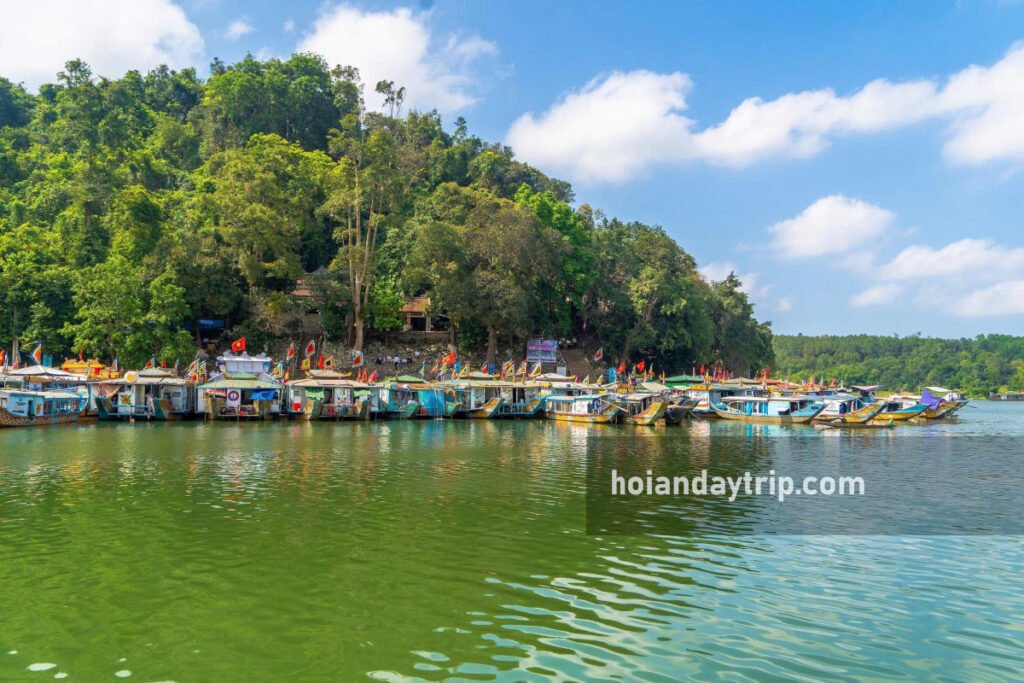
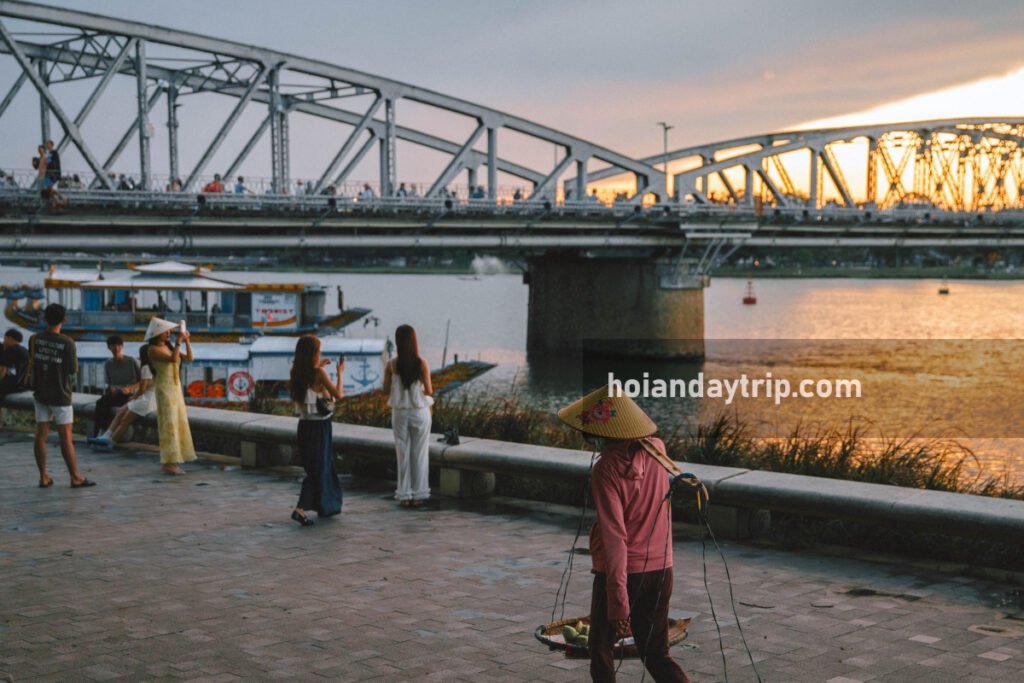
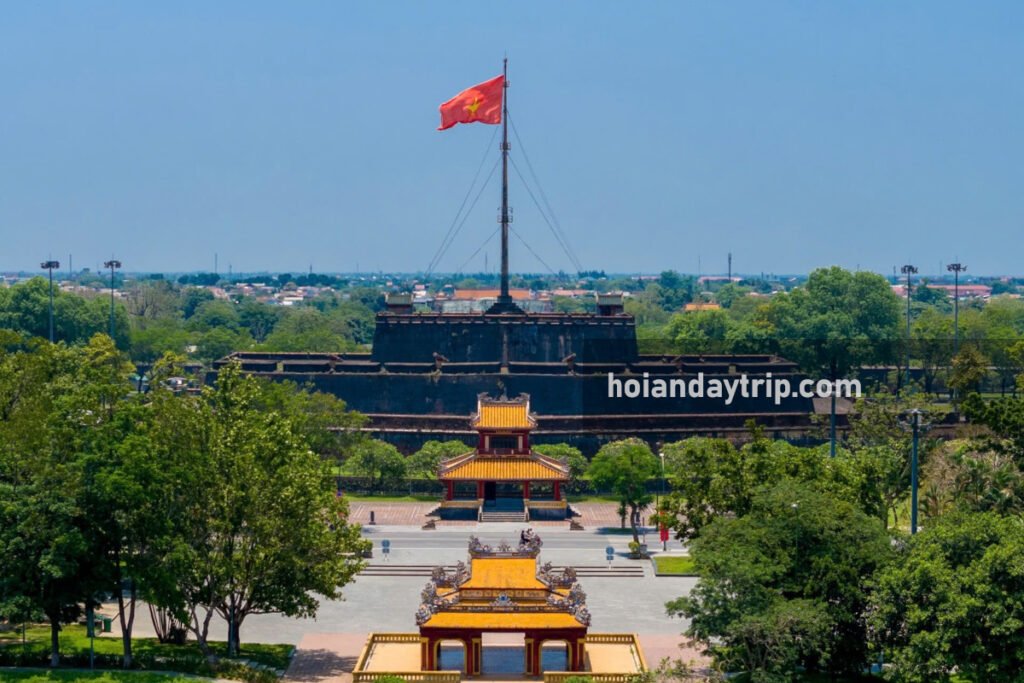
The most stunning way to go to Thien Mu Pagoda is by dragon boat on the Perfume River. The boats often depart in stations along the east bank (right bank) of the river because the city downtown is on this bank. It takes passengers about 20-30 mins to see the pagoda. If start the boat trip at Toa Kham station, visitors have the chance to see Truong Tien Bridge, the symbolic bridge of the city, and then go under it. Later, on the right hand side, it’s possible to see the Flag Tower, the landmark of the Hue Imperial City. See more information & details
HoiAn Day Trip Company daily organizes tours and transfers in Hue, Da Nang and Hoi An. Contact us by +84968009827 (hotline/whatsapp/line/zalo) or browse www.hoiandaytrip.com to see tours and make a reservation. Thank you very much!
HoiAn Day Trip Company daily organizes tours and transfers in Hue/Da Nang/Hoi An. Contact us by +84968009827 (hotline/whatsapp/line/zalo) or browse www.hoiandaytrip.com to see tours and make a reservation. Thank you very much!
Guided Tours to Thien Mu Pagoda
Places to Visit near Thien Mu Pagoda
Near Thien Mu Pagoda, visitors can go to these places: Temple of Literature or Temple of Letters, Temple of Military (distance: 750m), An Hien Garden House (distance: 1km), Huong River Antique Pottery Museum (distance: 400m).
Photos, Videos about Thien Mu Pagoda
Here are beautiful photos and videos about Thien Mu Pagoda in Hue Vietnam: