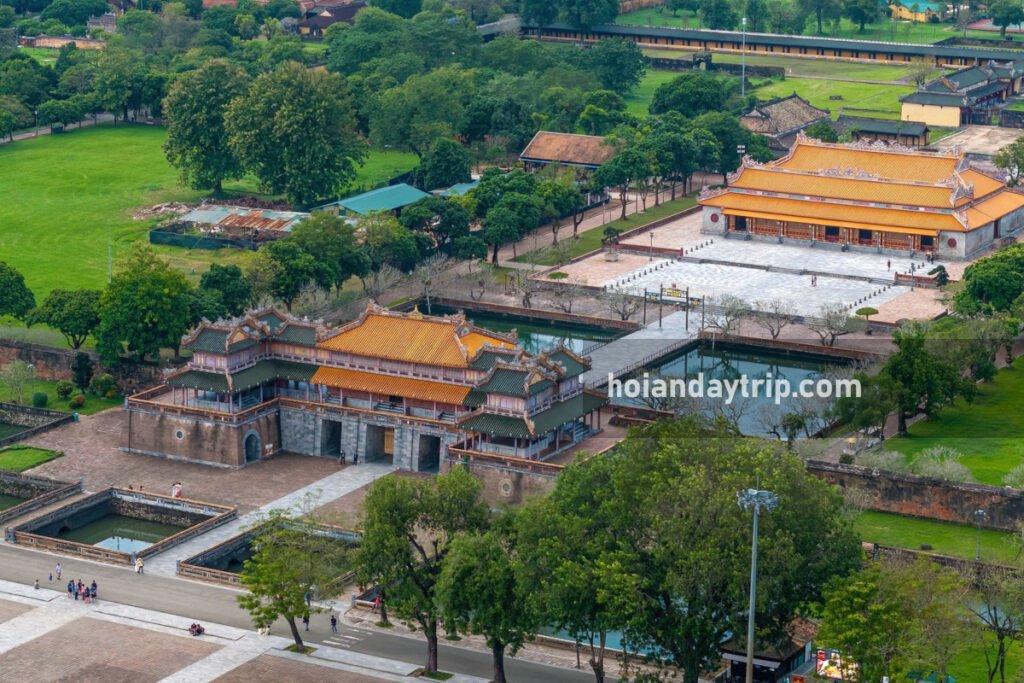
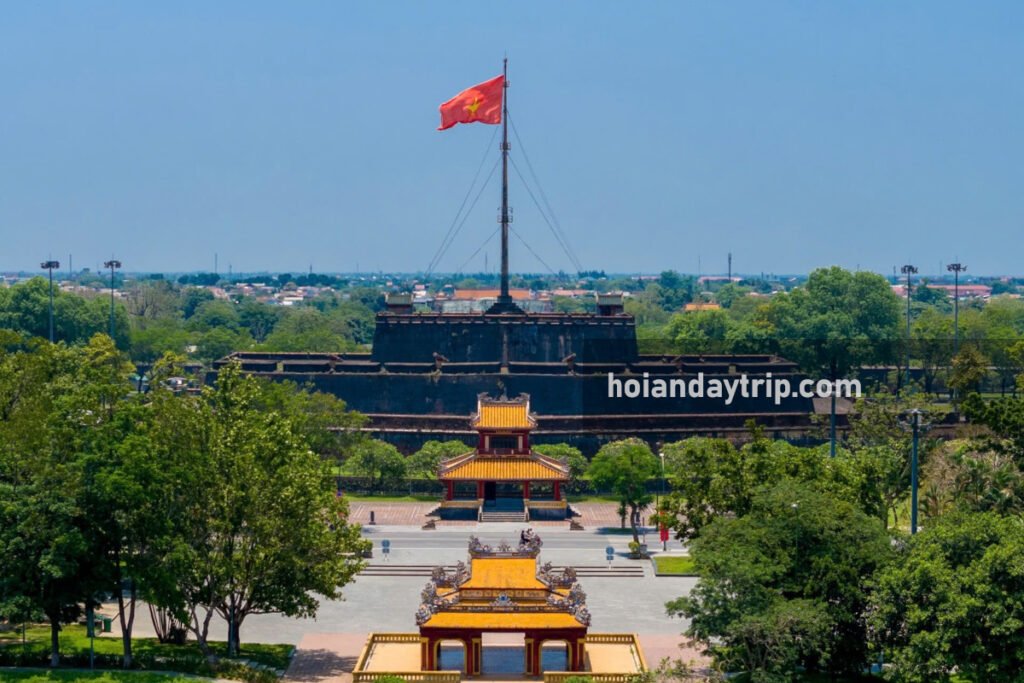
The Meridian Gate (or Noon Gate, Ngo Mon) is a must see attraction and the emblem of Hue city, Vietnam. It’s the largest and south entrance of the Hue Imperial City, seat of power for 13 Nguyen kings from 1802 to 1945. It stands between the Flag Tower and the Palace of Supreme Harmony. Both daytime and nighttime, the pavilion of this enormous building boasts a magnificent and grand architecture. Now, let’s HoiAn Day Trip Company provide you everything that you need to know about Ngo Mon or Meridian Gate in Hue.
You may also like:
• Content by Tam Le, founder of HOIAN DAY TRIP CO.,LTD
• Designed by Giang Cong Minh, co-founder of LS E&C LTD and his team
• Photo by Dang Cong Loi, Dao Xuan Son, Tam Le & others
Must Knows about Ngo Mon Gate (Hue)
– Location/address: 23 Thang 8 St, Phu Xuan district, Hue City, Vietnam
– Other name(s): Ngo Mon Gate, Noon Gate, South Gate
– Year of construction: 1833
– Height:
– Opening hours: 7:30 am to 5 pm daily
– Entrance fee: 200,000 VND for adult & children above 12 years old (2024)
– Reason(s) to visit: the emblem of Hue city, an impossing monument in Hue’s historic citadel, a world heritage site
– Time to spend: 30 to 60 mins
– Best time to visit: early morning, late afternoon
– Tour guide: contact +84968009827 (hotline/whatsapp/line/zalo)
– Travel blog: https://hoiandaytrip.com/meridian-gate-hue-imperial-city
– Recognition(s): Unesco world heritage site (1993)
– Tour guide: contact +84968009827 (hotline/whatsapp/line/zalo)
– Food & drink: yes available
– Shopping: no
– Fact:
Ngo Mon Gate on Map
History of Ngo Mon Gate in Hue
The Meridian Gate (Noon Gate, Ngo Mon) is the main gate or the south gate of the Imperial City of Hue (Hoang Thanh Hue). It’s built by request of Gia Long king, founder of the Nguyen dynasty (1802-1945) after he unified the country. At that time, its name was Nam Khuyet Dai which simply means ‘south gate’. Meanwhile, other gate-bastion of the Imperial City were named Dong Khuyet Dai (‘east gate’), Tay Khuyet Dai (‘west gate’), and Bac Khuyet Dai (‘north gate’). On its top, there was Can Nguyen Palace, and on both sides, there were two gates: Huu Doan Mon (literally ‘Right End Gate’) and Ta Doan Mon (literally ‘Left End Gate’).
In 1833, the son/successor of Gia Long king – Minh Mang king, re-planned the Imperial City of Hue, with some ideas taken from the Forbidden City at Beijing. By that time, Nam Khuyet Dai was replaced by another building, with a different size and style. Later, the new one was named ‘Ngo Mon’ or the Meridian Gate or the Noon Gate. This name originates from its direction, the south.
On 30th August 1945, the abdication announcement of Bao Dai king, the 13rd emperor of Nguyen dynasty took place in Ngu Phung Pavilion on the Meridian Gate. After this event, he became the last king in Vietnamese history, marking the end of 143-years-long Nguyen dynasty and 1000-years-long feudal period in the country. He abdicated in response to the August Revolution that was launched by Viet Minh (League for Independence of Vietnam) against the Empire of Vietnam (a puppet state of imperial Japan governed by him) and the Empire of Japan. Previously, on 25th August 1945, his abdication was done and the statement had been published at the Pavilion of Edicts to let all citizens know. At the Noon Gate, he passed a ceremonial seal and sword (two imperial power’s symbols) to representatives from the government of Democratic Republic of Vietnam (today Socialist Republic of Vietnam). After that, he became a common citizen and was invited by the new government to be an advisor. In 1997, Bao Dai died in Paris, France.
During French and American wars in the 20th century, particularly 1947 and 1968, the Meridian Gate had suffered from heavy battles. From 2012 to 2021, a large-scale restoration occurred, with a budget of 80 billions dong. Phase I lasted from 2012 to 2015, and Phase II lasted from 2016 to 2019. In early 2021, the upper pavilion Ngu Phung opened to visitors again.
In 2015, Hue city received a sponsor of 100,000 USD from a South Korean-owned company, to install a modern lighting system. At night, visitors can see a lightful and colorful building.
Architecture of Ngo Mon Gate in Hue
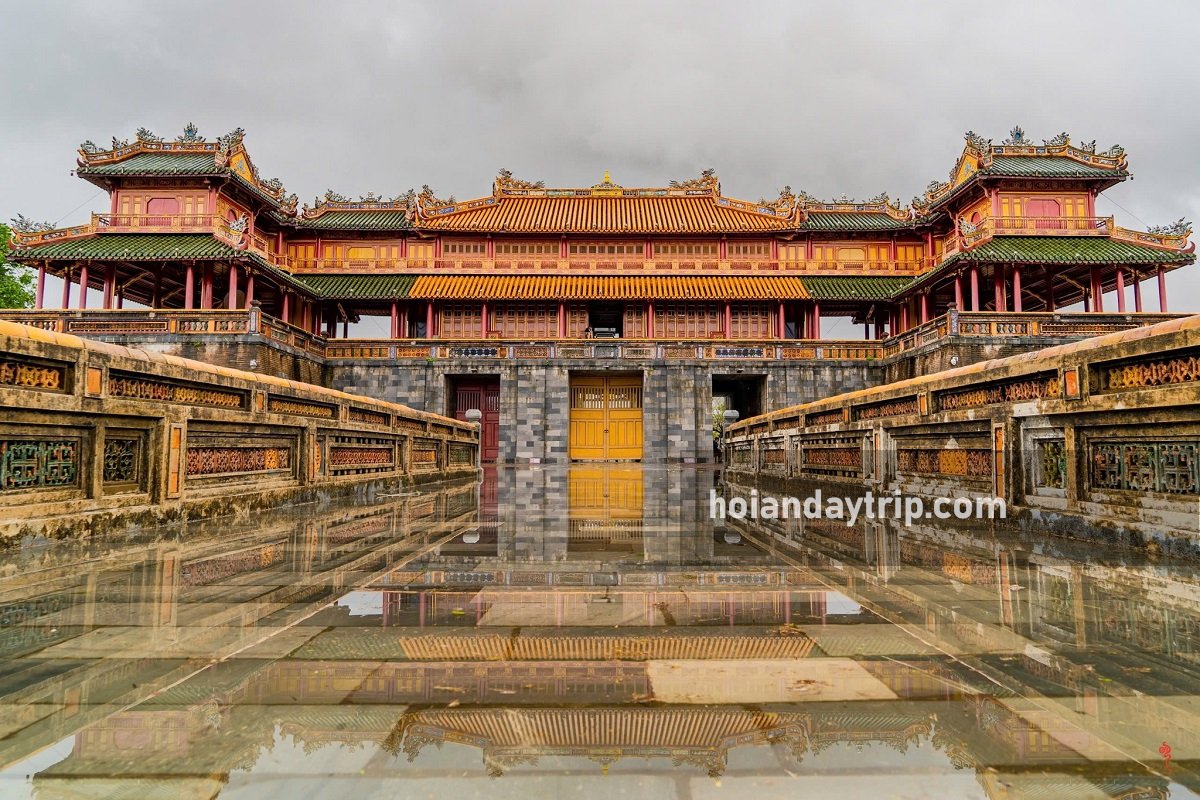
About the architecture, the Meridian Gate (Noon Gate, Ngo Mon) has two sections: the base and the pavilion sitting above it. This is the greatest imperial gate surviving in Vietnam after some thousands of years of ups and downs. Local people in Hue often describe its layout: ‘five doors, nine pavilions’ and ‘one yellow-tile pavilion, eight green-tile pavilions, three straight doors, two side doors’.
The base of the Meridian Gate is 5-meters tall, built by brick, and has an U-shape, with two protruding arms. It has 5 entrances, three in the middle, and two in the protruding wings. The central entrance is yellow lacquered, exclusive for the emperor. That’s why today it’s closed (there is no king anymore in Vietnam). There is a stone-paved imperial road running from the Flag Tower, through the square, through this entrance to Thai Hoa Palace. Only kings could walk on it. From outside, the entrance to the right, is for literature mandarins and the entrance to the left, is for military mandarins. During the reign of Gia Long king (first king), this rule was opposite because ‘military’ mandarins had a more important role than ‘literature’ ones. Two other entrances (in protruding wings) were for imperial guards, horse, and elephant. Visitors now go into the Imperial City by two mandarin doors.
In 2017, the 125th emperor of Japan Akihito walked on the imperial road and through the central entrance of the Meridian Gate to go into the Royal Palace of Hue. The reason is that he was still a king at that time! In the past, representatives of the French colonial government could use this way to see the king.
Sitting atop the base, there is Ngu Phung Pavilion (literally Pavilion of the Five Phoenixes), the highlight of the Meridian Gate. Its architecture portrays five phoenixes perching on a high place. According to the king, phoenixes also perched on the trees behind Thai Hoa Palace. Here, the abdication ceremony of the last ever king of Vietnam took place in 1945. He sometimes went with his wife although women were prohibited (she was the first woman ever too!). To visit this magnificent pavilion, visitors need to go to the side and then climb stairs.
Ngu Phung Pavilion has an ernomous hall in the middle, two side pavilions, and structures connecting them, all supported by nearly 100 ironwood columns. In total, it has 9 roofs, and in Vietnamese culture, number 9 symbolizes supreme power of the king and eternal longevity of the dynasty (similar to the Nine Dynastic Urns or the Nine Holy Cannons). On roof ridges, there are lots of dragons and the sun, both symbolize the monarchy. In the past, the king was considered the ‘son of heaven’.
The central hall of Ngu Phung Pavilion features a roof covered by yellow ceramic tiles, while others have a green tile roof. Within it, the king would sit on the throne and witness special/essential events of the country occuring on the front square, such as the ceremony to announce the highest-scored students in royal examinations, to publish the new calendar, or troop movements.
Today, after restoration projects, visitors have the chance to see the copy of the gold seal belonging to all kings. Most of them portray dragons and have some differences in style (or size) to show different reigns. Outside, it’s easy to view the whole square and the Flag Tower where Vietnam’s national flag has been hung. Everything behind the wall is impossible to observe from this point (and vice versa). On the other side, that is the view to the buildings inside the Imperial City, including Thai Hoa Palace and Kien Trung Palace.
Side halls of Ngu Phung Pavilion accommodate a large drum (right from the square) and a large bell (left from the square). In the past, they were hired to announce timings for Great meetings between the king and officials in his government.
Other Gates of Hue Imperial City
Hien Nhon Gate (East Gate)
This gate is at the east end of the walking path behind the Thai Hoa Palace (Palace of Supreme Harmony). It’s constructed in 1804 when the Gia Long emperor requested to build the Imperial City. Until now, its name has been unchanged. In 1923, it’s reconstructed by request of Khai Dinh king, with three entrances and two storeys. For that reason, this gate has beautiful decorations made by small pieces of ceramic and glasses that are typical to Khai Dinh’s reign, just similar to Mausoleum of Khai Dinh. It’s used to provide the entry into (or to leave) for male guardians, officials and servants.
Hien Nhon Gate is the exit gate of the Hue Imperial City. Anyway, it should be the last place on the visiting plan in this royal enclosure. After walking through it, visitors can see trishaws, taxi/cars or motorbike taxi to take one ride to return to the parking lot of the Imperial City (Nguyen Hoang parking lot). Just a few minutes away, it’s possible to see the Museum of Royal Antiquities and the Imperial Academy (Quoc Tu Giam).
Chuong Duc Gate (West Gate)
This gate is in the west end of the walking path behind the Thai Hoa Palace (Palace of Supreme Harmony). It’s constructed in 1804 when Gia Long emperor requested to build the Imperial City. Until now, its name has been unchanged. In 1921, it’s reconstructed by request of Khai Dinh king, with three entrances and two storeys. Two years late, he continued rebuilding Hien Nhon Gate on the other side of the citadel. For that reason, this gate has beautiful decorations made by small pieces of ceramic and glasses that are typical to Khai Dinh’s reign, just similar to Mausoleum of Khai Dinh. It’s used to provide the entry into (or to leave) for female guardians, officials, and servants. In 2003 and 2004, it’s restored after damages during the wars, following the architectural layout in Khai Ding time.
Hoa Binh Gate (North Gate)
This is the north or back gate of the Imperial City of Hue. It’s simple, with three entrances, and stands next to the Pavilion of Peace in Four Directions (Lau Tu Phuong Vo Su).
Tips to Visit Ngo Mon Gate in Hue
– In the dry season, from February to the end of August, visitors should bring sun cream, sun glasses, and some bottles of water.
– In the rainy season, from September to January, visitors should bring rain poncho or jacket, umbrella, sandal or waterproof shoes.
– The Meridian Gate of Hue (Ngo Mon) lies within the Imperial City, so visitors still need to wear respectively if want to visit. In other words, please wear long pants to cover upper knees, shirt to cover armpits, navel, chest and shoulder.
– Staircases leading to the pavilion of the Meridian Gate of Hue are steep and not wheelchair accessible like other traditional tall buildings in Vietnam. On rainy days, steps will be wet and slightly slippery.
– Do not touch on any ancient artifacts and photos in the Meridian Gate of Hue.
– If just want to see the Meridian Gate of Hue (Ngo Mon) from outside, there is no ticket required. It’s free!
– Traditional dress of Vietnamese people Ao Dai is highly recommended. It can be the best costume to wear and have awesome photos then!
– It’s better to visit with a local guide who knows the history well. Contact us by +84968009827 (hotline/whatsapp/line/zalo) to book.
How to Get to Ngo Mon Gate in Hue Imperial City
The Meridian Gate of Hue (Ngo Mon) is on 23 Thang 8 Road, Phu Xuan district, Hue city, Vietnam. It’s located on the north bank of the Perfume River;
In Hue city, from the north bank of the Perfume River (Phu Xuan district), visitors can walk, take a car/taxi, ride the motorbike or bicycle to the Meridian Gate of Hue. No matter where you start going, it’s needed to reach 23 Thang 8 Street.
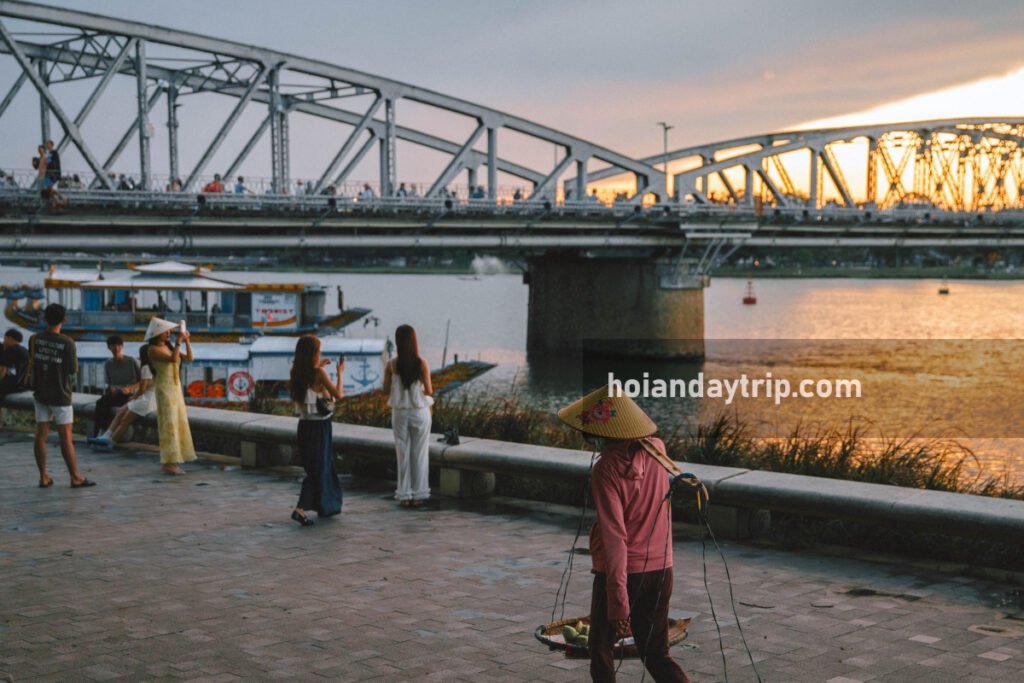
In Hue city, from the south bank of the Perfume River (Thuan Hoa district), visitors can walk, take a car/taxi, ride the motorbike or bicycle to the Meridian Gate of Hue. To go to the other side of the river where the Imperial Citadel is located, it’s needed to cross one of these bridges: Truong Tien Bridge, Phu Xuan Bridge and Da Vien Bridge. After that, follow Le Duan St and then go through one of these gates: Cua Ngan (Ngan Gate), Cua Quang Duc (Quang Duc Gate) to see the Meridian Gate.
Bus will park in Nguyen Hoang parking lot. After that, visitors will need to walk through the nearby gate to enter the citadel. While going on the bridge, please slow and careful because it’s small and motorbikes/cars are still moving on it. On the other side of the gate, there are walking streets leading to the ticket counter and the Meridian Gate then.
If ride the motorbike, visitors can ride through Cua Ngan Gate or Cua Quang Duc Gate to enter the citadel, and then park in a nearby parking lot. The fee is 5,000-10,000 VND/bike/time. From the parking lot, walk to 23 Thang 8 Street to see the ticket counter and the Meridian Gate.
From Da Nang, Hoi An and Lang Co, visitors need a private transfer or guided tour to get to the Meridian Gate of Hue (Ngo Mon).
HOIAN DAY TRIP CO.,LTD organizes guided tours and transfers everyday in Hue Vietnam. Contact us by +84968009827 (hotline/whatsapp/line/zalo) or browse www.hoiandaytrip.com to see tours & make a reservation. Thank you very much!
Places to Visit Near Ngo Mon Gate
Within the Hue Imperial City, visitors can go to these places: Thai Hoa Palace, The Mieu Temple, the Nine Dynastic Urns (Cuu Dinh), Thai Mieu Temple, Dien Tho Palace, Truong Sanh Residence, Kien Trung Palace, Thai Binh Pavilion, Duyet Thi Duong Royal Theater, Thieu Phuong Garden, Co Ha Gardens, the Nine Holy Cannons (Cuu Vi Than Cong) …
Near Ngo Mon Gate, visitors can go to these places: Museum of Royal Antiquities (distance: 650m), Imperial Academy or Quoc Tu Giam (distance: 500m), Ho Chi Minh House (distance: 1,3 km), Flag Tower or Ky Dai (distance: 100m), the Nine Holy Cannons (distance: 150m), Phu Van Lau or Pavillion of Edicts (distance: 600m), Nghenh Luong Dinh or Pavillion of the Welcoming (distance: 650m), Tinh Tam Lake (distance: 2 km), Xa Tac Esplanade or the Altar of Land and Grain (distance: 1,1 km), the Imperial Library or Tang Thu Lau (distance: 2 km).
Not far away from the Hue Imperial City, visitors can go to these places: Dong Ba Market (distance: 1,5 km), Truong Tien Bridge (distance: 1 km), An Hien Garden House (distance: 3 km), Thien Mu Pagoda (distance: 4 km), Hue’s Night Walking Street (distance: 2,5 km), Hai Ba Trung Walking Street (distance: 2 km).
Photos, Videos about Ngo Mon Gate in Hue
Here are beautiful photos and videos about Ngo Mon Gate in Hue: