The Nine Dynastic Urns (Cuu Dinh) is a must see in the Hue Imperial City, Vietnam. It’s a collection of nine bronze urns on which 162 images across the country are sophisticatedly casted on, including mountains, rivers, plants, animals, weapons,… For that reason, this is not only a precious antiquity, but also an ‘atlas of Vietnam’. Now, let’s HoiAn Day Trip Company provides all the information that visitors need to know about the Nine Dynastic Urns in Hue.
You may also like: Nine Holy Cannons (Cuu Vi Than Cong)
• Content by Tam Le, founder of HOIAN DAY TRIP CO.,LTD
• Designed by Giang Cong Minh, co-founder of LS E&C LTD and his team
• Photo by Dang Cong Loi, Dao Xuan Son, Tam Le & others
Must Knows about Nine Dynastic Urns in Hue
– Location/address: The Mieu Temple within Hue Imperial Citadel, 23 Thang 8 St, Phu Xuan district, Hue city, Vietnam
– Other name(s): Cuu Dinh, the Nine Tripod Cauldrons of Vietnam
– Opening hours: 24hrs a day, 7 days a week
– Ticket price: 200,000 VND/adult & children above 12 years old (2024)
– Reason(s) to visit: the best collection of Vietnamese antique urns
– Best time to visit: anytime
– Time to spend: 15-20 mins
– Recognition(s): Unesco world heritage site (1993), national treasure (2012)
– Travel blog: https://hoiandaytrip.com/nine-dynastic-urns-hue-vietnam
– Tour guide: contact +84968009827 (hotline/whatsapp/line/zalo)
Hue Nine Dynastic Urns on Map
Meaning of Number 9 in Vietnamese Culture
The Nine Dynastic Urns in Hue Citadel is a collection of 9 bronze cannons. During dynastic feudal periods in Vietnam, this number is associated with supreme imperial power or king’s power. It’s the highest natural number and the highest odd number, representing the maximum power and completeness. Additionally, nine also symbolizes the longevity or long life, so there are so many things made in nine, such as the Nine Holy Cannons which comprise nine bronze cannons casted to celebrate the victory of the first Nguyen emperor, nine different styles of dragon on the roof of Thai Hoa Palace where the coronation of kings takes place, nine dragons on ‘Dragon robe’ which the kings wear… The kings wished that all of them (and their dynasty, nation) would exist forever.
History & Meaning of Nine Dynastic Urns
The Nine Dynastic Urns (Cuu Dinh) were casted from October 1835 to early 1837 by craftsmen from Phuong Duc, the most famous ‘bronze workshop’ in the city. Minh Mang king, the second Nguyen emperor requested to make them, to symbolize the supreme power and authority of the Nguyen dynasty (1802-1945). His idea might be taken from the Nine Tripod Cauldrons (Jiu Ding) in China that are made by legendary king Yu the Great or Yu the Engineer.
On 4th March 1837, the inauguration ceremony of the Nine Dynastic Urns took place. Meanwhile, these urns were replaced at the The Mieu Temple where Gia Long emperor (father of Minh Mang king) and his successors are worshipped.
Each urn of the Nine Dynastic Urns represents a king worshipped inside The Mieu Temple. Before 1958, there were 7 emperors.
On 8th May 2024, collection of bas reliefs carved on the Nine Dynastic Urns was recognized as Asia Pacific’s documentary heritage. This is the 4th heritage of the kind in Hue, after woodblocks of the Nguyen dynasty (2009), imperial records of the Nguyen dynasty (2014), and the royal literature on Hue’s royal architecture (2016).
List of Symbols on Nine Dynastic Urns in Hue
There are 162 symbols and letters carved on the Nine Dynastic Urns at The Mieu Temple, Hue’s Imperial Citadel. This collection was known as ‘the atlas of Vietnam’ at that time. Every urn has 18 bas-reliefs in total, including 17 symbols and one title name (if plus 1 and 8, it’s nine!). Meaning that there are only 153 symbols. In which, it’s possible to find nine stars/natural phenomenon, nine major rivers, nine major mountains, nine canals, nine estuaries/mountain pass gates, nine animals, nine birds, nine grains, nine vegetables/herbs, nine flowers, nine fruit trees, nine wood trees, nine medical plants, nine fishes/bucks/snails/turtles, nine weapons/boats/ships.
Cao Dinh (Gia Long king’s urn, meaning ‘Great Urn’): (1) the urn’s name, (2) dragon, (3) the sun, (4) jackfruit tree, (5) tiger, (6) the East Sea, the vast sea to the east of Vietnam, part of the Pacific Ocean (7) Thien Ton Mountain, the mountain where ancestors of Nguyen lords and kings are buried, (8) Vinh Te Canal, a 80-kilometers-long canal built from 1819 to 1824, connecting Mekong River and Gulf of Thailand in Southern Vietnam, (9) sail boat, (10) cannon, (11) agarwood, (12) softshell turtle, (13) spring onion, (14) common rice, (15) pheasant, a rare bird found in Bach Ma National Park, (16) ironwood, (17) crape myrtle (lagerstroemia indica), (18) Ben Nghe Canal, a 3-kilometers-long canal connecting Tau Hu Canal and Saigon River in present-day Ho Chi Minh city.
Nhan Dinh (Minh Mang king’s urn): (1) the urn’s name, (2) two-floor boat, (3) Pho Loi River/Canal, a 30–kilometers-long canal running from the Perfume River towards Thuan An port, built in 1836 by request of Minh Mang king, (4) shallot leaf, (5) Kynam wood, an expensive wood, (6) the South Sea, the sea to the south of Vietnam (7) parasol tree or firmiana simplex, a tree where phoenixes love perching on, (8) whale, (9) lotus flower, (10) leopark, (11) the Perfume River, a 80-kilometers-long river flowing from confluence of Ta Trach and Huu Trach rivers, to Thuan An estuary, by the Imperial City of Hue, (12) langsat fruit or Lansium domesticum, (13) gun carriage, (14) glutinous rice, (15), moon, (16) peacock, (17) hawsbill sea turtle, (18) Ngu Binh Mountain, the ‘protective’ mountain of Hue in the front from bad and unlucky spirits, an iconic hill of Hue.
Chuong Dinh (Thieu Tri king’s urn): (1) the urn’s name, (2) coke, (3) golden turtle, (4) the West Sea, the sea to the west of Vietnam, (5) the Oriental onion, (6) rhinocerous, (7) mung bean, (8) musket or muzzle-loaded long gun, (9) five planets, (10) cardamon, a spice/medical plant, (11) leather-covered assault warship, (12) Loi Nong River/Canal, a 27-kilometers-long river running from An Cuu River to Tam Giang Lagoon, built in 1814 by request of Gia Long king, (13) mango tree, (14) crocodile, (15) Kim Phung Mountain, a 417-meters-tall mountain in Hue, visible from the Imperial City, (16) jasmin flower, (17) huen wood, a rare local wood, (18) .
Anh Dinh (Tu Duc king’s urn): (1) the urn’s name, (2) rose, (3), (4) kien kien wood or Hopea siamensis, (5) Hong Linh Mountain in Ha Tinh, a northern central province of Vietnam (6) crance, (7) snake, (8) Lo River, a 470-kilometers-long river in northern Vietnam, originating from China and flows into the Red River, (9) areca palm, (10) butterfly bullets, (11) the Big Dipper, (12) turmeric tree, (13) military flag, (14) Ma River, a 400-meters-long river in northwestern Vietnam, running through Laos, (15) sweetgum tree or Liquidambar, (16) mulberry tree, (17) the Milky Way, (18) cicada buck.
Nghi Dinh (Kien Phuc king’s urn): (1) the urn’s name, (2) coconut worm, (3) elephant, (4) Thuan An estuary where the Perfume River flows into the sea, gateway of Hue from the ocean, (5) camellia, (6) wild duck, (7) Bach Dang River, a river where Vietnamese people defeated Chinese and Mongolian invasions in the past, (8) long bean, (9) warship, (10) the Ursa Minor, (11) cinnamon, (12) long spear, (13) Cuu An River, a 27-kilometers-long artificial river in the Red River Delta, northern Vietnam, built in 1835, (14) cypress tree or Cupressus torulosa, (15) mustard, (16) snakehead fish, (17) Quang Binh Quan, an ancient gate in Dong Hoi city, (18) Ben Nghe River.
Thuan Dinh (Dong Khanh king’s urn): (1) the urn’s name, (2) golden oriole bird, (3) water buffalo or bull, (4) Can Gio estuary where Saion River flows into the sea, gateway of Gia Dinh city from the sea (today Ho Chi Minh city), (5) sunflower, (6) sen wood or Phoebe zhennan, (7) Thach Han River, a 270-kilometers-long river running from the Annamite Range and by Quang Tri Citadel, capital of Quang Tri province, (8) soybean, (9) hand-rowing wooden boat, (10) wind, (11) clam, (12) peach, (13) Tan Vien Mountain or Ba Vi Mountain, a 1,281-meters-tall mountain in northern Vietnam, known as ‘King of Vietnamese mountains’ due to its important role, (14) climing perch or Anabas testudineus, (15), (16) , (17) (18) .
Tuyen Dinh (Khai Dinh king’s urn): (1) the urn’s name, (2) Oriental arborvitae or Platycladus, (3) sea turtle, (4) Lam River, a 512-kilometers-long river running from Laotian mountains to the Gulf of Tonkin, northern central Vietnam, (5) peanut, (6) pig, (7) Dai Lanh Mountain, a mountain range between Phu Yen and Khanh Hoa province, where Ca pass cross, (8) pagoda tree or Styphnolobium japonicum, (9) imperial wooden boat rowed by 12 paddles, (10) cloud, (11) longan tree, (12) bow and arrow, (13) Red River, a 1149-kilometers-long river running from China to the Gulf of Tonkin, by Hanoi capital of Vietnam, the mother river of Vietnamese civilization, (14) bird’s nest, (15) ginger, (16) Due Mountain, a tall mountain in the upstream of the Perfume River, one of three major mountains of Hue city, (17) common hill myna, (18) mangrove horseshoe crab, popular found in Sam Lagoon, part of Tam Giang-Cau Hai Lagoon network.
Du Dinh (): (1) the urn’s name, (2) pine tree, (3) goat, (4) Da Nang estuary, where the Han River flows into the sea, one of the foremost ports of Vietnam, (5) hibiscus flower, (6) oyster, (7) Song Ve River, a 80-kilometers-long river in southern-central Quang Ngai province, (8) podao or ‘horse-cutter sword’, (9) white bean, (10) lightning, (11) betel tree, (12) black seaboat, (13) Vinh Dien River/Canal, a 30-kilometers-long artificial river connecting Thu Bon River and Cam Le River (then the Han River in Da Nang city), (14) beefsteak plant or perilla, (15) peach, (16) Hai Van Gate, a military post on the top of Hai Van Pass, a 20-kilometers-long pass between Hue and Da Nang, (17) threadfin sea catfish or Arius arius, (18)
Huyen Dinh (): (1) the urn’s name, (2) painted stork or Mycteria leucocephala, (3) mountain horse, (4) Thao River, a 140-kilometers-long stretch of the Red River from China border to confluence of Da River and Lo River, (5) cotton tree, (6) cashew fruit, (7) Hoanh Son Gate, on the top of a mountain range/pass between Ha Tinh and Quang Binh provinces, north-central Vietnam, (8) Vietnamese ginseng, (9) fire-breathing weapon, (10) rain, (11) garlic, (12) giant snake, (13) Hau Giang or Bassac River, a 120-kilometers-long river in Mekong Delta, major waterway in southern Vietnam, (14) lychee tree, (15) horse cart, (16) rainbow, (17) michelia flower, (18) water bug or Lethocerus indicus.
Tips to Visit Nine Dynastic Urns in Hue
– The Nine Dynastic Urns are inside the Hue Imperial City (particularly The Mieu Temple), so visitors must wear respectively if want to visit. Please wear long pants which cover the upper knees, the shirt which covers navel, breast, shoulder, and armpits. The ones of see-through fabric are not suitable.
– In the dry season, visitors should bring sun cream, sun glasses, hat/cap/umbrella, and some bottles of water.
– In the rainy season, visitors should bring rain poncho/jacket or umbrella, sandal or waterproof shoes.
– Visitors can take pictures with all urns of the Nine Dynastic Urns.
How to Get to Nine Dynastic Urns in Hue Imperial City
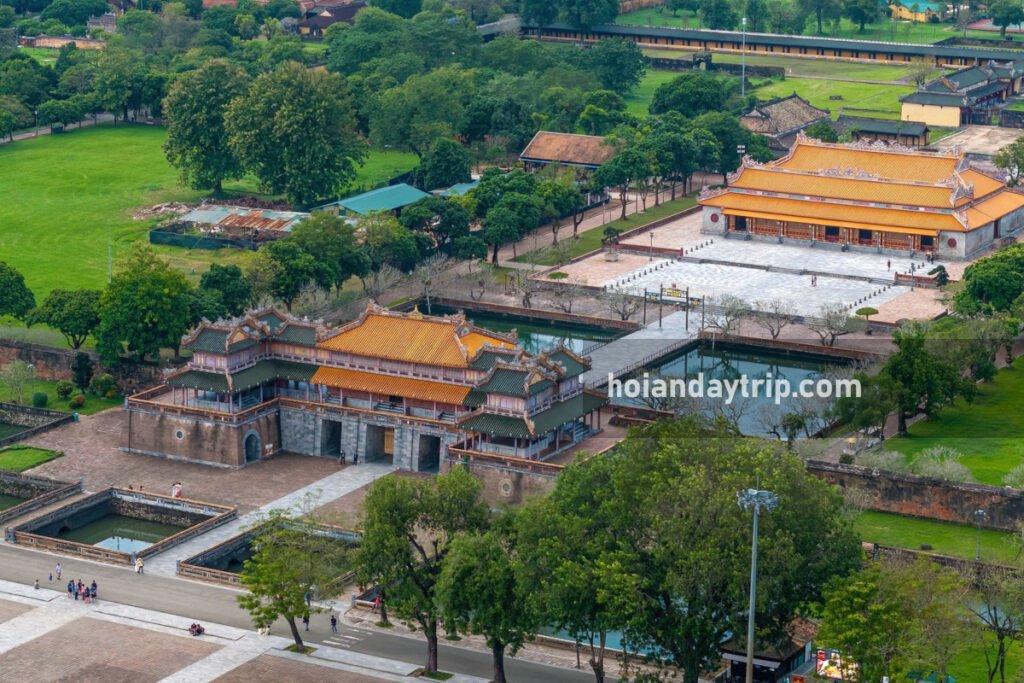
The Nine Dynastic Urns (Cuu Dinh) is within the Hue Imperial City/Hue Citadel, on the northern bank of the Perfume River, in Phu Xuan district of Hue city.
HOIAN DAY TRIP Company daily organizes tours and transfers in Hue, Da Nang, and Hoi An. Contact us by +84968009827 (hotline/whatsapp/line/zalo) or browse www.hoiandaytrip.com to see tours and make a reservation. Thank you very much!
Places to Visit Near Nine Dynastic Urns in Hue
Within the Hue Imperial City, visitors can go to these places: Thai Hoa Palace, The Mieu Temple, the Nine Dynastic Urns (Cuu Dinh), Thai Mieu Temple, Dien Tho Palace, Truong Sanh Residence, Kien Trung Palace, Thai Binh Pavilion, Duyet Thi Duong Royal Theater, Thieu Phuong Garden, Co Ha Gardens, the Nine Holy Cannons (Cuu Vi Than Cong) …
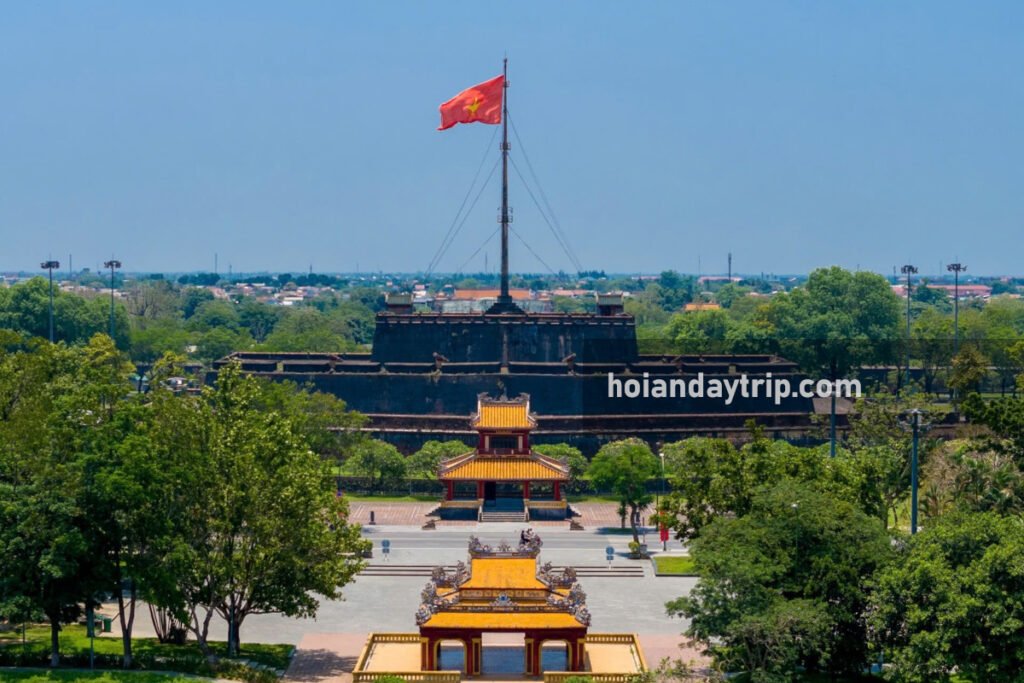
Near Ngo Mon Gate, visitors can go to these places: Museum of Royal Antiquities (distance: 650m), Imperial Academy or Quoc Tu Giam (distance: 500m), Ho Chi Minh House (distance: 1,3 km), Flag Tower or Ky Dai (distance: 100m), the Nine Holy Cannons (distance: 150m), Phu Van Lau or Pavillion of Edicts (distance: 600m), Nghenh Luong Dinh or Pavillion of the Welcoming (distance: 650m), Tinh Tam Lake (distance: 2 km), Xa Tac Esplanade or the Altar of Land and Grain (distance: 1,1 km), the Imperial Library or Tang Thu Lau (distance: 2 km).
Not far away from the Hue Imperial City, visitors can go to these places: Dong Ba Market (distance: 1,5 km), Truong Tien Bridge (distance: 1 km), An Hien Garden House (distance: 3 km), Thien Mu Pagoda (distance: 4 km), Hue’s Night Walking Street (distance: 2,5 km), Hai Ba Trung Walking Street (distance: 2 km).
Photos, Videos about Nine Dynastic Urns in Hue
Here are beautiful photos and videos about Nine Dynastic Urns in Hue: