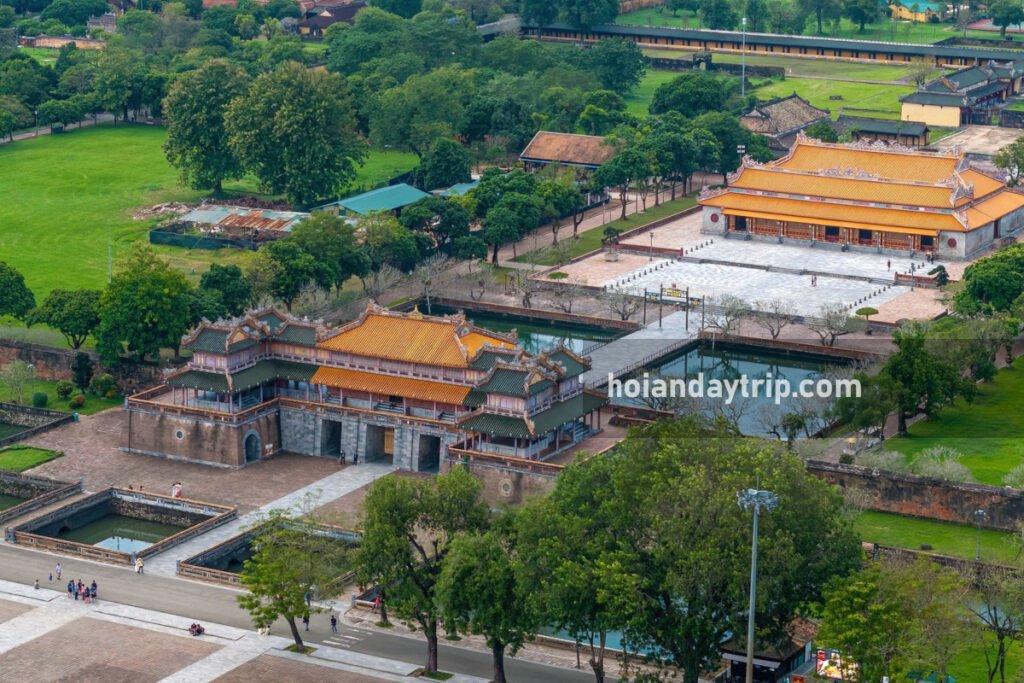
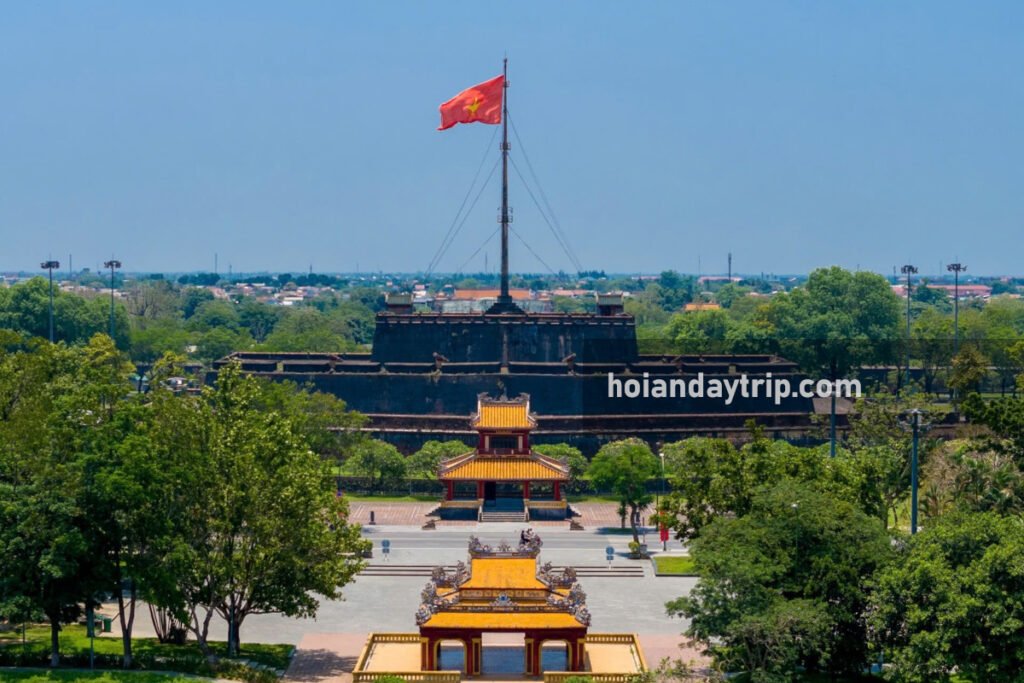
Tu Duc Tomb is the mausoleum of Tu Duc, the 4th emperor of the Nguyen dynasty. He ruled the country from 1847 to 1883 (36 years), longer than any kings in the same family. His life had many incidents, and his reign faced the invasion of colonists. Because of his artist’s soul, his tomb, which is designed by him, is poetic and harmonious between architectural buildings and the surrounding landscape. By that, Tu Duc Tomb is one of the greatest and most visited royal tombs in Hue. In this article, HoiAn Day Trip Company informs visitors of Tu Duc Tomb.
You may also like: Royal Tombs in Hue, Vietnam
• Content by Tam Le, founder of HOIAN DAY TRIP CO.,LTD
• Designed by Giang Cong Minh, co-founder of LS E&C LTD and his team
• Photo by Dang Cong Loi, Dao Xuan Son, Tam Le & others
Must Knows about Tu Duc Tomb (Hue)
– Location/Address: Doan Nhu Hai St, Thuy Xuan ward, Thuan Hoa district, Hue City, Vietnam
– Other name(s): Tomb of Tu Duc Emperor, Mausoleum of Emperor Tu Duc, Khiem Lang or Mausoleum of the Modesty
– Opening hours: 6:30 AM to 5:30 PM (summer/dry season), 7 AM to 5 PM (winter/rainy season)
– Entrance fee: 150,000 VND for adult & children above 12 (2024)
– Reason(s) to visit: one of the best royal tombs in Hue, stories about the king
– Time to spend: 1-1,5 hour
– Best time to visit: anytime of the day
– Tour guide: contact +84968009827 (hotline/whatsapp/line/zalo)
– Travel blog: https://hoiandaytrip.com/tu-duc-tomb-hue-vietnam
– Recognition(s): Unesco world heritage site (1993)
– Food & drink: yes available
– Shopping: yes available
Tu Duc Tomb on Map
Better to Know about Tu Duc Emperor
Before coronation, Tu Duc king was known as Nguyen Phuc Hong Nham prince, the second son of Thieu Tri king (1807-1847). He is borned in 1829, at Hue. His mother is Mrs Pham Thi Hang (later Tu Du queen), daughter of a high-ranking mandarin from Go Cong area in the Mekong Delta. With the same mother, he has two older sisters, one of them died at age of 3. He was the first son of his mother.
In the beginning, Tu Duc king was thought not to be the next king (after his father). His older brother, Nguyen Phuc Hong Bao prince is the one who should be chosen because he’s the oldest son. In 1847, Thieu Tri king passed away, and after that, Nguyen Phuc Hong Nham prince was chosen to succeed him (this information was written on a secret letter). Hong Bao couldn’t believe it, and then he cried, vomited blood from his mouth, fell down on the palace’s floor. Later, somebody had to hold him up during the coronation ceremony of his younger brother.
Tu Duc king had 103 official wifes, but no biological children because of smallpox. For that reason, he thought that he didn’t fulfill his responsibilities for the family and the country, to have a boy to hand over the throne and to perpetuate the family’s lineage. Later, he adopted three grandchilds from his brother’s family, including Nguyen Phuc Ung Chan, Nguyen Phuc Ung Ky, and Nguyen Phuc Ung Dang. Nguyen Phuc Ung Chan (later Duc Duc king) was raised and educated directly by his beloved wife, Le Thien Anh queen. This prince became king right after him, but kept the role for 3 days only because he had rude, unaccepted actions in Tu Duc’s funeral ceremony. He died in 1883 in the jail due to no food. Nguyen Phuc Ung Dang (later Kien Phuc king) was crowned in 1883, at age of 15, but short-lived (only 8 months as a king). He died suddenly, without clear reasons. The last son, Nguyen Phuc Ung Ky (later Dong Khanh king) sat on the throne longest, about 4 years.
History of Tu Duc Tomb in Hue
Tu Duc Tomb (or Khiem Lang, Tomb of the Modesty) was built from 1864 to 1867. Like his great-grandfather Gia Long king, his grandfather Minh Mang king, and his father Thieu Tri king, he chose a piece of land in mountains in the upstream of the Perfume River to construct his mausoleum. This area is to the west of Hue citadel, symbolizing the death (sunset direction). Otherwise, it has many hills which protect the tomb from bad spirits, according to feng shui principles (a popular geomancy tradition in Asia).
In the beginning, Tu Duc Tomb was going to be constructed in 6 months. Interestingly, it’s designed by its owner Tu Duc king. At that time, its name was ‘Van Nien Co’ or ‘Tomb of the Thousands of Years’ because the emperor desired that it could have an eternal life. However, in 1966, it must be renamed ‘Khiem Lang’ or ‘Tomb of the Modesty’, after an uprising of workers led by Doan Huu Trung (1844-1866) and his brothers.
Doan Huu Trung was son-in-law of Tung Thien Vuong, one of grand-uncles of Tu Duc king, and supported Nguyen Phuc Hong Bao princess, older brother of Tu Duc king. On 8th August 1866, he came to the tomb, and had called many of about 50,000 persons who worked under excessive work pressures and poor living conditions, to struggle. They used the pestle as weapons, so their uprising was called ‘pestle rebellion‘ in history books. In the early morning on 9th August 1866, they came to the Meridian Gate (Royal Palace’s entrance), but then captured by imperial guards. They not only wanted to protest for better working and living conditions at the tomb, but also to dethrone Tu Duc king and let his brother Hong Bao to be crowned. After that, three Doan brothers were killed, and their family members in three generations must change their names, or suffer different penalties. Because of this uprising, Tu Duc king changed his mausoleum’s name to express his ‘modesty’ to workers, and the name for all buildings within it would start with ‘khiem’ (or modesty).
In 1867, Tu Duc tomb was finished, but the owner hadn’t passed away yet. For that reason, it’s used as a mountain palace where the king could come for relaxation, until his death in 1883 (16 years). Meanwhile, ‘Tomb of the Modesty’ was renamed ‘Palace of the Modesty’. This historic role makes the tomb more special than others in Hue. At that time, there were two palaces: Hoa Khiem Palace serving for his meetings with mandarins, and Luong Khiem Palace serving for his living. Nearby Minh Khiem Duong theater served for art performances (a small version of Duyet Thi Duong Royal Theater in the Forbidden Purple City). This place is unseen anywhere else in the country because it’s in a tomb! Not far away, there are residences for his wifes, concubines, eunuchs, and other servants.
After the death of Tu Duc king, two palaces became temples, the theater stopped its role. His wifes and servants moved from the Imperial City to the tomb, and lived there to worship the king, and preserve buildings. Mausoleum’s name was changed again, from ‘Palace of the Modesty’ to ‘Tomb of the Modesty’.
Buildings in Mausoleum of Tu Duc Emperor
The Protective Wall
Tu Duc Tomb is one of the largest imperial mausoleums in Hue city. It’s protected by a brick wall, like Tomb of Minh Mang king (Tu Duc’s grandfather), and has a total area of 12 hectares. Within the high wall, there are more than 50 buildings, including the temple zone, the tomb zone, lakes, gardens, and artificial hills. Two main zones, the temple zone and the tomb zone are set parallelly, similar to tomb of Gia Long king (Tu Duc’s great-grandfather), and tomb of Thieu Tri king (Tu Duc’s father).
Luu Khiem Lake
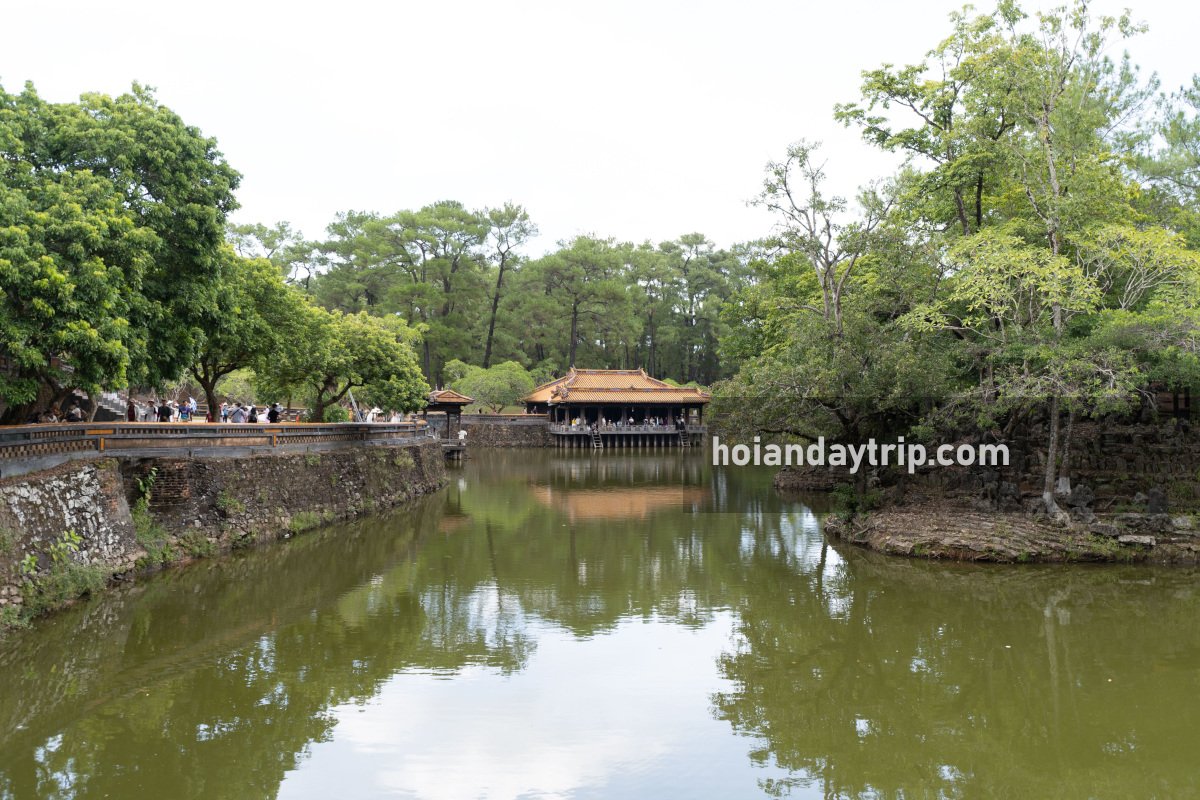
This lake is one of the highlights of Tu Duc Tomb. It’s fed by small streams running from the hills behind the mausoleum, and has an island. In the summer, it’s filled by lotus leaf and flowers, and in the winter, it’s calm and has a poetic golden reflection of pavilions. Here, the king raised golden carp fishes, and deers or other animals on the island.
On the water edge of Luu Khiem Lake, there are two pavilions, both made of wood and covered by yellow ceramic tiles. The smaller one, Du Khiem Ta, is by the main walking path. It has three levels, and three roofs. Here, the king sat to cool off, read books, write poetries or embark on a boat ride on the lake. The larger one, Xung Khiem Ta is on a curving lakeshore, connected with the main path by a bridge. It has wooden floors, and could accommodate many people in performances. The king listened to Hue singings in this place. On the lowest floor, visitors can see seats to have a break, enjoy the tranquility, feed fishes, or take pictures.
Hoa Khiem Palace & Luong Khiem Palace
Both Hoa Khiem Palace and Luong Khiem Palace sit atop the hill to the left of the main lake. So, visitors need to climb stairs to see it. On the stop of the staircase, there is a three-arched and two-storied entrance gate, made of wood and tiles. From here, it’s possible to view the lakes and surrounding gardens.
The first temple, Hoa Khiem Palace is behind an open yard, with two small shrines on the sides, for worship of literature and military mandarins who worked in Tu Duc’s reign. As an imperial building, this temple has overlapping roofs covered by yellow ceramic tiles, and decorated by flying dragons and dragons fighting the sun. Its main door doesn’t open to respect the king. So, visitors need to go in by the door in the left corner.
To show modesty, the interior of Hoa Khiem Palace where Tu Duc king is worshipped, has an uncomplicated decorative style. The columns are brown or black, not red lacquered like other royal temples and palaces.
Luong Khiem Temple stands behind Hoa Khiem Palace. It’s used to worship Tu Duc’s mother Tu Du empress.
Tomb of Tu Duc Emperor
Next to the temples, there is the Tomb of Tu Duc emperor (burial zone). This area has buildings arranged along an axis, and the king’s grave is at the end. After a few steps from the main walking path, there is a courtyard with low statues at both sides, including the ones portraying elephants, horse, military mandarins, and literature mandarins. On anniversaries, living mandarins come here to pray and pay homage to the former king.
On the higher terrace, there is the Stele Pavilion that is the biggest in the country. It houses a giant stone stele (4m high, 20 tons weigh) with more than 4,900 Chinese words. As a tradition, in a royal tomb, the son who handed over the throne, will write a paragraph to honour his dead father. However, because of no biological children, Tu Duc king did it by himself. He told stories about his life, what happened in the country during his reign, his parents, and about his tomb. Everything showed his modesty and a true history. In 2015, it’s recognized to be a Vietnam’s national treasure thanks to its uniqueness.
Close to the stele pavilion, there are two tall pillars, symbolizing candles.
After a half-moon pond and stairs, visitors can see the grave of Tu Duc king. It’s simply made of granite stone blocks, protected by two walls. Local people believe that king’s body is not here, but still inside the protected wall of the whole mausoleum. The exact location is a secret. Except closed persons and family members, those who brought king’s coffin into the pulchre were killed after their duty done. In colonial time, French tried to discover treasures in Tu Duc tomb, but failed.
Tomb of Le Thien Anh Queen
Le Thien Anh queen (1828-1902) was the first wife ever of Tu Duc king. She had no children because her husband was infertile. She was the daughter of Vo Xuan Can, a high-ranking military mandarin in the Nguyen dynasty. At age of 15, she married Tu Duc king. //
Tomb of Kien Phuc King
Another special thing about the Tomb of Tu Duc is that it has the tomb of Kien Phuc king in its ground. Kien Phuc king (birth name: Nguyen Phuc Ung Dang) was the son of Nguyen Phuc Hong Cai prince, younger brother of Tu Duc king. He was adopted and educated by his uncle at age of 2, and when turned 15, he became a king (the 7th king). Previously, his nephew Nguyen Phuc Ung Chan was crowned but dethrone after 3 days, and his uncle Nguyen Phuc Hong Dat was also crowned but dethrone after 3 months. Because Kien Phuc was still a teenager, so decision makers in the government in his reign were Nguyen Van Tuong, the greatest literature mandarin and Ton That Thuyet, the greatest military mandarin. After 240 days as an emperor, he died due to unknown disease/reason. After that, he was buried inside Tu Duc Tomb (because of no time to construct a separate tomb). That’s why it’s called ‘Boi Lang’, meaning ‘the additional tomb’.
Tomb of Kien Phuc king has one temple, and one grave, all set on a small hill.
Tips to Visit Tu Duc Tomb in Hue
– Visitors must wear respectively to visit Tu Duc Tomb, a holy/solemn place. In other words, it’s needed to wear clothes which cover armpits, navel, shoulder, breast, and upper knees. See-through clothings is not accepted.
– If want to sightsee other historical monuments besides Tu Duc Tomb, visitors should buy a combo ticket, to save money. ‘Tu Duc Tomb and Dong Khanh Tomb’ combo costs 200,000 VND/adult and children above 12 years old, 30,000 VND for children from 7 to 12 years old, and free for smaller kids. ‘Imperial City, Minh Mang Tomb & Tu Duc Tomb’ combo price is 420,000 VND/adult and children above 12 years old. ‘Imperial City, Khai Dinh Tomb & Tu Duc Tomb’ combo price is 420,000 VND/adult and children above 12 years old. It’s 530,000 VND/adult and children above 12 years old if choose ‘Imperial City, Minh Mang Tomb, Khai Dinh Tomb & Tu Duc Tomb’. See more information & details
– Visitors do not need to take shoes off, but need to remove sun glasses and hat/cap.
– In the dry season, visitors should bring sun cream, sun glasses, bottles of water, and hat/cap or umbrella. If don’t have, it’s easy to find one(s) of them in shops around Tu Duc Tomb.
– In the rainy season, visitors need to remove rain poncho/jacket, and close the umbrella. After that, hang it on the rack.
– Visitors are not allowed to take pictures inside temples in Tu Duc Tomb.
– Tu Duc Tomb is a worshipping place, so vistors can not make noise (like talking loud, laughing, singing, dancing,…) or sit inside it. Instead, nearby gardens are better places to have a seat and take a rest under tree shade.
– Visitors do not touch on any worshipping objects in temples of Tu Duc Tomb. Only members in Nguyen royal family can burn incense sticks and do ceremonies here, not visitors. Visitors can put the incense stick in the urn outside.
– It’s better to visit Tu Duc Tomb with a guide. Contact us by +84968009827 if you need a private tour guide in Hue/Da Nang/Hoi An.
– Toilets are outside the protective wall of Tu Duc Tomb.
Places to Visit near Tu Duc Tomb in Hue
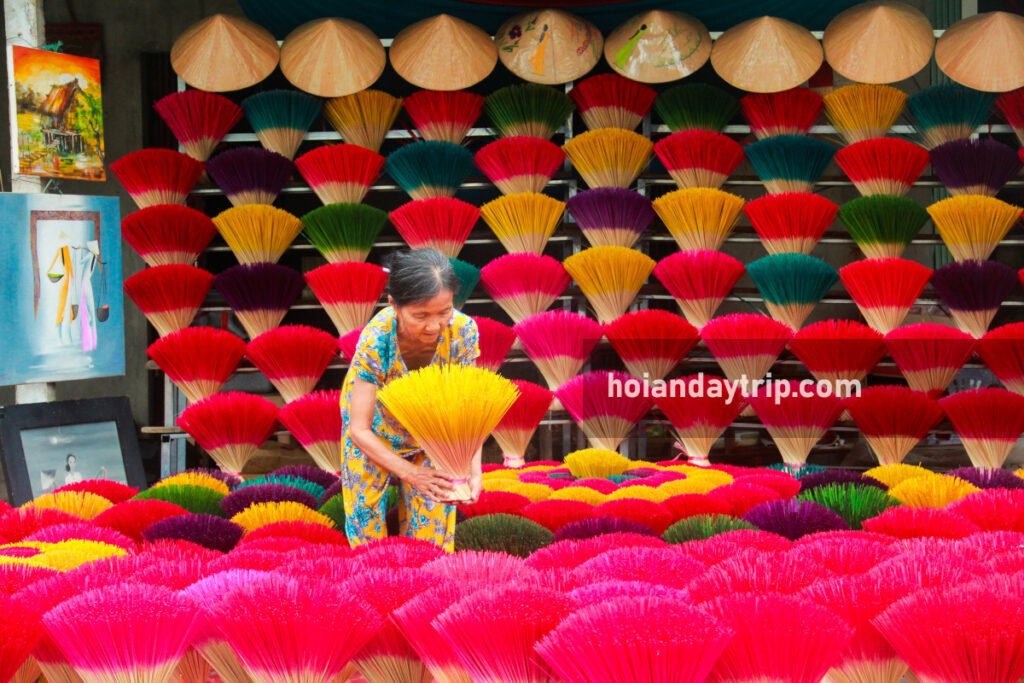
Near Tu Duc Tomb, visitors can go to these places: Dong Khanh Tomb (distance: 600m), Thuy Xuan Incense Village (distance: 500m), Vong Canh Hill or the Bunker Hill (distance: 900m), Tu Hieu Pagoda (distance: 1,1 km), Nam Giao Esplanade (distance: 1,8 km), Thieu Tri Tomb (distance: 2,5 km), Hon Chen Temple (distance: 2,5 km), Tiger Arena and Voi Re Temple (distance: 3km), Thuy Bieu Ancient Village (distance: 4,5 km), Hue Abandoned Water Park or Thuy Tien Lake (distance: 4 km), Thien An Hill and Church (distance: 4 km), Khai Dinh Tomb (distance: 5,5 km).
How to Get to Tu Duc Tomb in Hue
Tu Duc Tomb is on Doan Nhu Hai St, Thuy Xuan ward, Thuan Hoa district, Hue city, Vietnam. It’s around 4 kilometers away from Hue city centre.
If travel by a car/taxi/minivan/bus to Tu Duc Tomb, it takes visitors 15-20 mins. The price of a roundtrip transfer starts from 500,000 VND. We advise seeing other attractions in the same direction, such as Khai Dinh Tomb, Abandoned Water Park, or Minh Mang Tomb. Contact us by +84968009827 (hotline/whatsapp/line/zalo) to book private transfers by car in Hue.
If ride the motorbike by yourself, there are two routes to reach Tu Duc Tomb from Hue city centre. The first route is Dien Bien Phu St – Le Ngo Cat St – Doan Nhu Hai St. The second route is Bui Thi Xuan St – Huyen Tran Cong Chua St – Doan Nhu Hai St. When it’s closer to the tomb, riders can see colorful incences at Thuy Xuan Incense Village. Parking is around the tomb’s main entrance/ticket counter, in local shops; The fee is 5,000-10,000 VND/bike/time;
From Da Nang/Hoi An, visitors can hire a private car or book a day tour to Hue, including sightseeing Tu Duc Tomb.
HoiAn Day Trip Company organizes Hue tours everyday from Hue/Da Nang/Hoi An. Contact us by +84968009827 (hotline/whatsapp/line/zalo) or browse www.hoiandaytrip.com to book. Thank you very much!
Photos, Videos about Tu Duc Tomb in Hue
Here are beautiful photos and videos about Tu Duc Tomb in Hue Vietnam: